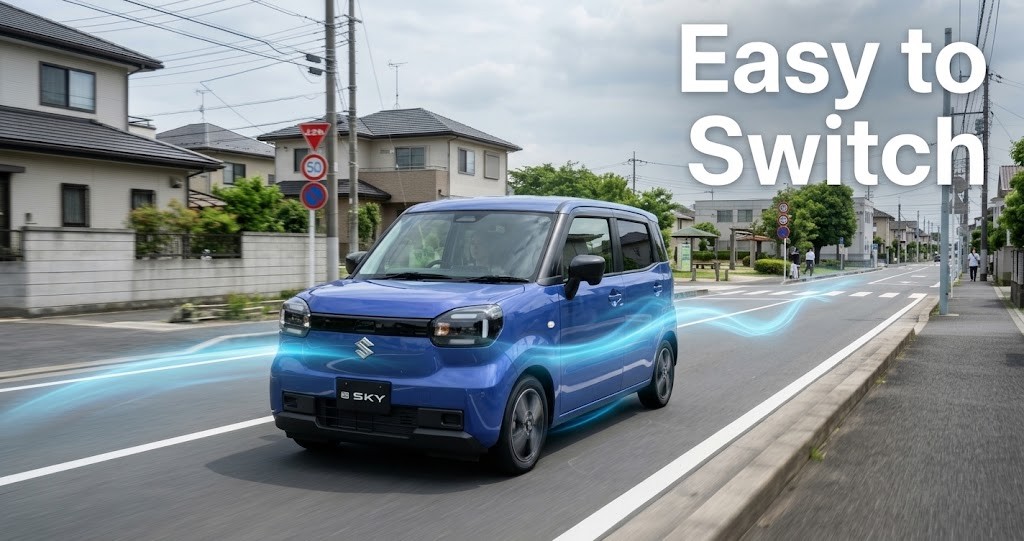
従来のEV開発で主流だった「バッテリーの超大容量化による航続距離の伸長」という力任せの設計手法に対し、スズキは「EVである前に、軽自動車」という原点に立ち返り、車両全体の無駄を排した徹底的な効率化によって実用性と低価格を両立させました。
主なポイント
- 商品コンセプト「Easy to Switch」ガソリン軽自動車から違和感なく自然に乗り換えられる日常の足を目指して開発されました。
- 圧倒的な省電費性能 軽EVクラストップとなる交流電力量消費率 97Wh/km を達成し、コンパクトな 26kWh のバッテリー容量でありながら WLTCモード一充電走行距離 310km を実現しています。
- 技術的アプローチ 油冷方式を採用した小型軽量の電動駆動ユニット「eAxle」、EV専用プラットフォーム「HEARTECT-e」、回生協調ブレーキ、ブレーキ引きずり低減機構など、全社的な改善を積み重ねた成果です。
- 寒冷地・冬場への配慮 電池容量が小さいために影響を受けやすい冬場の暖房消費電力を抑えるため、ダイレクトヒートポンプシステムや空気加熱電気ヒーターを効果的に組み合わせて採用しています。
- 実質購入価格の抑止 車両本体価格は 212万円~279万円(税込)ですが、国のCEV補助金(56万8000円)や各自治体の補助金を組み合わせることで、実質150万円台からの手頃な価格帯でガソリン軽自動車と同等に検討可能です。
関連補足情報(技術・背景の解説)
記事の理解を深めるため、使用されている技術や背景に関する補足情報をまとめています。
1. 駆動用バッテリー:リン酸鉄リチウムイオン電池(LFP)の採用
e SKYの 26kWh バッテリーには、正極材料にリン酸鉄リチウム(LiFePO4)を用いたLFPバッテリーが採用されています。 一般的な三元系(NMC)リチウムイオン電池と比較してエネルギー密度はやや低いものの、以下の特徴を備えています。
- 優れた熱安定性と安全性: 発火・熱暴走のリスクが極めて低い。
- 長寿命(高いサイクル特性): 繰り返しの充電・放電による劣化が少なく、日常使いに適している。
- 希少金属(コバルト・ニッケル)不使用: 原材料コストを格段に抑えることができ、車両本体価格の引き下げに直接寄与。
スズキはこのLFPバッテリーを薄型・フラット形状で床下に配置し、車体構造の一部として組み込むことで、低重心化と軽量・高剛性なボディー設計(HEARTECT-e)を両立させています。
2. 電動駆動ユニット「eAxle」と油冷技術
モーター、インバーター、ギヤ(減速機)を一体化したコンパクトな「eAxle」を採用。 モーターの冷却に従来の水冷ではなく「油冷方式」を採用し、オイルの供給位置や量を精密に制御することで、ユニットの小型・軽量化と高負荷時における安定した出力特性を高次元でバランスさせています。最高出力 47kW(約 64馬力)、最大トルク 135Nm を発揮します。
3. 急速充電規格と外部給電能力
普通充電(3kW / 6kW)に対応するほか、最大 50kW の急速充電を利用した場合、約25分で 80% までの充電が可能です。また、AC100V / 1500W の車内電源コンセントや外部給電機能を備えており、アウトドアレジャーや災害時の非常用電源としても活用できます。
(参考)現行の乗用軽EVスペック比較表(2026年10月現在)
※本表の価格はすべて消費税込、電力量および走行距離はWLTCモードに基づく値です。
| メーカー・車種 | 電池容量 | 一充電走行距離 | 希望小売価格(税込) | CEV補助金額 | 実質負担額(参考) |
| スズキ e SKY (26/11/16発売) | 26 kWh | 310 km | 2,120,000円~2,790,000円 | 568,000円 | 1,552,000円~2,222,000円 |
| 日産 サクラ | 20 kWh | 180 km | 2,448,600円~2,998,600円 | 580,000円 | 1,868,600円~2,418,600円 |
| 三菱 eKクロス EV | 20 kWh | 180 km | 2,446,400円~3,214,200円 | 574,000円 | 1,872,400円~2,640,200円 |
| ホンダ N-ONE e: | 29.6 kWh | 295 km | 2,699,400円~3,198,800円 | 580,000円 | 2,119,400円~2,618,800円 |
| BYD ラッコ (RACCO) 200 | 22.4 kWh | 210 km | 2,145,000円 | 150,000円 | 1,995,000円 |
| BYD ラッコ (RACCO) 300Plus | 35.84 kWh | 320 km | 2,398,000円 | 150,000円 | 2,248,000円 |
(注: CEV補助金は2026年12月31日までの登録分に対する想定額です。居住する都道府県・市区町村の独自補助金制度を組み合わせることで、さらに実質負担額が下がる場合があります)
出典:https://kakakumag.com/car/?id=22531
310 km on 26 kWh! Explaining the High-Efficiency Design and Practicality of Suzuki’s New Kei EV “e SKY”
In contrast to the brute-force engineering approach prevalent in conventional EV development—which relies on ultra-large batteries to extend driving range—Suzuki has returned to its roots with the philosophy “A Kei car before an EV.” By systematically eliminating waste throughout the entire vehicle to achieve high efficiency, Suzuki has successfully balanced practical utility with affordability.
Key Highlights
- Product Concept: “Easy to Switch”Developed as a daily vehicle intended to provide a seamless, natural transition from conventional gasoline-powered Kei cars.
- Outstanding Energy EfficiencyAchieves a class-leading power consumption rate of 97 Wh/km (WLTC mode) for Kei EVs. Despite its compact 26 kWh battery capacity, it delivers a driving range of 310 km on a single charge under WLTC testing.
- Technical ApproachThe result of company-wide cumulative improvements, including a compact, lightweight “eAxle” integrated drive unit using an oil-cooling system, the “HEARTECT-e” dedicated EV platform, regenerative cooperative braking, and a brake drag reduction mechanism.
- Cold Climate and Winter ConsiderationsTo mitigate heating power consumption, which significantly impacts smaller battery capacities during winter, the system effectively combines a direct heat pump system with an electric air heater.
- Accessible Effective Purchase PriceWhile the base vehicle price ranges from 2,120,000 JPY to 2,790,000 JPY (tax included), combining national CEV subsidies (568,000 JPY) with local municipal subsidies brings the practical starting price into the 1.5 million JPY range, making it directly competitive with premium gasoline Kei cars.
Supplementary Technical & Background Information
The following background details provide deeper insight into the technologies used in the vehicle.
1. Traction Battery: Adoption of Lithium Iron Phosphate (LFP) Battery
The 26 kWh battery in the e SKY utilizes Lithium Iron Phosphate (LiFePO4) as its cathode material. Although its energy density is slightly lower than conventional ternary (NMC) lithium-ion batteries, it offers the following advantages:
- Superior Thermal Stability & Safety: Extremely low risk of ignition or thermal runaway.
- Long Service Life (High Cycle Life): Minimal degradation over repeated charge/discharge cycles, ideal for daily use.
- Free of Rare Metals (Cobalt/Nickel): Significantly reduces raw material costs, directly contributing to a lower vehicle retail price.
Suzuki places this flat, thin-profile LFP battery under the floor and integrates it as a structural component of the chassis, achieving both a low center of gravity and a lightweight, high-rigidity body structure (HEARTECT-e).
2. Integrated “eAxle” Drive Unit and Oil-Cooling Technology
The vehicle utilizes a compact “eAxle” that integrates the motor, inverter, and reduction gear into a single unit. Instead of conventional water cooling, an oil-cooling system is employed for the motor. By precisely controlling oil supply location and flow rate, Suzuki achieves a high-level balance between compact unit sizing and stable power output under heavy loads. Maximum output is 47 kW (approx. 64 hp) with a peak torque of 135 Nm.
3. Fast Charging Specs and V2L Capability
In addition to standard AC charging (3 kW / 6 kW), the vehicle supports DC fast charging up to 50 kW, enabling an 80% charge in approximately 25 minutes. It is also equipped with an internal AC 100 V / 1500 W power outlet and external vehicle-to-load (V2L) power supply capability, allowing it to serve as a power source for outdoor activities or emergency backup during natural disasters.
(Reference) Current Kei EV Specification Comparison (As of October 2026)
Note: All prices include tax. Power consumption rates and range figures are based on the WLTC test cycle.
| Manufacturer / Model | Battery Capacity | Single-Charge Range | Retail Price (Tax Included) | CEV Subsidy Amount | Effective Cost (Reference) |
| Suzuki e SKY (Release: Nov 16, 2026) | 26 kWh | 310 km | 2,120,000 JPY – 2,790,000 JPY | 568,000 JPY | 1,552,000 JPY – 2,222,000 JPY |
| Nissan Sakura | 20 kWh | 180 km | 2,448,600 JPY – 2,998,600 JPY | 580,000 JPY | 1,868,600 JPY – 2,418,600 JPY |
| Mitsubishi eK X EV | 20 kWh | 180 km | 2,446,400 JPY – 3,214,200 JPY | 574,000 JPY | 1,872,400 JPY – 2,640,200 JPY |
| Honda N-ONE e: | 29.6 kWh | 295 km | 2,699,400 JPY – 3,198,800 JPY | 580,000 JPY | 2,119,400 JPY – 2,618,800 JPY |
| BYD RACCO 200 | 22.4 kWh | 210 km | 2,145,000 JPY | 150,000 JPY | 1,995,000 JPY |
| BYD RACCO 300Plus | 35.84 kWh | 320 km | 2,398,000 JPY | 150,000 JPY | 2,248,000 JPY |
(Note: CEV subsidy amounts reflect estimated figures for registrations completed by December 31, 2026. Effective costs may be reduced further when combined with local prefecture or municipal subsidy programs.)


コメント