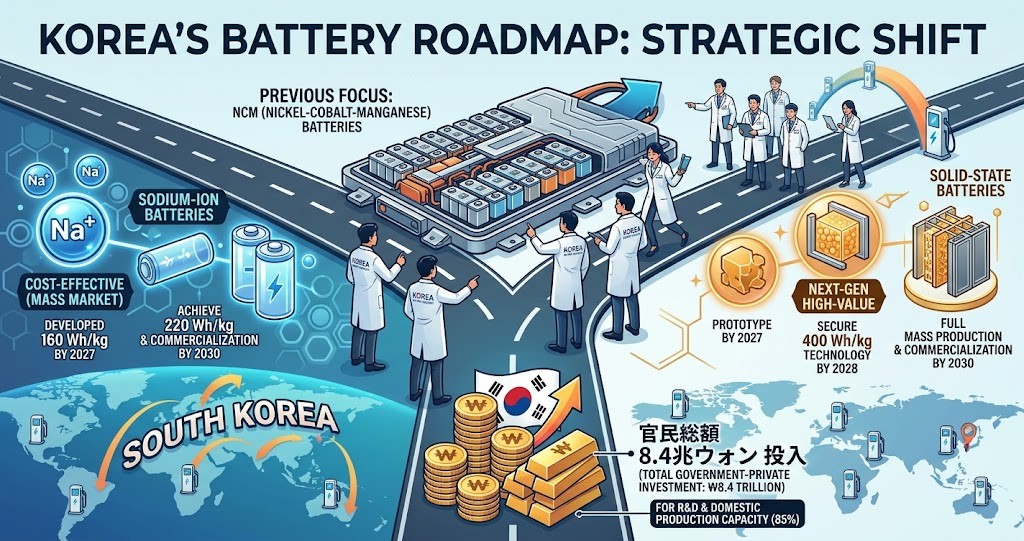
グローバルな電気自動車(EV)市場で価格競争が激化する中、韓国のバッテリー産業が構造転換に乗り出しました。これまで韓国企業が得意としてきた高価な三元系(NCM)電池依存から脱却し、普及型市場向けの「ナトリウムイオン電池」と次世代高付加価値市場向けの「全固体電池」の二眼構えで世界シェアの奪還を狙います。2026年9月22日、韓国産業通商資源部は主要バッテリー3社および素材メーカーとともに懇談会を開き、官民で総額8.4兆ウォン(約9,700億円)を投入する戦略的な「バッテリー産業技術ロードマップ」を発表しました。
以下に、今回の発表内容と背景となる関連情報をまとめてお届けします。
1. 発表概要:8.4兆ウォン規模の官民共同ロードマップ
韓国政府と民間企業は、2030年に向けた技術開発および設備投資を共同で進めます。
- 財源と投資構造:
- 韓国政府: 2027年から2031年にかけて約4,000億ウォン(約460億円)の新規R&D予算を新設。
- 民間企業: 2030年までに約8兆ウォン(約9,300億円)をR&Dおよび設備に投資。そのうち約85%(約6.75兆ウォン)を国内生産能力の拡充と工程革新(乾式電極や低炭素化プロセス等)に集中させます。
- 主要参加企業: セルメーカー大手3社(LG Energy Solution、Samsung SDI、SK On)および素材メーカー(POSCO Future M、L&F、EcoPro BMなど)。
- 二大技術軸の目標値:
- ナトリウムイオン電池: 2027年にエネルギー密度 160 Wh/kg 級を開発し、2030年までに 220 Wh/kg 級の達成と本格商用化を目指す。
- 全固体電池: 2027年にプロトタイプ(試作品)を公開、2028年までに 400 Wh/kg 級セル技術を確保し、2030年の本格量産化・商用化を標榜。
2. 戦略の核心と制度的支援
- 非競争分野での標準化・共同開発: パウチ型・角型電池の寸法規格統一や、次世代集電体などの共通素材仕様の策定を3社共同で実施し、重複投資を抑制。
- サプライチェーン自給とリサイクル: 前駆体や負極材、硫化リチウムの国産化率向上に加え、EU基準に合わせた循環型バッテリーエコシステム(リサイクル規制対応)を構築。
- 制度的インセンティブ: 2027年からの国内生産税額控除の導入や、電力貯蔵システム(BESS)の競争入札における国内エコシステム貢献度の評価反映を推進。
3. 【関連情報】背景と補足解説
① 中国勢(LFP電池)の台頭と欧州市場シェアの急減
韓国が今回の大型ロードマップを提示した最大の背景には、中国企業の急速な台頭があります。
- シェアの逆転: 欧州市場における韓国製バッテリーのシェアは2023年の55%から2025年には35%へ急落した一方、中国勢は同期間に42%から61%へ拡大しました。
- 原価競争の限界: 中国は安価なリン酸鉄リチウム(LFP)電池を武器にグローバルシェアを伸ばしており、韓国が得意とする高価格・高ニッケルNCM電池のみでは普及型EVやエネルギー貯蔵システム(ESS)市場で苦戦を強いられていました。
② ナトリウムイオン電池と全固体電池の技術的ポジション
- ナトリウムイオン電池: リチウムやコバルトを使わないため原材料コストを大幅に抑制でき、寒冷地での性能低下が少ない特長があります。主に普及型EVや定置用ESSが標的です。
- 全固体電池: 液体電解液を固体化することで発火リスクを極限まで下げ、劇的な高エネルギー密度化を実現します。自動車だけでなく、ロボット、ドローン、都心航空交通(UAM)といった高付加価値領域の主要電源として期待されています。
③ 共同開発における「知的財産権(IP)」と企業側の懸念
今回の官民ワンチーム構想における最大の課題は、競合関係にあるバッテリー3社の技術共有の範囲です。
- 特許とノウハウの流出懸念: 3社のR&D投資額は年間合計3兆ウォン(約3,500億円)を超えており、各社が独自に培った製造プロセスや材料配合は最重要機密です。
- 権利配分の調整: 共同開発で生じた特許やIPの権利帰属、大企業と中小企業・研究機関の間での実質的な負担金や役割分担の調整が、プロジェクトの円滑な進行における重要なカギとなります。
4. まとめ
今回のロードマップは、韓国バッテリー産業が「三元系NCM偏重」から脱却し、中国主導の低価格市場をナトリウムイオンで打ち消しつつ、全固体電池で次世代ハイエンド市場を先行確保するという明確な転換点を示しています。企業間の知的財産権の懸念を解消しながら、2030年の本格商用化に向けて共同開発の成果を迅速に実効化できるかが今後の焦点となります。
出典:https://finance.biggo.jp/news/e3101d6b-3fe2-429c-ba90-747e3418c87f
South Korean Government and Top 3 Battery Makers Jointly Invest 8.4 Trillion Won: Chasing Chinese Rivals with Sodium-Ion and All-Solid-State Batteries
As price competition intensifies in the global electric vehicle (EV) market, South Korea’s battery industry has embarked on a structural transformation. Moving away from its heavy dependence on expensive nickel-cobalt-manganese (NCM) ternary batteries, South Korea aims to reclaim global market share through a dual-track strategy: sodium-ion batteries for the mass-market segment and all-solid-state batteries for the next-generation high-value-add segment. On September 22, 2026, the South Korean Ministry of Trade, Industry and Energy held a roundtable meeting with three major battery manufacturers and material producers to announce a strategic “Battery Industry Technology Roadmap,” committing a combined public-private investment of 8.4 trillion won (approx. 970 billion yen / 6.3 billion USD).
Below is a summary of the announcement along with relevant background information.
1. Announcement Overview: 8.4 Trillion Won Public-Private Joint Roadmap
The South Korean government and private sector will jointly advance technology development and capital expenditure through 2030.
- Funding and Investment Structure:
- South Korean Government: Establishing a new R&D budget of approximately 400 billion won from 2027 to 2031.
- Private Companies: Investing approximately 8 trillion won in R&D and facilities by 2030. About 85% of this (approx. 6.75 trillion won) will be concentrated on expanding domestic production capacity and process innovation (such as dry electrode technology and low-carbon manufacturing processes).
- Key Participating Companies: Top 3 cell manufacturers (LG Energy Solution, Samsung SDI, SK On) and material suppliers (POSCO Future M, L&F, EcoPro BM, etc.).
- Target Milestones for the Two Core Technologies:
- Sodium-Ion Batteries: Develop 160 Wh/kg class energy density cells by 2027, targeting 220 Wh/kg class cells and full commercialization by 2030.
- All-Solid-State Batteries: Unveil prototypes by 2027, secure 400 Wh/kg class cell technology by 2028, and aim for full mass production and commercialization by 2030.
2. Strategic Core and Institutional Support
- Standardization and Joint R&D in Non-Competitive Areas: The three battery makers will jointly standardize pouch and prismatic cell dimensions and establish common specifications for materials like next-generation current collectors to prevent redundant investment.
- Supply Chain Self-Sufficiency and Recycling: In addition to boosting domestic production ratios for precursors, anode materials, and lithium sulfide, South Korea will build a circular battery ecosystem compliant with EU recycling regulations.
- Institutional Incentives: Plans include introducing domestic production tax credits starting in 2027 and reflecting contributions to the domestic industry ecosystem when evaluating competitive bids for Battery Energy Storage Systems (BESS).
3. Background and Supplementary Information
(1) Rise of Chinese Competitors (LFP Batteries) and Rapid Decline in European Market Share
The primary catalyst behind South Korea’s massive roadmap is the rapid ascent of Chinese battery manufacturers.
- Reversal of Market Share: South Korean battery makers saw their market share in Europe plummet from 55% in 2023 to 35% in 2025, while Chinese competitors expanded their footprint from 42% to 61% over the same period.
- Limits of Cost Competition: Armed with low-cost lithium iron phosphate (LFP) batteries, Chinese firms have rapidly grown their global market share. Relying solely on high-cost, high-nickel NCM batteries left South Korean companies struggling in mass-market EV and energy storage system (ESS) segments.
(2) Technical Positioning of Sodium-Ion and All-Solid-State Batteries
- Sodium-Ion Batteries: By eliminating lithium and cobalt, raw material costs drop significantly, and low-temperature performance degradation is minimal. Primary targets include mass-market EVs and stationary ESS.
- All-Solid-State Batteries: Replacing liquid electrolyte with solid materials drastically minimizes fire risks and enables extremely high energy densities. They are positioned as key power sources not only for automobiles, but also for high-value applications like robotics, drones, and Urban Air Mobility (UAM).
(3) Intellectual Property (IP) and Corporate Concerns in Joint R&D
The greatest hurdle facing this public-private “one team” concept lies in defining the scope of technology sharing among three direct rivals.
- Risk of Patent and Know-How Leakage: Combined annual R&D expenditure by the three battery makers exceeds 3 trillion won. Manufacturing processes and material formulations developed independently by each firm represent critical business secrets.
- IP Allocation: Establishing clear ownership of patents resulting from joint R&D, managing royalty rights, and balancing financial burdens and responsibilities among conglomerates, small and medium enterprises, and research institutes will be crucial to seamless execution.
4. Conclusion
This roadmap marks a clear turning point for the South Korean battery industry as it seeks to move beyond its heavy reliance on NCM chemistries. By leveraging sodium-ion batteries to counter China’s dominance in low-cost markets and capturing next-generation high-end markets with all-solid-state technology, South Korea aims to regain its competitive edge. Resolving corporate concerns over intellectual property while swiftly translating joint research into commercialized products by 2030 will determine the ultimate success of this initiative.
コメント