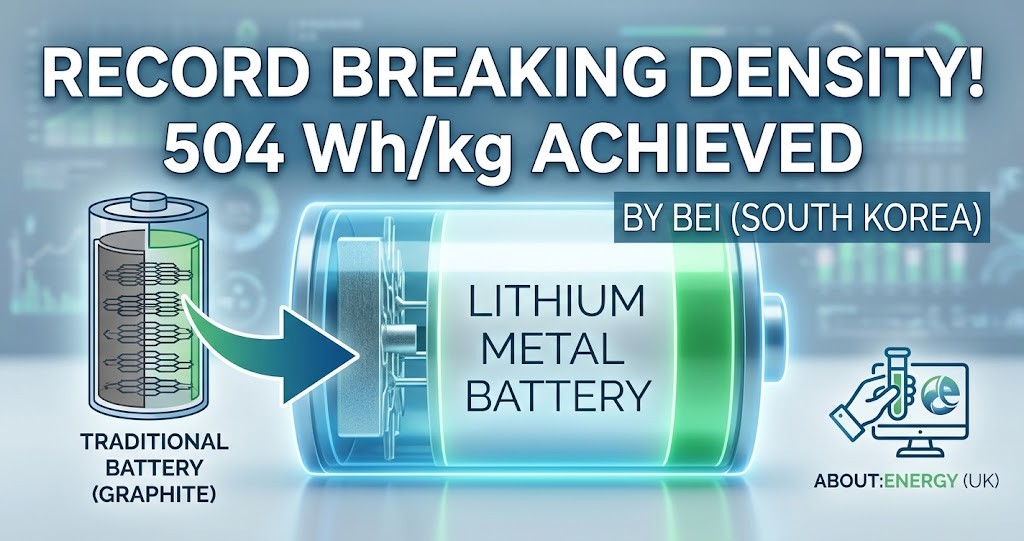
次世代のバッテリー技術として世界中から注目を集める「リチウム金属電池」。従来のグラファイト(黒鉛)電極を排除したアノードフリー構造を採用することで、エネルギー密度の劇的な向上が可能となります。このたび、英国の独立系バッテリー試験・モデリング企業であるAbout:Energyのテストにおいて、韓国のバッテリーメーカーBEIが製造したリチウム金属電池が504 Wh/kgという驚異的な比エネルギー(重量エネルギー密度)を記録しました。これは同社が過去に実施した試験の中で最高値であり、次世代電池の商業化に向けた大きな進展を示しています。
以下に、今回の発表内容と背景となる関連情報をまとめてお届けします。
1. 発表概要:独立試験機関による504 Wh/kgの測定
バッテリー評価を専門とするAbout:Energyは、BEI製のリチウム金属電池「MUL20A」の性能測定を実施し、同社テスト史上初となる500 Wh/kg超えを達成したと発表しました。
- 測定結果と条件: C/5の放電レートにおいて、比エネルギー 504 Wh/kg を測定。
- メーカー公表値との整合性: BEIが公表する低速レート(C/10)での定格値 519 Wh/kg に対し、放電レートが高い条件(C/5)でありながらメーカー公表値の約97%という非常に高い性能を保持していることが実証されました。
- 独立した検証: About:EnergyはBEIから対価を受け取っておらず、完全なサードパーティ(第三者)による独立検証です。現在はドローンやeVTOL(電動垂直離着陸機)の実際の飛行環境を模した負荷テストが進められています。
2. セルの主要仕様と技術的特徴
「MUL20A」は、充電時にリチウムが負極集電体に直接析出するアノードフリー設計を採用しています。重いグラファイト電極を排除することでセル質量を劇的に削減し、活物質の占めるスペースを最大化しています。
- 公称容量: 21.1 Ah(アンペア時間)
- エネルギー: 約 81.5 Wh(ワット時)
- セル質量: 157 g(グラム)
- 体積エネルギー密度: 1281 Wh/L(ワット時毎リットル)
- 最大連続放電電流: 100 A(アンペア)
3. 【関連情報】背景と補足解説
① 504 Wh/kgという数値のインパクト
現在、電気自動車(EV)や各種デバイスで主流となっている従来型リチウムイオン電池の比エネルギーは、一般的に200〜300 Wh/kg程度です。500 Wh/kgを超える領域は、航空分野での電動化(eAviation)を実現するための重要なボーダーラインと言われており、同等重量で従来の約2倍の飛行距離・運用時間をもたらします。
② 主なターゲット市場:ドローンとeVTOL
リチウム金属電池の初期市場として特に期待されているのが、ドローンやeVTOL(いわゆる「空飛ぶクルマ」)分野です。
- 軽量化の命題: 航空分野では重量制限が非常に厳しいため、自動車以上に高エネルギー密度電池へのニーズが高まっています。
- BEIの市場開拓: BEIは2026年7月、In-Q-Tel(米国情報機関系の戦略的投資ファンド)などから300億ウォン(約300億円規模の韓国通貨)のシリーズB資金調達を完了。すでに30社以上のグローバルなドローン企業がBEIの技術を評価・実運用に導入しています。
③ リチウム金属電池(アノードフリー)の課題と克服
リチウム金属電池はエネルギー密度が高い反面、充放電を繰り返すことでリチウムが針状に結晶化する「デンドライト」が発生し、ショートや発火、寿命低下を起こしやすいという技術的難題があります。今回の実験データやメーカーの定格スペックは、高度な電解液技術や界面制御により、急速な性能劣化を抑えつつ高い充放電レートに耐えうるセル構造が実現しつつあることを示しています。
4. まとめ
今回のAbout:Energyによる独立検証は、BEIのアノードフリーリチウム金属電池が理論や研究室レベルにとどまらず、実際の使用環境に近い負荷条件(C/5放電や100A連続放電)でも機能することを実証しました。ドローンや次世代エアモビリティ分野におけるバッテリー革命を加速させる、重要なマイルストーンとなります。
出典:https://www.bestmag.co.uk/bei-504wh-kg-aboutenergy/
Verified by Independent Body: South Korean BEI’s Anode-Free Battery Achieves Specific Energy Over 500 Wh/kg
Lithium-metal batteries are drawing global attention as a next-generation battery technology. By utilizing an anode-free design that eliminates conventional graphite electrodes, dramatic improvements in energy density become possible. In recent testing by About:Energy, an independent UK-based battery testing and modeling company, a lithium-metal battery produced by South Korean manufacturer BEI recorded a remarkable specific energy (gravimetric energy density) of 504 Wh/kg. This represents the highest value ever recorded in tests conducted by About:Energy and signals major progress toward the commercialization of next-generation batteries.
Below is a summary of the announcement along with relevant background information.
1. Announcement Overview: Independent Testing Measures 504 Wh/kg
About:Energy, a company specializing in battery evaluation, measured the performance of BEI’s “MUL20A” lithium-metal battery cell and announced that it achieved over 500 Wh/kg for the first time in the company’s testing history.
- Test Results and Conditions: Measured a specific energy of 504 Wh/kg at a C/5 discharge rate.
- Consistency with Manufacturer Ratings: Compared to BEI’s published rating of 519 Wh/kg at a lower discharge rate (C/10), the test proved that the cell maintained approximately 97% of the manufacturer’s rated specific energy despite operating under a higher discharge current (C/5).
- Independent Verification: About:Energy received no financial compensation from BEI, making this a fully independent, third-party validation. Load testing is currently underway to evaluate performance under representative mission profiles for drones and eVTOL (electric vertical takeoff and landing) aircraft.
2. Key Cell Specifications and Technical Features
The “MUL20A” utilizes an anode-free design where lithium deposits directly onto the negative current collector during charging. Eliminating the heavy graphite electrode dramatically reduces cell mass and maximizes space for energy-storing materials.
- Nominal Capacity: 21.1 Ah (ampere-hours)
- Energy: Approximately 81.5 Wh (watt-hours)
- Cell Mass: 157 g (grams)
- Volumetric Energy Density: 1281 Wh/L (watt-hours per liter)
- Maximum Continuous Discharge Current: 100 A (amperes)
3. Background and Supplementary Information
(1) Impact of the 504 Wh/kg Benchmark
Conventional lithium-ion batteries currently mainstream in electric vehicles (EVs) and consumer electronics typically offer a specific energy of around 200 to 300 Wh/kg. Surpassing 500 Wh/kg is considered a vital threshold for enabling electric aviation (eAviation), delivering nearly double the flight range and operational time compared to conventional batteries of equal weight.
(2) Primary Target Markets: Drones and eVTOL
The early target markets for lithium-metal batteries are drones and eVTOL aircraft (often called “flying cars”).
- The Imperative of Weight Reduction: Strict weight limits in aviation make high-energy-density batteries even more critical than in automotive applications.
- BEI’s Market Expansion: In July 2026, BEI completed a 30 billion KRW Series B funding round, including investment from In-Q-Tel (a strategic investment firm connected to US intelligence agencies). Over 30 global drone customers are evaluating BEI’s battery technology, with some already deploying it in active operations.
(3) Overcoming Challenges of Lithium-Metal (Anode-Free) Batteries
While lithium-metal batteries offer high energy density, repeated charging and discharging can form needle-like lithium structures called “dendrites,” posing technical hurdles such as short circuits, fire risks, and rapid capacity loss. The latest test data and manufacturer specifications suggest that advanced electrolyte chemistry and interface controls are successfully enabling cell structures that resist rapid degradation and withstand high discharge rates.
4. Conclusion
This independent validation by About:Energy proves that BEI’s anode-free lithium-metal battery functions reliably not just in theory or lab settings, but also under realistic load conditions (such as C/5 discharge rates and 100 A continuous discharge). It represents a crucial milestone in accelerating the battery revolution for drones and next-generation air mobility.

コメント