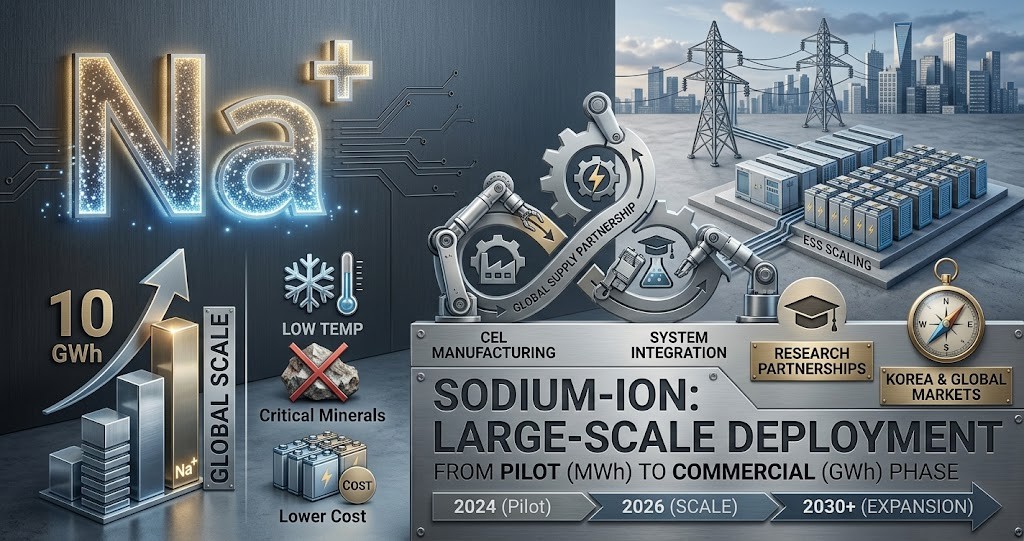
次世代電池として世界的な注目を集める「ナトリウムイオン電池」が、実証・試験運用段階(メガワット時クラス)から本格的な大型商業調達(ギガワット時クラス)のフェーズへと進展を見せています。リチウム資源の価格高騰やサプライチェーンリスクの回避、低温環境における優れた特性などを背景に、特に定置型エネルギー貯蔵システム(ESS)領域での導入が加速しています。
以下では、中国のHiNa Battery社が韓国企業との間で締結した大規模契約の概要をはじめ、世界市場での競合動向やナトリウムイオン電池の技術的特徴・課題について総合的にまとめています。
1. ニュースの主要概要
- HiNa BatteryとVoltaの10GWh合意 中国のナトリウムイオン電池メーカーであるHiNa Battery(中科海鈉)は2026年9月2日、韓国のVolta社と5年間で累計10GWhに及ぶナトリウムイオン電池の供給枠組み協定を締結した。
- 段階的な拡大プロセス 両社はこれまでに、韓国国内で15MWh規模の検証プログラム(公益事業用、商業・産業用、住宅用蓄電)を実施してきた。この実証実績が今回の10GWh規模への大幅拡大の基盤となった。
- 三者協力による推進体制 本取り決めにより、「HiNa Batteryによるセル製造(中国)」「Voltaによるシステム統合および韓国市場開拓」「光雲(Kwangwoon)大学による研究・試験・技術検証」という役割分担が確立された。
2. HiNa Battery社の技術・製品および海外展開実績
- 創業者と技術的ルーツ 中国科学院物理研究所の胡永生(Yongsheng Hu)教授らの研究成果を基礎に設立された、中国におけるナトリウムイオン電池商業化のパイオニア企業。
- 主要製品ラインナップ
- HE240:主に大規模蓄電向けに開発された240Ahセル。安徽省阜陽市のGWh級生産ラインで2年間の生産検証を完了。
- NE170:周波数調整や分散型蓄電向けの170Ahセル。すでに量産化を開始。
- 欧州への出荷実績 2025年7月、ドイツのエネルギー企業向けにコンテナ型蓄電システム用として1.1MWhの電池クラスターを出荷。IEC 62619、UN 38.3、RoHS、REACHなどの国際規格認証を取得済み。
3. 【関連情報】急速に加速するナトリウムイオン電池の世界市場動向
HiNa Batteryの動きにとどまらず、2026年に入り業界大手企業によるGW級の超大型供給契約が相次いで発表されています。
- CATLとHyperStrongの60GWh契約(2026年4月) 車載電池世界大手のCATL(寧徳時代)は、蓄電インテグレーターのHyperStrongと3年間で60GWhのナトリウムイオン電池供給協定を締結。現時点で世界最大のナトリウムイオン電池調達契約となっている。
- CATLとAlfenの5GWh欧州展開(2026年7月) CATLはオランダのAlfen社と提携し、2027年から欧州全域向けに5GWh規模のナトリウムイオン蓄電システムを順次導入していくことで合意。
4. 【関連情報】ナトリウムイオン電池のメリットと今後の課題
主なメリット
- 豊富な資源とコスト優位性:構成要素であるナトリウム(塩などから採取可能)は地球上に極めて豊富に存在するため、リチウムのような地政学的リスクや価格高騰の影響を受けにくい。
- 優れた低温特性:マイナス20度〜マイナス40度といった極低温環境下でも容量維持率が高く、出力特性が低下しにくい。
- 安全性と急速充放電:熱暴走リスクが低く、安全性が高いうえに高いCレートでの急速充放電に対応しやすい。
普及に向けた現状の課題
- リン酸鉄リチウム(LFP)との圧倒的なスケール差:定置型蓄電市場では、すでに巨大な製造基盤と成熟したサプライチェーンを持つLFP電池が圧倒的シェアを保持している。
- エネルギー密度の差:重量あたりのエネルギー密度では依然としてリチウムイオン電池が優位であるため、空間制限の厳しい用途(電気自動車の長距離モデルなど)よりも定置型蓄電(ESS)分野が主戦場となっている。
- 実プロジェクトでの納入スピード:今回のような5年間の包括的枠組み協定が、具体的にどの程度の速さで実際の現地プロジェクト着工および連続納入に移行できるかが実運用上の焦点となる。
China’s HiNa Battery and South Korea’s Volta Agree on 10GWh Sodium-Ion Battery Supply Over 5 Years
Sodium-ion batteries, attracting global attention as next-generation energy storage technology, are transitioning from the demonstration and pilot testing phase (megawatt-hour scale) to full-scale commercial procurement (gigawatt-hour scale). Driven by factors such as surging lithium resource prices, supply chain risk mitigation, and superior low-temperature performance, deployment is accelerating particularly in stationary energy storage systems (ESS).
Below is a comprehensive summary covering the overview of the large-scale agreement signed between China’s HiNa Battery and the South Korean company, along with competitive trends in the global market, technical characteristics, and key challenges of sodium-ion batteries.
1. Key Highlights of the News
- HiNa Battery and Volta’s 10GWh Agreement On September 2, 2026, Chinese sodium-ion battery manufacturer HiNa Battery signed a 5-year framework agreement with South Korea’s Volta to supply a cumulative total of 10GWh of sodium-ion batteries.
- Phased Expansion Process The two companies had previously conducted a 15MWh validation program in South Korea covering utility-scale, commercial and industrial, and residential energy storage. This empirical track record served as the foundation for scaling up significantly to 10GWh.
- Three-Party Advancement Structure This arrangement established a clear division of roles: cell manufacturing by HiNa Battery in China, system integration and market development by Volta in South Korea, and research, testing, and technical validation support by Kwangwoon University.
2. HiNa Battery’s Technology, Products, and Overseas Track Record
- Founders and Technical Roots Founded based on research from Professor Yongsheng Hu and his team at the Institute of Physics, Chinese Academy of Sciences, HiNa Battery is a pioneer in the commercial development of sodium-ion batteries in China.
- Major Product Lineup
- HE240: A 240Ah cell designed mainly for large-scale energy storage. It has completed two years of production validation on a GWh-scale manufacturing line in Fuyang, Anhui Province.
- NE170: A 170Ah cell targeted at frequency regulation and distributed storage, which has already entered mass production.
- Shipment Record to Europe In July 2025, HiNa Battery delivered a 1.1MWh sodium-ion battery cluster to a German energy company for integration into containerized energy storage systems. The product meets international standards including IEC 62619, UN 38.3, RoHS, and REACH.
3. [Related Information] Rapidly Accelerating Global Market Trends in Sodium-Ion Batteries Beyond HiNa Battery’s initiatives, several ultra-large GW-scale supply agreements by major industry players have been announced in 2026.
- CATL and HyperStrong’s 60GWh Agreement (April 2026) Global EV battery leader CATL signed a 3-year, 60GWh sodium-ion battery supply agreement with Chinese storage integrator HyperStrong. This stands as the world’s largest sodium-ion energy storage procurement deal to date.
- CATL and Alfen’s 5GWh European Expansion (July 2026) CATL partnered with Dutch energy tech company Alfen to deploy 5GWh of sodium-ion energy storage systems across Europe starting in 2027.
4. [Related Information] Advantages and Future Challenges of Sodium-Ion Batteries
Key Advantages
- Abundant Resources and Cost Edge: Sodium, the primary component, can be extracted from common salt and is extremely abundant globally, making it less susceptible to geopolitical risks and price surges associated with lithium.
- Superior Low-Temperature Performance: It retains high capacity and stable output power even in extreme cold environments ranging from minus 20 to minus 40 degrees Celsius.
- Safety and Fast Charging/Discharging: It offers a lower risk of thermal runaway, high safety, and strong capability for fast charging and discharging at high C-rates.
Current Challenges for Widespread Adoption
- Overwhelming Scale Gap with Lithium Iron Phosphate (LFP): In the stationary energy storage market, LFP batteries currently hold a dominant market share backed by massive manufacturing capacity and mature supply chains.
- Energy Density Gap: Because lithium-ion batteries remain superior in energy density per unit weight, sodium-ion batteries find their primary application in stationary energy storage (ESS) rather than space-constrained uses like long-range electric vehicles.
- Execution Speed for Real Projects: A key operational focus moving forward is how quickly 5-year framework agreements like this one can translate into concrete local project deployment and continuous shipments.
コメント