1. 背景と課題:リチウム金属電池(LMB)の宿命的な弱点
リチウム(Li)金属は、高い理論容量(3860 mAh g-1)と極めて低い電位(標準水素電極に対して -3.04 V)を持つことから「究極の負極材料」と期待されています。しかし、以下の深刻な課題がありました。
- 高い可燃性: 熱、湿気、空気に触れると容易に発火し、約1200℃の激しい燃焼を引き起こします。これは従来の消火手法では消し止めることが困難です。
- 難燃剤との不適合性: 従来の「難燃剤を混ぜる」戦略では、反応性の高いLi金属が難燃剤(リンやハロゲン系)と激しく副反応(腐食)を起こし、難燃効果と電池機能の両方が失われていました。
2. 提案された解決策:多層構造(Li/ZnO/TPP/GO)負極の開発
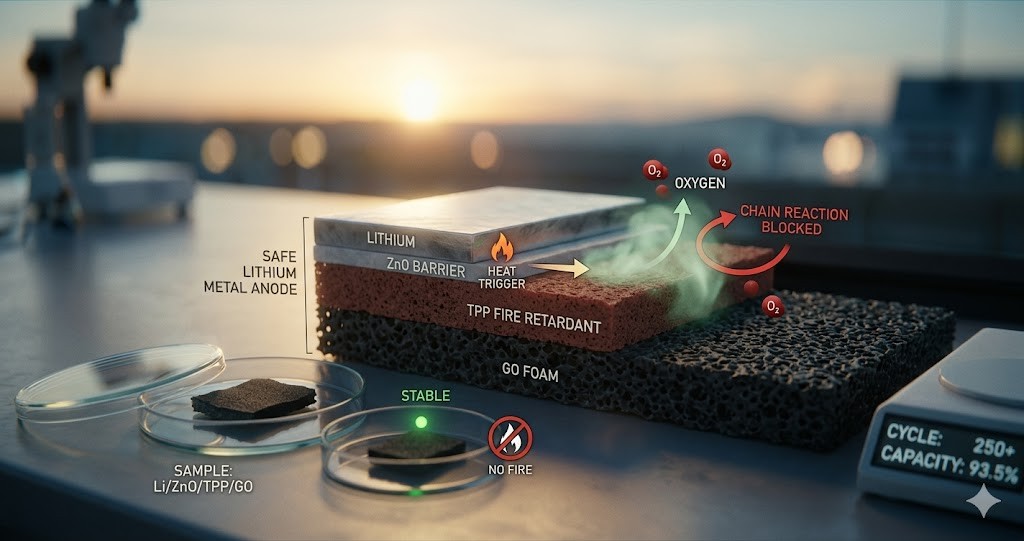
本研究では、酸化グラフェン(GO)フォームを基盤とした「テトラレイヤー(4層)構造」を提案しています。
- 層の構成:
- GO(酸化グラフェン)アエロゲル: 骨格となる3次元多孔質構造。
- TPP(リン酸トリフェニル): 難燃剤。GO層上に均一にコーティング。
- ZnO(酸化亜鉛)層: ALD(原子層堆積法)により形成。難燃剤とLiを隔離する「盾」兼「親リチウム層」。
- Li(リチウム)金属: 溶融注入により細孔に充填。
3. スマート難燃メカニズム(3つの鍵)
この負極は、通常時は安定し、異常時のみ難燃機能を発揮する「スマート機能」を備えています。
- 熱断熱・放熱効果: 3次元多孔質構造が熱伝導を遅らせ、Liの融解と引火を遅延させます。シミュレーションでは、緻密なLi箔に比べ熱伝導率を約1/63(1.3327 W m-1 K-1)に抑制しました。
- 副反応の完全遮断: ZnO層が難燃剤の溶出を防ぎ、充放電中の腐食を94.68%抑制。これにより、従来の難燃剤混合系よりも301.61%長いサイクル寿命を実現しました。
- 熱トリガーによるガス放出: 発火等の高温時には、内部の難燃剤が分解して難燃性ガスを放出。酸素を遮断すると同時に、Li原子と結合して燃焼の連鎖反応を遮断します。
4. 実証された性能と安全性
各種試験において、従来のLi負極を圧倒する数値が記録されました。
- 自己消火性能(SET): 600℃の炎にさらした後、純Li負極が激しく燃え続けるのに対し、本負極は0秒(即座に消火)を達成。
- 過酷試験後の容量保持: 炎にさらした後でも、負極容量の85.81%を維持。これを用いたフルセル電池は250サイクル後も93.57%の容量を維持しました。
- 実用性: 100 mAhのパウチセルを用いた実験では、外装を損傷させて直接点火しても燃焼せず、LEDを点灯させ続ける安定した電力供給を確認しました。
5. 結論と意義
本研究は、数十年にわたりリチウム金属電池の実用化を阻んできた「可燃性」と「難燃剤による腐食」のトレードオフを、積層ホスト設計によって解決しました。 市販の原材料(GO、TPP)と成熟した工業技術(ALD、溶融注入)を組み合わせているため、大型のパウチセルへの応用や量産化の可能性も非常に高いと考えられます。
技術用語・単位のプレーンテキスト表記(抜粋)
- 理論容量: 3860 mAh g-1
- 標準電位: -3.04 V
- 燃焼温度: 約1200℃
- 熱伝導率(多孔質Li): 1.3327 W m-1 K-1
- 熱伝導率(緻密Li): 84 W m-1 K-1
- サイクル寿命向上: 2677.78%(点火試験後)
出典:https://www.nature.com/articles/s41467-026-71069-9
- 1. 背景と課題:リチウム金属電池(LMB)の宿命的な弱点
- 2. 提案された解決策:多層構造(Li/ZnO/TPP/GO)負極の開発
- 3. スマート難燃メカニズム(3つの鍵)
- 4. 実証された性能と安全性
- 5. 結論と意義
- 技術用語・単位のプレーンテキスト表記(抜粋)
- Ending the Fire Hazard of Lithium Metal Batteries: Non-combustible Layered Anodes Open a High-Energy-Density Future
- 1. Background and Challenges: The Fatal Weakness of Lithium Metal Batteries (LMBs)
- 2. Proposed Solution: Development of a Multi-layered (Li/ZnO/TPP/GO) Anode
- 3. Smart Flame-Retardant Mechanisms (Three Keys)
- 4. Demonstrated Performance and Safety
- 5. Conclusion and Significance
- Technical Terms and Units (Plain Text Excerpts)
Ending the Fire Hazard of Lithium Metal Batteries: Non-combustible Layered Anodes Open a High-Energy-Density Future
1. Background and Challenges: The Fatal Weakness of Lithium Metal Batteries (LMBs)
Lithium (Li) metal is considered the “ultimate anode material” due to its high theoretical capacity (3860 mAh g-1) and extremely low electrochemical potential (-3.04 V vs. standard hydrogen electrode). However, serious challenges remained:
- High Flammability: Li metal ignites easily upon exposure to heat, humidity, or air, causing intense combustion at approximately 1200 degrees C. This is extremely difficult to extinguish using conventional fire-fighting methods.
- Incompatibility with Flame Retardants: Conventional “mixing” strategies fail because highly reactive Li metal causes severe side reactions (corrosion) with phosphorus- or halogen-based flame retardants, destroying both the fire-extinguishing effect and the battery function.
2. Proposed Solution: Development of a Multi-layered (Li/ZnO/TPP/GO) Anode
This research proposes a “tetra-layered structure” based on graphene oxide (GO) foam.
- Layer Composition:
- GO (Graphene Oxide) Aerogel: A 3D porous structure serving as the framework.
- TPP (Triphenyl Phosphate): The flame retardant, uniformly coated onto the GO layers.
- ZnO (Zinc Oxide) Layer: Formed via Atomic Layer Deposition (ALD). It acts as a “shield” to isolate the flame retardant from the Li, while providing “lithiophilic” properties.
- Li (Lithium) Metal: Infused into the pores through a molten infusion process.
3. Smart Flame-Retardant Mechanisms (Three Keys)
This anode remains stable during regular operation and activates its flame-retardant function only during emergencies.
- Thermal Insulation and Dissipation: The 3D porous structure delays heat conduction, slowing down Li melting and ignition. Simulations show thermal conductivity is suppressed to approximately 1/63 (1.3327 W m-1 K-1) compared to dense Li foil.
- Total Blockage of Side Reactions: The ZnO layer prevents the dissolution of the flame retardant, suppressing corrosion by 94.68% during charging and discharging. This resulted in a cycle life 301.61% longer than conventional flame-retardant mixtures.
- Thermally-Triggered Gas Release: Under high temperatures such as ignition, the internal flame retardant decomposes to release fire-extinguishing gases. This isolates the Li from oxygen and bonds with Li atoms to break the combustion chain reaction.
4. Demonstrated Performance and Safety
In various tests, this anode recorded figures that far outperform conventional Li anodes.
- Self-Extinguishing Time (SET): After exposure to a 600 degrees C flame, the pure Li anode continued to burn intensely, while this layered anode achieved 0 seconds (instant extinguishing).
- Capacity Retention After Extreme Testing: Even after exposure to fire, the anode reserved 85.81% of its capacity. Full cells using this ignited anode maintained 93.57% capacity after 250 cycles.
- Practicality: In a 100 mAh pouch cell experiment, the battery did not combust even when the casing was damaged and directly ignited, maintaining a stable power supply to an LED.
5. Conclusion and Significance
This research resolves the long-standing trade-off between “flammability” and “corrosion by flame retardants” through a layered host design. Since it utilizes commercially available raw materials (GO, TPP) and mature industrial techniques (ALD, molten infusion), it has high potential for large-scale pouch cell applications and mass production.
Technical Terms and Units (Plain Text Excerpts)
- Theoretical Capacity: 3860 mAh g-1
- Standard Potential: -3.04 V
- Combustion Temperature: approx. 1200 degrees C
- Thermal Conductivity (Porous Li): 1.3327 W m-1 K-1
- Thermal Conductivity (Dense Li): 84 W m-1 K-1
- Cycle Life Improvement: 2677.78% (after ignition test)


コメント