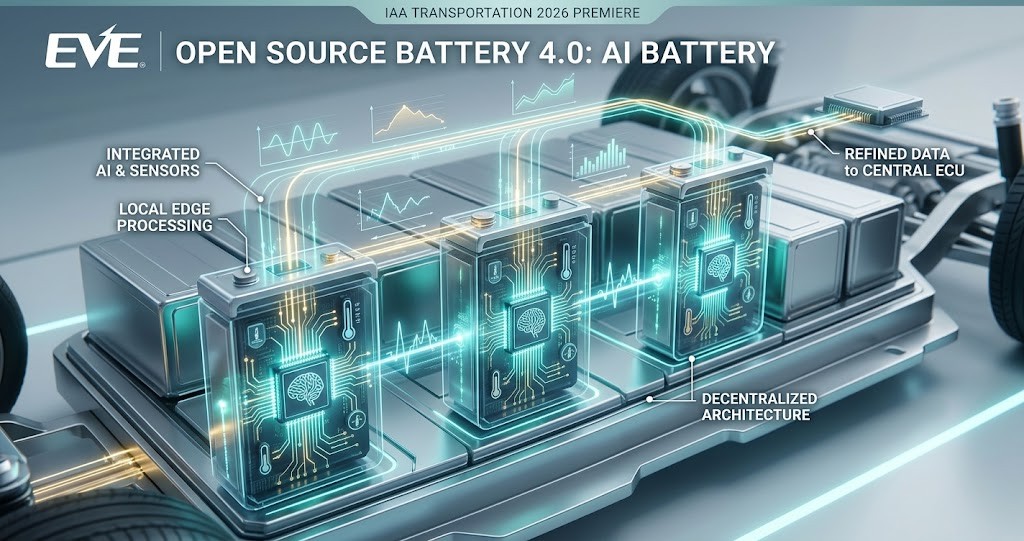
2026年9月、ドイツ・ハノーファーで開催された「IAA TRANSPORTATION 2026」にて、車載電池大手の中国EVE Energy(億緯鋰能)が欧州で初披露した「Open Source Battery 4.0: AI Battery」が業界内で大きな話題を呼んでいます。
従来の電気自動車(BEV)における電池管理システム(BMS)は、車両側の中央ECUやパック単位のBMSが数百〜数千個のセルデータを一括して集約・演算する「中央集権型」が主流でした。これに対しEVE Energyが提示したのは、「セル自身にAIチップとセンサを組み込み、その場で一次処理を行う(エッジコンピューティング)」という「自律分散型」のアプローチです。
「電池セルが自ら考える」という言葉の真意、そしてこの構想が車載バッテリー技術や次世代E/E(電気/電子)アーキテクチャに与えるインパクトについて、関連技術および業界動向を踏まえて整理・解説します。
1. ニュースの要約と整理
① 従来のBMSと「AI Battery 4.0」の構造比較
- 従来のBMS構造:
[各セル] → センサー情報伝送 → [中央BMS / 車両ECU]で集約・演算 → 制御指示- 課題: 数千個のセルから発生する巨大なデータ量と演算負担が中央BMSに集中し、通信帯域と応答性に制約が生じる。
- AI Battery 4.0の構造:
[セル内センシング] → [セル内専用AIチップでデータ処理] → [上位BMS / クラウドへ有益情報のみ送信]- メリット: エッジ処理により必要な情報のみを抽出し上位に伝送。レスポンス向上とデータ量の最適化を実現。
② AI Battery 4.0 を構成する「3つの階層」
- 全感知(セルレベル): 各セル内部のセンサーと専用AIチップ、近距離無線通信により、セルの内部状態(局所的な温度・電圧・膨張圧・劣化兆候など)を高度に即時検知。
- 深思考(システム / クラウドレベル): クラウド側のAIモデルと連携し、車両の運行パターンや周辺環境データを複合的に解析。
- 自進化(制御アルゴリズム): 走行条件や路面状況、ドライバーの癖などを学習し、充電速度の最適化や寿命を最大化する制御戦略を自律的に更新。
③ 車両アーキテクチャとの対比
- 車両全体: 演算処理を中央集中型(ドメイン/ゾーンECU)へ統合するトレンド。
- 電池内部: 演算処理を最小単位である「セル」へ分散配置。⇒ 「全体は中央集権、内部は自律分散」 という相補的なシステム設計が最大の特徴。
④ IAA 2026での実機展示
- 商用車(トラック・バス)向け: 大型商用車は過酷な運用環境と長距離走行、過酷な充放電サイクルが求められるため、エッジAIによる個別管理の恩恵が大きい。
- 化学組成: 同社独自の高エネルギー密度・高安全性正極材料「LMX」(LFPの安全性・長寿命をベースにエネルギー密度と低温特性を高めた材料系)をベースにしたセル(LM815、LM285、V63)や、重トラック用床下パック(LM815-641kWh)などに適用。
2. 関連情報と技術的バックグラウンドの補足
(1) なぜ今「セルレベルのエッジAI」が必要なのか?
車載電池のセル数が増加するにつれ、セルの「個体差」や「不均一な劣化(熱分布や化学的歪み)」の管理が困難になります。
- 内部短絡(熱暴走)の早期検知: 従来のパック外部センサでは、特定セルの急速な内部異常(デンドライト形成や微小短絡)の予兆を捉えるのにタイムラグが発生します。セル内部にチップとセンサを持つことで、マイクロ秒〜ミリ秒単位での異常検知が可能になります。
- セル・バランシングの最適化: 従来のセルバランシング(電圧の均一化)を超え、各セルの「リアルタイムの健全性(SoH)」に応じた精密な電力分配が可能になります。
(2) 「有線配線の排除」と「セル内無線通信」
セル内部にチップを配置し、データを上位BMSに届けるにあたり、大量のワイヤーハーネス(配線)を追加すると重量増や故障リスク(断線)を招きます。
EVE Energyが言及する「無線通信技術(Wireless BMS / wBMS)」は、ハーネスを削減してバッテリーパックの重量エネルギー密度を向上させることにも直結しています。
(3) EVE Energyの正極技術「LMX」とは?
AI Battery 4.0の基盤となる「LMX」は、LFP(リン酸鉄リチウム)の持つ優れた耐久性・熱安定性を維持しつつ、マンガン添加や電極構造改質(LMFP系等)によってエネルギー密度の向上と極低温下(-30℃〜-40℃級)での放電特性改善を図った材料プラットフォームです。
過酷な欧州の冬期環境や高速長距離移動が求められる大型商用車において、この「高機能材料(LMX)」と「リアルタイムインテリジェンス(AI Battery)」の融合が強みとなります。
3. 考察:「電池セルが自分で考える」の実現性と課題
| 評価項目 | 期待される効果 | 克服すべき実用化課題 |
| 安全性・耐久性 | 微小な異常予兆をセル単位で即時検知し、熱暴走事故を未然に防止。電池寿命の延長。 | 電池セル内部(電解液や熱サイクル)という過酷環境に耐えるAIチップ・センサの長期耐久性。 |
| システム負荷 | 上位BMSやECUの演算負荷・通信トラフィックを劇的に削減。 | セル1個あたりのICチップ・センサ追加に伴うコスト増加(コスト見合いの価値提供)。 |
| データ活用 | クラウドAIと連携したバッテリーパスポート(残価診断・2ndライフ利用)のデータ精度飛躍。 | セル単体での消費電力(チップ駆動による自己放電)の極小化。 |
結論
「電池セルが自分で考える」という表現は、単なるSF的な比喩ではなく、「高度なセンシングとエッジ演算処理を最小の構成単位であるセル内部に組み込み、自律的に一次判断を行わせるアーキテクチャ」を意味しています。
中央集権的な車載OS/ECUと、自律分散型のセルレベルAIが協調するこの技術は、特に長寿命・高安全性が直結して運用コスト(TCO)を左右する商用EV領域から実装が進むと予想されます。今後の量産コスト低減と過酷環境下での長期信頼性検証が、実用化の波を左右するカギとなります。
出典:https://motor-fan.jp/article/1629804/
Can Battery Cells Really “Think for Themselves”? The True Intent and Architecture Behind EVE Energy’s “AI Battery 4.0”
In September 2026, at “IAA TRANSPORTATION 2026” held in Hanover, Germany, Chinese automotive battery giant EVE Energy debuted its “Open Source Battery 4.0: AI Battery” in Europe, sparking significant industry buzz.
Traditional battery management systems (BMS) in battery electric vehicles (BEVs) have predominantly used a centralized approach, where a central vehicle ECU or pack-level BMS aggregates and processes data from hundreds to thousands of cells all at once. In contrast, EVE Energy presented an autonomous, decentralized approach: embedding dedicated AI chips and sensors directly into each cell to perform primary processing on-site via edge computing.
Below is an overview and analysis of the true meaning behind “battery cells thinking for themselves,” as well as the impact this concept could have on EV battery technology and next-generation E/E (electrical/electronic) architectures, based on relevant technology and industry trends.
1. Summary and Structure of the News
(1) Structural Comparison: Traditional BMS vs. “AI Battery 4.0”
- Traditional BMS Architecture:
[Individual Cells] → Sensor Data Transmission → Centralized Aggregation & Computation at [Central BMS / Vehicle ECU] → Control Commands- Challenge: Massive data volume and computational burden from thousands of cells concentrate on the central BMS, creating bottlenecks in bandwidth and system responsiveness.
- AI Battery 4.0 Architecture:
[In-Cell Sensing] → [Data Processing by Dedicated In-Cell AI Chip] → [Transmitting Only Essential Insights to Higher-Level BMS / Cloud]- Benefit: Edge processing filters and extracts only essential data for upstream transmission, optimizing data volume and drastically improving response speeds.
(2) The Three Layers of AI Battery 4.0
- Omni-Sensing (Cell Level): In-cell sensors, dedicated AI chips, and short-range wireless communication deliver instant, high-precision detection of internal cell states (localized temperature, voltage, swelling pressure, early degradation signs, etc.).
- Deep Thinking (System / Cloud Level): Integrates with cloud-based AI models to perform complex analyses combining vehicle operation patterns and environmental data.
- Self-Evolution (Control Algorithms): Learns driving conditions, road status, and driver behavior to autonomously update control strategies for optimized charging speed and maximized lifespan.
(3) Contrast with Vehicle Architecture
- Entire Vehicle: A trend toward centralizing processing power into domain/zone ECUs.
- Inside the Battery: Distributing processing power down to the smallest unit—the individual cell.
- Key Feature: A complementary system design characterized by “Centralized Control Overall, Decentralized Autonomy Within.”
(4) Physical Exhibits at IAA 2026
- Target Application: Designed for commercial vehicles (heavy trucks and buses), where severe operating environments, long-distance routes, and harsh charge/discharge cycles gain the greatest advantage from cell-level edge AI.
- Chemistry: Applied to cell formats (LM815, LM285, V63) and underfloor heavy-truck battery packs (LM815-641kWh) using EVE Energy’s proprietary high-energy-density, high-safety LMX cathode platform (a chemistry system enhancing energy density and low-temperature performance while retaining LFP’s intrinsic safety and long cycle life).
2. Technical Background & Supplementary Context
(1) Why Is “Cell-Level Edge AI” Needed Now?
As cell counts in automotive battery packs increase, managing cell-to-cell variations and non-uniform degradation (thermal distribution and chemical stress) becomes increasingly difficult.
- Early Detection of Internal Short Circuits (Thermal Runaway): Conventional external pack sensors experience latency when detecting rapid internal anomalies (such as dendrite formation or micro-shorting) within specific cells. Placing chips and sensors inside the cell enables microsecond-to-millisecond anomaly detection.
- Optimization of Cell Balancing: Moving beyond conventional voltage-based cell balancing, this architecture allows precise power distribution tailored to the real-time State of Health (SoH) of each individual cell.
(2) Elimination of Wired Harnesses via In-Cell Wireless Communication
Routing physical wiring from in-cell chips to higher-level BMS units would add significant weight and increase failure risks, such as wire breakage. EVE Energy’s integration of Wireless BMS (wBMS) eliminates complex harnesses, directly contributing to higher volumetric and gravimetric energy densities at the pack level.
(3) What Is EVE Energy’s “LMX” Cathode Technology?
LMX serves as the chemical foundation for AI Battery 4.0. It is a material platform that maintains the high durability and thermal stability of LFP (lithium iron phosphate) while incorporating manganese doping and electrode structural modifications (e.g., LMFP-based systems) to boost energy density and improve discharge characteristics in extreme cold environments (-30°C to -40°C). Combining this advanced material platform with real-time cell intelligence creates a distinct competitive edge for heavy commercial EVs operating in harsh European winters and long-haul transportation.
3. Analysis: Feasibility and Challenges of “Self-Thinking Battery Cells”
| Evaluation Metric | Expected Benefits | Key Commercialization Challenges |
|---|---|---|
| Safety & Durability | Immediate cell-level detection of minute anomaly signs to prevent thermal runaway before it occurs; extended overall battery lifespan. | Long-term robustness and durability of AI chips and sensors exposed to harsh internal cell environments (corrosive electrolyte, thermal cycling). |
| System Load | Dramatic reduction in computational load and communication traffic for central BMS and vehicle ECUs. | Cost increases associated with adding IC chips and sensors to every individual cell (delivering value commensurate with added cost). |
| Data Utilization | Leap in data precision for Battery Passports (residual value diagnostics, 2nd-life utilization) in tandem with cloud AI. | Minimizing power consumption (self-discharge caused by driving in-cell electronics) at the individual cell level. |
Conclusion
The phrase “battery cells thinking for themselves” is not merely sci-fi marketing hyperbole; it describes an architecture that embeds advanced sensing and edge processing directly into the smallest structural unit—the cell—allowing it to make autonomous primary evaluations.
This technology—where centralized vehicle OS/ECU platforms cooperate with decentralized, cell-level AI—is expected to see its first practical rollouts in commercial EVs, where long cycle life and high safety directly dictate total cost of ownership (TCO). The pace of widespread adoption will ultimately depend on reducing mass-production costs and validating long-term reliability under extreme operational conditions.


コメント