パナソニックホールディングス傘下の電池事業会社であるパナソニックエナジーが、産業用小型全固体電池の新規開発およびヒューマノイド(ヒト型ロボット)向け電池の開発強化を発表しました。発表された内容の要約と、理解を深めるための関連情報は以下の通りです。
発表内容のまとめ
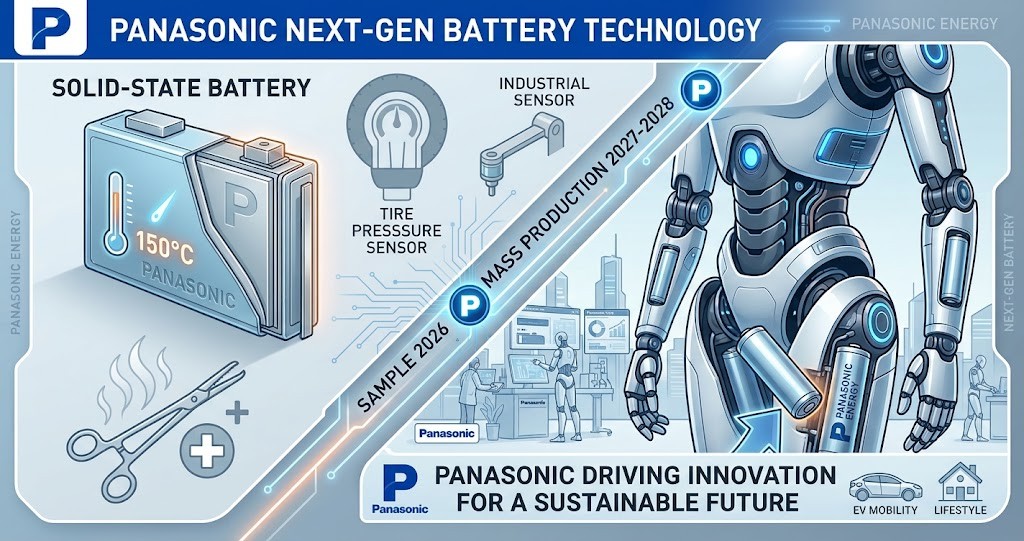
- 高温対応・角形全固体電池の開発 従来はコイン形・最大125℃までだった全固体電池に、レイアウト自由度の高い「角形」を追加し、耐熱性能を「最大150℃」まで引き上げました。
- 新たな用途の開拓 150℃の高温に対応することで、従来のタイヤ空気圧センサーや産業用ロボット向けセンサーに加え、高温での滅菌処理が必要な医療用器具などへの展開が可能になります。
- 出荷および量産スケジュール コイン形および角形の産業用小型セルを2026年度第3四半期(10-12月期)にサンプル出荷し、その1-2年後に量産化を目指します。
- ヒューマノイド向け円筒型電池への注力 ヒト型ロボットの曲面形状や限られたスペースに対して、同社の円筒型電池が持つ適応力が高いとし、開発を加速させる方針を示しました。
関連情報・背景解説
- 全固体電池の特徴と産業用での先行採用 全固体電池は、従来の液状電解質を固体に置き換えた次世代電池です。漏液や発火のリスクが極めて低く、耐熱性やエネルギー密度に優れています。EV(電気自動車)向けの開発が注目されがちですが、車載用は大型で安全認証やコストのハードルが高いため、まずは小型で高付加価値が狙える産業・医療・車載センサー領域から実用化を進めるアプローチが取られています。
- パナソニックエナジーの強み(円筒型電池) 同社は車載用円筒型リチウムイオン電池(テスラ向けなど)で世界トップクラスの実績を持ちます。円筒型電池は自動化ラインでの大量生産に適しており、構造的に堅牢であるため、振動や可動範囲の広いヒューマノイドロボットの関節付近やフレーム内への配置において高い親和性を持ちます。
出典:https://jp.reuters.com/economy/CFMST5OPMZPLTDJ3LRZOQNAN6Y-2026-09-09/
Panasonic Energy Battery Strategy: 150 ℃ Compatible All-Solid-State Batteries and the Potential of Cylindrical Batteries for Humanoid Robots
Panasonic Energy, a battery business company under Panasonic Holdings, announced the development of a new compact all-solid-state battery for industrial use and the acceleration of battery development for humanoid robots. Below is a summary of the announcement along with relevant background information to deepen understanding.
Summary of the Announcement
- Development of High-Temperature Prismatic All-Solid-State Battery In addition to the existing coin-type cells capped at 125℃, a “prismatic” form factor offering greater layout flexibility was added, raising the heat resistance limit to 150℃.
- Expansion into New Applications Withstanding 150 ℃ heat allows expansion beyond traditional tire pressure monitoring sensors and industrial robot sensors into applications such as medical equipment requiring high-temperature sterilization.
- Shipment and Mass Production Schedule Sample shipments of coin-type and prismatic small industrial cells are scheduled for the third quarter of FY2026 (October–December), with mass production targeted 1 to 2 years later.
- Focus on Cylindrical Batteries for Humanoid Robots The company expressed its strategy to accelerate development, noting that its cylindrical batteries are highly adaptable to the curved shapes and limited spaces of humanoid robots.
Relevant Background Information
- Characteristics of All-Solid-State Batteries and Initial Industrial Adoption All-solid-state batteries are next-generation batteries that replace liquid electrolytes with solid ones. They feature an extremely low risk of leakage or fire, as well as superior heat resistance and energy density. While EV applications attract the most attention, automotive cells face high hurdles in size, safety certification, and cost. Therefore, Panasonic Energy is adopting an approach to implement the technology first in small, high-value-added areas such as industrial, medical, and automotive sensors.
- Panasonic Energy Strength: Cylindrical Batteries The company holds a world-leading track record in automotive cylindrical lithium-ion batteries (such as those supplied to Tesla). Cylindrical batteries are suitable for mass production on automated lines and are structurally robust, making them highly compatible with placement inside frames or near joints in humanoid robots, where vibration resistance and movement flexibility are required.


コメント