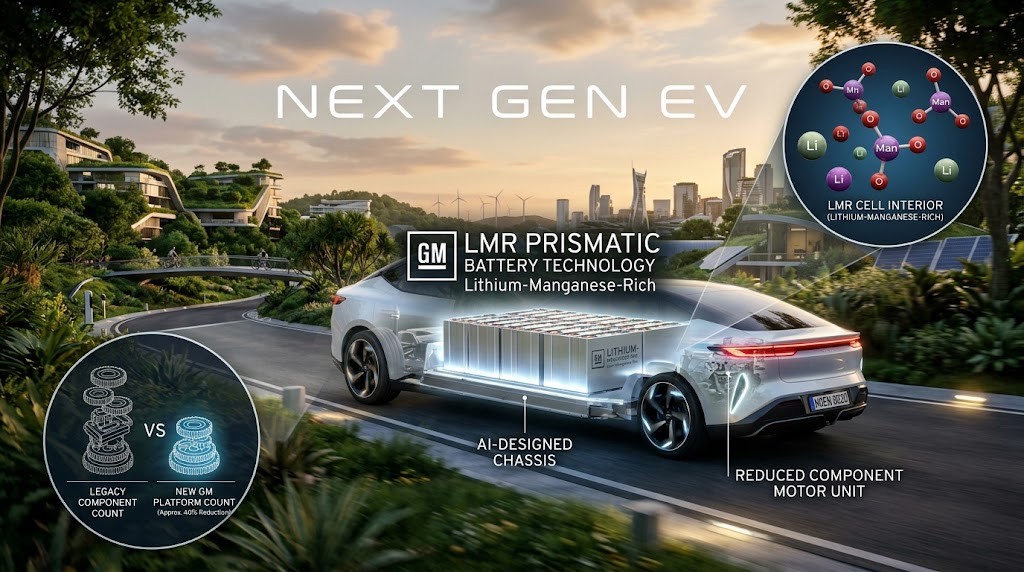
ゼネラル・モーターズ(GM)は、次世代EV戦略の核となる第4世代EVプラットフォームを発表しました。新開発のオペレーティングシステムやAIシミュレーションの導入により開発基盤を根本から刷新し、車体軽量化、部品削減、バッテリー技術の刷新を同時に進めることで、圧倒的なコスト削減と高効率化を実現します。
以下に、発表された主要ポイントと背景・関連情報をまとめました。
ニュースの概要と重要ポイント
GMは、主要な普及価格帯市場(クロスオーバーやSUVなど)への導入を見据えた第4世代EVプラットフォームの全貌を明らかにしました。
- 何が起きたか: リチウム・マンガン・リッチ(LMR)角型バッテリー、部品点数を約40%削減した新モータユニット、単一の集中型コンピューティングアーキテクチャを採用した新世代プラットフォームを発表。
- なぜ重要か: 従来の段階的な車両開発からAI・デジタルモデルを活用した並行開発(デジタルツイン)へ移行したことで、開発期間を従来の5年から約2年に半減。さらに電費効率(1 kilowatt-hourあたりの走行距離)が約20%向上し、より少ないバッテリー容量(約20%削減)で既存モデルと同等以上の航続距離を実現。
- 次に見るべき点: LMRバッテリーの本格量産(テネシー州スプリングヒルのUltium Cells工場にて2028年量産予定)に向けた立ち上げ状況、および新プラットフォームが適用される量産車種の市場投入時期。
主な技術革新と数値目標
| 項目 | 主な技術と効果 |
| LMRバッテリー技術 | LFP(リン酸鉄リチウム)と同等の低コストを実現しつつ、エネルギー密度を約33%向上。30万種類以上のバーチャルテストを経て実証。 |
| 駆動系・パワーユニット | モーター内部の部品点数を約40%削減。ユニット自体の小型・軽量化により車内スペースを拡大。 |
| 電子・電気アーキテクチャ | 集中型コンピューティング(CCU)の導入により配線を約30%削減、制御モジュール数を大幅削減。AI処理能力は40倍に向上。 |
| 生産・組み立て効率 | 工場データ分析プラットフォーム「PlantBrAIn」の活用やライン上での通電自動テストにより、パック組み立て工程を30%短縮。 |
関連情報と背景解説
- EV需要減速と低価格化への対応米国における補助金(7,500 USD)の縮小・廃止やEV市場全体の需要鈍化を受け、各社は「航続距離の長さ」と「価格の手頃さ」の両立を強く求められています。GMは安価だが重いLFP電池に頼るのではなく、高エネルギー密度と低コストを兼ね備えたLMR電池を採用することで、バッテリーパック自体を小型・軽量化し、大幅な原価低減を図る戦略を打ち出しています。
- ガソリン車・HVを含む全社的ソフトウェア刷新今回導入される centralized computing(集中型コンピューティング)アーキテクチャは、EV専用にとどまらず、ガソリン車やハイブリッド車(HV)にも横展開される予定です。2028年モデルの「キャデラック・エスカレードIQ」をはじめとして順次適用され、ハンズフリー運転支援システム「Super Cruise」の高度化やOTA(オンライン)アップデートによるライフサイクル全体の機能更新を可能にします。
20 Percent Efficiency Boost! GM Adopts World-First “LMR Prismatic Battery” in 4th-Gen EV Platform
General Motors (GM) has unveiled its 4th-generation EV platform, which serves as the core of its next-generation EV strategy. By fundamentally overhauling its development foundation through a newly developed operating system and AI simulation, GM is simultaneously advancing vehicle weight reduction, component minimization, and battery technology innovation to achieve dramatic cost reductions and high efficiency. Below is a summary of the key announced highlights, background, and related information.
News Summary and Key Highlights
GM revealed the full scope of its 4th-generation EV platform, designed for rollout in high-volume, mainstream segments such as crossovers and SUVs.
- What happened: GM announced a new-generation platform featuring lithium-manganese-rich (LMR) prismatic batteries, a new drive unit with roughly 40 percent fewer parts, and a single centralized computing architecture.
- Why it matters: Transitioning from traditional sequential vehicle development to parallel development leveraging AI and digital models (digital twin) slashes development time in half, from the conventional 5 years to approximately 2 years. Furthermore, energy efficiency (driving range per 1 kilowatt-hour) improves by about 20 percent, enabling current or superior driving range with roughly 20 percent less battery capacity.
- What to watch next: The ramp-up status toward full-scale commercial production of LMR batteries (scheduled for 2028 production at the Ultium Cells plant in Spring Hill, Tennessee) and the timing of market introduction for mass-production models utilizing this new platform.
Key Technological Innovations and Target Metrics
| Item | Key Technologies and Effects |
| LMR Battery Technology | Achieves low cost comparable to LFP (lithium iron phosphate) while boosting energy density by approximately 33 percent. Verified through over 300,000 virtual design tests. |
| Drivetrain & Power Units | Reduces internal motor parts count by approximately 40 percent. System downsizing and weight reduction expand cabin interior space. |
| Electronic & Electrical Architecture | Introduction of Centralized Computing Units (CCU) reduces wiring by about 30 percent and drastically cuts the number of control modules. AI processing capability is boosted by 40 times. |
| Production & Assembly Efficiency | Utilization of the factory data analytics platform “PlantBrAIn” and automated line-side electrical testing cut battery pack assembly processes by 30 percent. |
Related Information and Background Context
- Responding to EV Demand Slowdown and Cost Pressure Following the reduction and elimination of federal subsidies (7,500 USD) in the US and a broader market slowdown in EV demand, automakers face strong pressure to deliver both long driving range and affordability. Rather than relying solely on inexpensive but heavy LFP batteries, GM is adopting LMR batteries that combine high energy density with low cost, allowing for smaller, lighter battery packs that drive down overall manufacturing costs.
- Company-Wide Software Refresh Including Gasoline Vehicles and Hybrids The centralized computing architecture introduced here is not limited to EVs; it is scheduled for rollout across gasoline and hybrid vehicle (HEV) lineups as well. Starting sequentially with the 2028 Cadillac Escalade IQ, this platform enables advanced capabilities for the Super Cruise hands-free driving system and OTA (over-the-air) updates for feature enhancements throughout the vehicle lifecycle.


コメント