電気自動車(EV)から空飛ぶクルマ(低空経済)、さらには人型ロボット(ヒューマノイド)まで——。新興産業の爆発的な成長に伴い、エネルギー密度の限界(約350Wh/kg)に達したリチウムイオン電池に代わる「次世代の心臓部」への渇望がかつてないほど高まっている。
こうした中、2026年を全固体電池の産業チェーン構築の重点年と定めた中国工業情報化部(MIIT)の号令に呼応するように、一校のスタートアップが異彩を放っている。2022年末に設立された「安高特電(AnGaoTe Electric)」だ。彼らが掲げるのは、従来の電池製造の常識を覆す「半導体の発想」によるアプローチ。ついに1000Wh/kgという驚異の領域を見据えた「ウエハー型電池」の実用化がカウントダウンに入った。
- ## 1. 「粉」から「結晶」へ:半導体技術による構造改革
- ## 2. 技術主導から「市場主導」への転換と受注獲得
- ## 3. 2026年、量産フェーズへのロードマップ
- ## 4. 背景と展望:電池は「消費電力ゼロ」のデバイスへ
- 1. From “Powder” to “Crystal”: Structural Reform via Semiconductor Tech
- 2. Transition from Technology-Driven to “Market-Driven” and Order Acquisition
- 3. 2026 Roadmap to Mass Production
- 4. Outlook: Batteries as “Low Power Consumption” Devices
## 1. 「粉」から「結晶」へ:半導体技術による構造改革
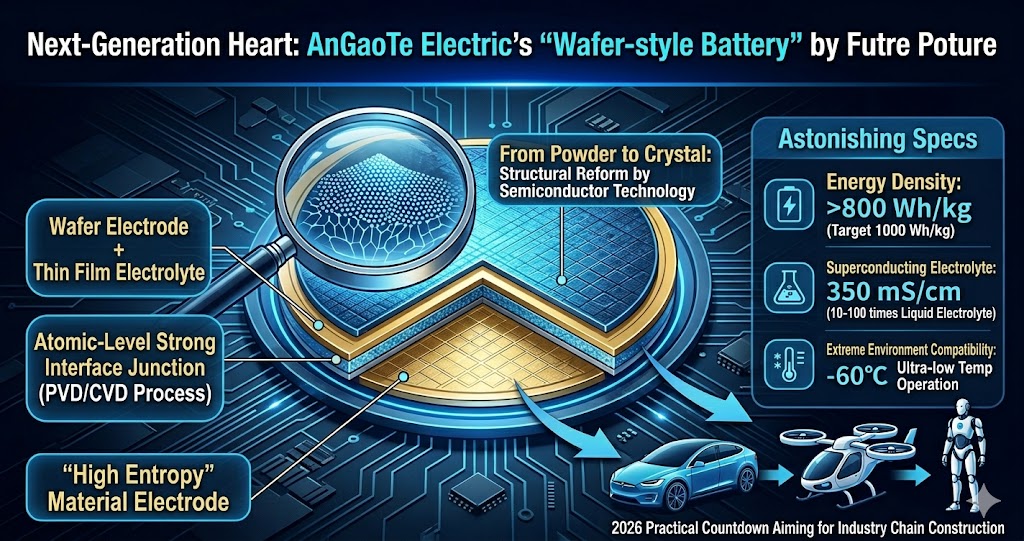
従来の全固体電池開発における最大の障壁は、固体材料同士の接触不良(界面抵抗)でした。安高特電はこの問題を、電池を「化学製品」ではなく「精密デバイス」として捉え直すことで解決しました。
- ウエハー電極 + 薄膜電解質:従来の粉体電極構造を捨て、半導体チップ並みの緻密な構造を持つ電極を採用。物理蒸着(PVD)や化学蒸着(CVD)といった半導体成膜プロセスを用いることで、原子レベルでの強固な界面接合を実現しました。
- 「ハイエントロピー」による安定化:複数の元素を協調させる「ハイエントロピー材料」を電極に応用。充放電時の膨張・収縮を抑制し、結晶格子の崩壊を防ぐことで、安全性を飛躍的に高めています。
- 驚異のスペック:
- エネルギー密度: 現在800Wh/kgを突破(将来目標:1000Wh/kg)。
- 超電導電解質: 350mS/cmという、液体電解質を10〜100倍上回るイオン導電率を達成。
- 極限環境対応: -60℃の超低温下でも正常動作が可能。
## 2. 技術主導から「市場主導」への転換と受注獲得
安高特電の強みは、その卓越した技術を「売れる製品」へと落とし込む商用化思考にあります。ファーウェイの「技術・製品・顧客」の三位一体体制を参考に、顧客の現場ニーズに即した設計へと舵を切りました。
| ターゲット市場 | 商用化の進捗・受注規模 |
| 二輪車(交換式) | 初回3,100セット納品済、今後3年で数十万セットを予定。 |
| 産業用無人設備 | 国有大手向けにサンプル送付完了。受注規模は数十万セット。 |
| エネルギー貯蔵 | 「一帯一路」沿線国で1.5GWh規模のプロジェクトが目前。 |
| 乗用車(EV) | 大手自動車メーカー数社と車両搭載試験の協議が進行中。 |
## 3. 2026年、量産フェーズへのロードマップ
シリーズA資金調達を完了した同社は、技術の世代ごとに段階的な生産戦略を敷いています。
- 第1世代(現行): 既存の液体電池ラインを一部活用し、迅速な市場投入を優先。
- 第2世代(乾式ラミネート): 浙江省にて自社パイロットラインの建設を開始。
- 第3世代(ウエハー電池): 半導体装置メーカーと専用設備を共同開発。大型化と完全量産化を目指す。
## 4. 背景と展望:電池は「消費電力ゼロ」のデバイスへ
2026年、中国では全固体電池の国家規格(標準化)の策定が進んでおり、研究室の成果が公的な産業計画へと組み込まれる転換点を迎えています。
安高特電の呉珠智CEOは、2026年の受注額が10億元(約230億円)を突破すると予測。その視線は電池製造の先、「低消費電力デバイス」としての進化に向いています。「将来的に、スーパーコンピューターの消費電力を現在の20MWから、人間の脳と同程度の20Wにまで引き下げたい」という壮大な抱負は、半導体と電池の境界が消滅する未来を予感させます。
Ending the EV Range Problem? AnGaoTe Electric’s “Semiconductor-Inspired” All-Solid-State Battery
From Electric Vehicles (EVs) and the “Low-Altitude Economy” (flying cars) to humanoid robots—the explosive growth of emerging industries has ignited an unprecedented thirst for a “next-generation heart” to replace lithium-ion batteries, which have hit an energy density ceiling of approximately 350Wh/kg.
Amidst this backdrop, 2026 has been designated by China’s Ministry of Industry and Information Technology (MIIT) as a pivotal year for establishing the all-solid-state battery industrial chain. Responding to this call, one startup is standing out: AnGaoTe Electric. Founded in late 2022, they advocate an approach that defies conventional battery manufacturing wisdom by “developing batteries with a semiconductor mindset.” The countdown has officially begun for the commercialization of their “wafer-style battery,” which eyes a staggering energy density of 1000Wh/kg.
1. From “Powder” to “Crystal”: Structural Reform via Semiconductor Tech
The greatest barrier to all-solid-state battery development has been poor contact between solid materials (interfacial resistance). AnGaoTe Electric solved this by reimagining the battery not as a “chemical product,” but as a “precision device.”
- Wafer Electrodes + Thin-Film Electrolytes: Moving away from traditional powder-based electrode structures, the company employs dense electrodes comparable to semiconductor chips. By utilizing semiconductor film-forming processes such as Physical Vapor Deposition (PVD) and Chemical Vapor Deposition (CVD), they have achieved robust interfacial bonding at the atomic level.
- Stabilization via “High-Entropy”: The application of “high-entropy materials” to the electrodes coordinates multiple elements to stabilize the crystal lattice. This suppresses expansion and contraction during charging/discharging, dramatically increasing safety.
- Stunning Specifications:
- Energy Density: Currently exceeded 800Wh/kg (Future target: 1000Wh/kg).
- Superconducting Electrolyte: Achieved an ionic conductivity of 350mS/cm—10 to 100 times higher than conventional liquid electrolytes.
- Extreme Environment Resilience: Capable of normal operation in ultra-low temperatures as low as -60°C.
2. Transition from Technology-Driven to “Market-Driven” and Order Acquisition
AnGaoTe Electric’s strength lies in its commercialization mindset, translating superior technology into “sellable products.” Drawing inspiration from Huawei’s “Technology-Product-Customer” trinity, the company has pivoted its design process to start from the actual needs of customers in the field.
| Target Market | Commercialization Progress / Order Scale |
| Two-Wheelers (Swappable) | Initial 3,100 sets delivered; hundreds of thousands planned over the next 3 years. |
| Industrial Unmanned Equipment | Samples sent to major state-owned enterprises. Order scale reaching hundreds of thousands. |
| Energy Storage | A 1.5GWh project in an “Belt and Road” initiative country is imminent. |
| Passenger Vehicles (EV) | Discussions ongoing with several major automakers regarding on-vehicle testing. |
3. 2026 Roadmap to Mass Production
Having completed its Series A funding, the company is deploying a tiered production strategy for each generation of its technology:
- Generation 1 (Current): Leveraging existing liquid battery production lines for certain processes to prioritize rapid market entry.
- Generation 2 (Dry Lamination): Construction of a dedicated pilot line has commenced in Zhejiang Province.
- Generation 3 (Wafer Battery): Jointly developing specialized equipment with semiconductor tool manufacturers, focusing on scaling up for full mass production.
4. Outlook: Batteries as “Low Power Consumption” Devices
In 2026, China is advancing the formulation of national standards for all-solid-state batteries, marking a turning point where laboratory achievements are integrated into official industrial plans.
Wu Zhuzhi, CEO of AnGaoTe Electric, predicts that orders in 2026 will surpass 1 billion yuan (approx. 23 billion JPY). His vision extends beyond battery manufacturing toward an evolution into “low power consumption devices.” His ambitious goal—to eventually reduce the power consumption of supercomputers from the current 20MW to just 20W (comparable to a human brain)—hints at a future where the boundary between semiconductors and batteries disappears.
コメント