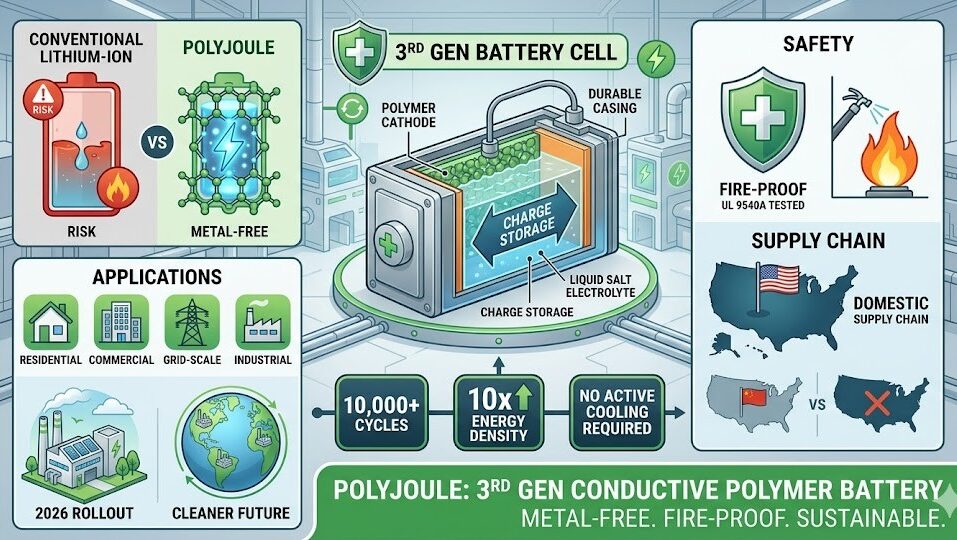
世界のエネルギー需要が再生可能エネルギーへとシフトする中、蓄電システムの重要性が急速に高まっています。しかし、現在主流のリチウムイオン電池は、発火リスクや特定の金属への依存といった課題を抱えています。こうした中、マサチューセッツ工科大学(MIT)発のスタートアップ、PolyJoule(ポリジュール)社が発表した「第3世代導電性ポリマー電池」は、金属を電荷貯蔵に使用しないという革新的なアプローチにより、蓄電業界に安全面と供給面での新たな選択肢を提示しています。
PolyJoule第3世代蓄電システムの概要と主要技術
PolyJoule社の技術は、従来の金属ベースの電池とは根本的に異なる化学組成に基づいています。
1. 革新的な化学組成:導電性ポリマーと液体塩
- 導電性ポリマー正極: 従来のリチウムイオンやナトリウムイオン電池が金属を利用するのに対し、有機骨格に沿って電荷を保持する導電性ポリマーを採用しています。
- 液体塩電解質: リチウムイオン電池に使用される有機溶媒に比べ、蒸気圧が10億分の1という極めて低い液体塩電解質を使用。これにより、揮発や発火のリスクを最小限に抑えています。
- 非金属・非リチウム: 希土類(レアアース)や特定の金属に依存しないため、環境負荷が低く、材料調達の安定性が高いのが特徴です。
2. 圧倒的な安全性:自己消火機能
- 熱暴走の回避: 導電性ポリマーの特性により、デンドライト(樹枝状結晶)による短絡が発生せず、根本的に熱暴走が起こらない設計です。これはUL 9540A試験によっても証明されています。
- 極限環境試験: プロパンバーナーによる約1982℃ (3600℉) の炎を直接照射する試験において、バーナーを離した瞬間に炎が消える「自己消火性」を実証しました。
- 熱管理の不要化: 外部からのアクティブな冷却や熱管理システムを必要とせず、極端な熱条件下でも安定して動作します。
3. 性能と運用メリット
- 長寿命: 第3世代では、10000サイクル以上の寿命を実現しています。
- エネルギー密度の向上: 第1世代と比較してエネルギー密度が10倍に向上しました。
- シンプルなシステム設計: 熱管理が不要なため、システム全体の構造が簡素化され、設置や運用のコスト削減が期待できます。
関連情報:蓄電業界における位置付けと背景
PolyJoule社の技術が注目される背景には、現在のエネルギー市場が抱える以下の課題があります。
- リチウムイオン電池の限界: リチウムイオン電池は高いエネルギー密度を持ちますが、有機電解液が可燃性であるため、大規模蓄電所での火災事故が世界的な懸念事項となっています。PolyJouleはこの「安全性」の隙間を埋める存在です。
- サプライチェーンの国内回帰: リチウムやコバルトなどの重要鉱物は特定の国に依存する傾向が強いですが、PolyJouleは米国内での調達・製造(Domestic Supply Chain)を強調しており、地政学的リスクを回避したい企業の需要に応えています。
- 定置型蓄電市場への特化: 導電性ポリマー電池は、電気自動車(EV)向けよりも、安全性とサイクル寿命が最優先される電力網(グリッド)、商業施設、産業用、住宅用の定置型蓄電システム(BESS)に適しています。
今後の展開
PolyJoule社は2026年後半、一部の地域において、太陽光発電や蓄電池の設置業者を通じ、商業・産業・住宅分野向けにエネルギー貯蔵システムの提供を開始する予定です。これにより、これまで火災リスク等の理由でリチウムイオン電池の設置が困難だった場所への導入が進むことが期待されます。
PolyJoule, Inc. Announces Third-Generation Self-Extinguishing Conductive Polymer Chemistry for BESS
As global energy demand shifts toward renewable energy, the importance of energy storage systems is rapidly increasing. However, today’s mainstream lithium-ion batteries face challenges such as fire risks and dependence on specific metals. In this context, PolyJoule, a startup spun out of the Massachusetts Institute of Technology (MIT), has introduced its “Third-Generation Conductive Polymer Battery.” With an innovative approach that eliminates the use of metal for charge storage, PolyJoule offers the energy storage industry a new alternative in terms of both safety and supply chain stability.
Overview and Key Technologies of the PolyJoule Gen 3 Storage System
PolyJoule’s technology is based on a chemical composition fundamentally different from traditional metal-based batteries.
1. Innovative Chemical Composition: Conductive Polymers and Liquid Salts
- Conductive Polymer Cathode: While conventional lithium-ion or sodium-ion batteries utilize metal, PolyJoule employs conductive polymers that hold a charge along an organic backbone.
- Liquid Salt Electrolyte: The system uses a liquid salt electrolyte with a vapor pressure one billion times lower than the organic solvents used in lithium-ion batteries. This minimizes the risk of volatilization and ignition.
- Non-Metallic and Lithium-Free: By not relying on rare earth elements or specific metals, the technology features a low environmental impact and high stability in material procurement.
2. Unmatched Safety: Self-Extinguishing Capability
- Prevention of Thermal Runaway: Due to the properties of conductive polymers, dendrites (branch-like crystals) do not form, preventing short circuits. The design fundamentally eliminates thermal runaway, a fact proven through UL 9540A testing.
- Extreme Environmental Testing: In tests involving direct exposure to a propane burner flame at approximately 1982 deg C (3600 deg F), the battery demonstrated “self-extinguishing” properties, with the flames vanishing the moment the burner was removed.
- No Active Thermal Management: The cells operate stably under extreme thermal conditions without the need for external active cooling or complex thermal management systems.
3. Performance and Operational Benefits
- Long Cycle Life: The third-generation chemistry achieves a lifespan of over 10000 cycles.
- Increased Energy Density: Energy density has improved tenfold compared to the first-generation cells.
- Simplified System Design: Because active thermal management is unnecessary, the overall system structure is simplified, leading to expected reductions in installation and operational costs.
Context: Positioning in the Energy Storage Industry
The attention surrounding PolyJoule’s technology stems from several critical challenges in the current energy market:
- Limitations of Lithium-ion Batteries: Although lithium-ion batteries offer high energy density, their flammable organic electrolytes make fire accidents at large-scale storage facilities a global concern. PolyJoule fills this “safety gap.”
- Reshoring the Supply Chain: While critical minerals like lithium and cobalt often depend on specific foreign countries, PolyJoule emphasizes a domestic supply chain (USA). This meets the needs of companies looking to avoid geopolitical risks.
- Focus on Stationary Storage Markets: Conductive polymer batteries are ideally suited for the Battery Energy Storage System (BESS) market—including power grids, commercial, industrial, and residential sectors—where safety and cycle life are prioritized over the high energy density required for electric vehicles (EVs).
Future Outlook
In the second half of 2026, PolyJoule plans to begin accepting applications from qualified solar, storage, and generator installers in select regions to provide energy storage systems for the commercial, industrial, and residential sectors.


コメント