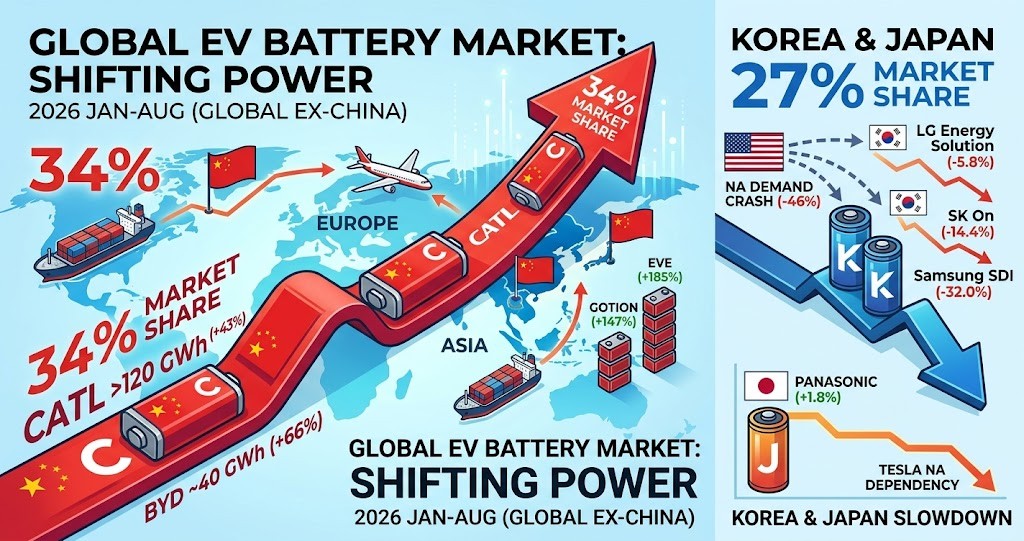
中国系EV(電気自動車)電池メーカーが、中国以外の世界市場で急拡大を続けています。価格競争力や欧州・アジア市場での展開力を強みに市場支配力を強める一方、北米依存度の高かった韓国主要3社は、北米需要の急減速を受けてシェアを大きく落とす結果となりました。
本レポートでは、2026年1~8月のデータをもとに、中国系企業の躍進と韓国企業の失速、そして今後の市場を左右する要素についてまとめています。
中国系電池、中国外市場でシェア34%…韓国3社は27%に急落
1. 市場の全体像と成長動向
- 総使用量: 2026年1~8月に中国を除く世界のEV(BEV、PHEV、HEV)に搭載された電池総使用量は約 360.5 GWh となり、前年同期比で 23.7% 増加しました。
- 成長率の減速: 世界全体の成長率(19.7%)を上回る推移を見せているものの、8月単月では前年同月比 9% 増へと減速しています。これは主に北米市場における需要空白の影響が浮き彫りになったためです。
2. 中国系メーカーの急速な拡大
中国メーカーは、欧州やアジアなど広域での伸びを背景に著しい成長を遂げています。
- CATL: 使用量は 121.3 GWh(前年同期比 43.3% 増)で首位を堅持。シェアは 29.0% から 33.7%(+4.7%p)へ拡大しました。欧州(80.6 GWh、30.4% 増)およびアジア(24.0 GWh、2倍以上)での大幅増が寄与しています。
- BYD: 使用量は 39.7 GWh(66.5% 増)で 3位を維持。シェアは 8.2% から 11.0%(+2.8%p)へ伸長しました。欧州(14.5 GWh)、アジア(13.2 GWh)、南米(6.2 GWh)などで満遍なく伸ばしています。
- 後発メーカーの急成長:
- Gotion High-tech: 14.4 GWh(147.2% 増)
- SVOLT: 11.4 GWh(105.2% 増)
- CALB: 8.4 GWh(77.6% 増)
- EVE: 7.5 GWh(185.6% 増、上位10社中トップの伸び率)
3. 韓国3社の苦戦と日本勢の動向
韓国電池3社(LG Energy Solution、SK On、Samsung SDI)の合算シェアは、前年同期の 37.9% から 26.8% へと 11.1%p 大幅に低下しました。
- 北米市場での不振:韓国3社の北米での使用量は 47.4 GWh から 25.3 GWh へと 46.5% 減少しました。欧州(52.5 GWh、5.2% 増)やアジア(14.8 GWh、33.0% 増)では成長したものの、北米での激減が全体実績を押し下げました。
- 企業別の実績:
- LG Energy Solution: 58.1 GWh(5.8% 減)で 2位を維持。北米が 42.3% 減となり、シェアは 21.2% から 16.1%(-5.1%p)へ低下。
- SK On: 24.8 GWh(14.4% 減)で 5位。北米(41.8% 減)と欧州(1.5% 減)の不振で、シェアは 9.9% から 6.9%(-3.0%p)へ低下。
- Samsung SDI: 13.6 GWh(32.0% 減)で上位10社中最大の減少幅を記録。北米が 10.4 GWh から 3.9 GWh へと 62% 急減し、シェアは 6.8% から 3.8%(-3.0%p)へ低下。
- Panasonic(日本): 29.7 GWh(1.8% 増)で 4位。Tesla の北米向け出荷が支えとなったものの、市場平均の成長を下回り、シェアは 10.0% から 8.3%(-1.7%p)へ縮小しました。
4. 主要メーカー別実績一覧(2026年1~8月 中国外市場)
| メーカー名 | 使用量 (GWh) | 前年同期比 | シェア | シェア変動 (%p) |
| CATL | 121.3 | +43.3% | 33.7% | +4.7 |
| LG Energy Solution | 58.1 | -5.8% | 16.1% | -5.1 |
| BYD | 39.7 | +66.5% | 11.0% | +2.8 |
| Panasonic | 29.7 | +1.8% | 8.3% | -1.7 |
| SK On | 24.8 | -14.4% | 6.9% | -3.0 |
| Gotion High-tech | 14.4 | +147.2% | 非公開 | – |
| Samsung SDI | 13.6 | -32.0% | 3.8% | -3.0 |
5. 関連情報・今後の鍵(政策とサプライチェーン)
- 米国の政策変化とIRAの影響:韓国勢の失速背景には、米国でのインフレーション抑制法(IRA:Inflation Reduction Act)などの政策変更や補助金適用の見直しに伴う、北米EV市場全体の減速があります。韓国勢は北米生産拠点への投資に大きく依存していたため、需要減退の直撃を受ける形となりました。
- LFP電池(リン酸鉄リチウム電池)の台頭と価格競争力:中国メーカーが得意とする LFP電池は、韓国勢が中心とする NCM(ニッケル・コバルト・マンガン)三元系電池に比べて製造コストが安く、安全性が高いため、低価格~中価格帯EVへの採用がグローバルで急増しています。欧州や新興国市場で中国勢がシェアを伸ばす最大の原動力となっています。
- EUの「バッテリーパスポート」導入方針(2027年~):欧州連合(EU)では、電池の原材料調達からリサイクル履歴までを透明化・追跡可能にするデジタル制度「バッテリーパスポート(Battery Passport)」の運用が計画されています。SNE Research は、現地での生産能力やコストパフォーマンスに加え、サプライチェーンの追跡・トレーサビリティ能力が今後の競争力を決定づける核心要素になると分析しています。
出典:https://finance.biggo.jp/news/59d72b02-e954-4cb7-99bd-1b0b1781f5c0
Chinese EV Battery Makers Surge to 34% Share Outside China… Korean Trio Plunges to 27%
Chinese electric vehicle (EV) battery manufacturers continue their rapid expansion in global markets outside China. Leveraging price competitiveness and strong market entry capabilities across Europe and Asia, Chinese companies are bolstering their market dominance. In contrast, the three major South Korean manufacturers, which were heavily dependent on North America, saw a sharp drop in market share due to a steep slowdown in North American demand.
Based on data from January to August 2026, this report summarizes the rapid rise of Chinese companies, the slowdown of Korean firms, and the key factors that will shape the future market landscape.
Chinese EV Battery Makers Surge to 34% Share Outside China… Korean Trio Plunges to 27%
1. Market Overview and Growth Trends
- Total Usage: From January to August 2026, total battery usage installed in electric vehicles (BEV, PHEV, HEV) globally excluding China reached approximately 360.5 GWh, representing a 23.7% increase year-over-year.
- Slowing Growth Rate: While growth outpaced the overall global market growth rate (19.7%), growth in August alone slowed to 9% year-over-year. This was mainly due to the visible impact of a demand vacuum in the North American market.
2. Rapid Expansion of Chinese Manufacturers
Chinese battery makers achieved remarkable growth driven by expansion across broad regions including Europe and Asia.
- CATL: Maintained top position with 121.3 GWh in usage (a 43.3% increase year-over-year). Its market share expanded from 29.0% to 33.7% (+4.7 %p). Significant growth in Europe (80.6 GWh, up 30.4%) and Asia (24.0 GWh, more than double) contributed to this performance.
- BYD: Maintained 3rd place with 39.7 GWh (up 66.5%). Its market share grew from 8.2% to 11.0% (+2.8 %p). BYD recorded balanced gains across Europe (14.5 GWh), Asia (13.2 GWh), and South America (6.2 GWh).
- Rapid Growth of Emerging Manufacturers:
- Gotion High-tech: 14.4 GWh (up 147.2%)
- SVOLT: 11.4 GWh (up 105.2%)
- CALB: 8.4 GWh (up 77.6%)
- EVE: 7.5 GWh (up 185.6%, highest growth rate among top 10 companies)
3. Challenges for Korean Trio and Japanese Market Dynamics
The combined market share of the three major Korean battery makers (LG Energy Solution, SK On, and Samsung SDI) declined sharply by 11.1 %p, falling from 37.9% in the same period last year to 26.8%.
- Slump in the North American Market:Battery usage by the three Korean companies in North America plummeted by 46.5%, falling from 47.4 GWh to 25.3 GWh. Although they recorded growth in Europe (52.5 GWh, up 5.2%) and Asia (14.8 GWh, up 33.0%), the sharp decline in North America dragged down overall results.
- Performance by Company:
- LG Energy Solution: Maintained 2nd place with 58.1 GWh (down 5.8%). With North American usage down 42.3%, its market share fell from 21.2% to 16.1% (-5.1 %p).
- SK On: Placed 5th with 24.8 GWh (down 14.4%). Weakness in North America (down 41.8%) and Europe (down 1.5%) reduced its market share from 9.9% to 6.9% (-3.0 %p).
- Samsung SDI: Recorded the largest drop among top 10 companies with 13.6 GWh (down 32.0%). Usage in North America fell sharply by 62% from 10.4 GWh to 3.9 GWh, reducing its market share from 6.8% to 3.8% (-3.0 %p).
- Panasonic (Japan): Ranked 4th with 29.7 GWh (up 1.8%). Supported by Tesla shipments in North America, its growth nevertheless lagged behind the overall market average, reducing its market share from 10.0% to 8.3% (-1.7 %p).
4. Top Manufacturers’ Performance (Jan–Aug 2026, Excl. China Market)
| Company Name | Usage (GWh) | YoY Change | Market Share | Share Change (%p) |
| CATL | 121.3 | +43.3% | 33.7% | +4.7 |
| LG Energy Solution | 58.1 | -5.8% | 16.1% | -5.1 |
| BYD | 39.7 | +66.5% | 11.0% | +2.8 |
| Panasonic | 29.7 | +1.8% | 8.3% | -1.7 |
| SK On | 24.8 | -14.4% | 6.9% | -3.0 |
| Gotion High-tech | 14.4 | +147.2% | Undisclosed | – |
| Samsung SDI | 13.6 | -32.0% | 3.8% | -3.0 |
5. Key Perspectives and Future Factors (Policies and Supply Chains)
- Impact of US Policy Shifts and IRA:Behind the slowdown of Korean battery makers lies a broader deceleration in the North American EV market, triggered by policy changes such as the Inflation Reduction Act (IRA) and revisions to subsidy qualifications in the United States. Having invested heavily in North American production bases, Korean firms were directly impacted by the weakening demand.
- Rise of LFP Batteries and Price Competitiveness:LFP (Lithium Iron Phosphate) batteries, a specialty of Chinese manufacturers, offer lower manufacturing costs and higher thermal safety compared to NCM (Nickel-Manganese-Cobalt) ternary batteries favored by Korean firms. As a result, global adoption of LFP batteries in entry-level to mid-tier EVs has surged, serving as the primary growth engine for Chinese companies in Europe and emerging markets.
- EU Battery Passport Initiative (From 2027):The European Union (EU) plans to implement a digital “Battery Passport” system to ensure transparency and traceability across the entire battery life cycle, from raw material sourcing to recycling history. SNE Research projects that supply chain tracking and traceability capabilities, alongside local production capacities and cost competitiveness, will become critical factors determining future market leadership.

コメント