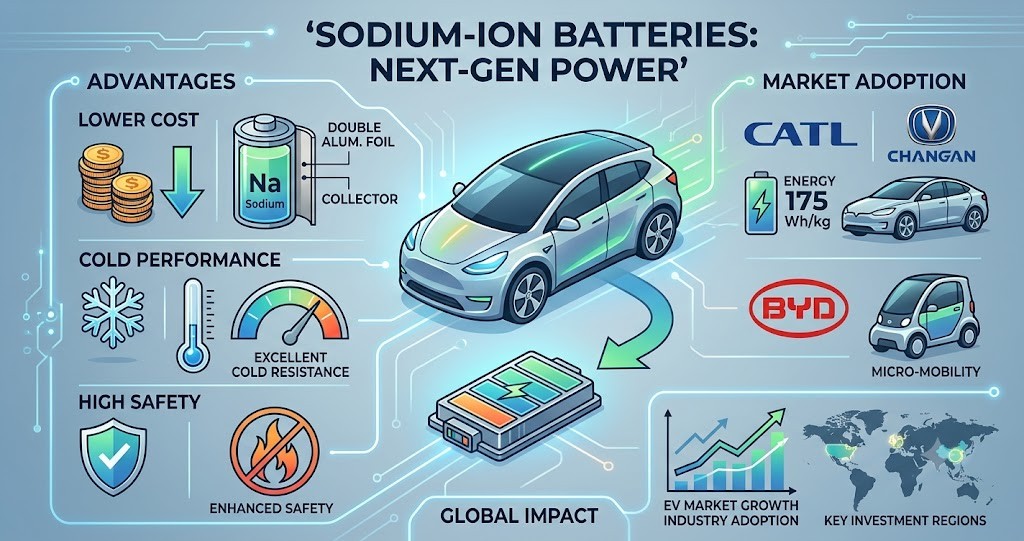
電気自動車(EV)市場が急速に拡大する中、リチウムに代わる安価で安定した次世代バッテリーとして「ナトリウムイオン電池」が大きな注目を集めています。リチウム鉄リン(LFP)電池が低価格帯EVの主流となる一方で、リチウムの価格変動リスクや資源の偏在という課題がありました。
こうした中、中国の車載電池最大手CATLが開発した175 Wh/kg(ワット時毎キログラム)のエネルギー密度を持つナトリウムイオン電池が、大手自動車メーカー長安汽車の市販車に本格採用され、量産フェーズに突入しました。製造コストは1ワット時あたり0.051米ドルという極めて低いベンチマークを達成し、リチウム電池との価格差を急速に縮めています。本レポートでは、この革新的な技術の現状、コスト競争力、技術的優位性、そして直面する課題についてまとめます。
1. 技術概要と製造コストの現状
ナトリウムイオン電池の最大の特徴は、埋蔵量が豊富で安価なナトリウムを主原料とすることです。
- 構造的工夫: 従来のリチウムイオン電池で高価な「銅箔」が使われていた集電体に、ナトリウム電池では安価な「アルミニウム箔」を正極・負極の両方に採用(二重アルミニウム箔集電体)。これにより材料コストを大幅に削減しています。また、寿命や安全性を最適化するため、ポリアニオン正極の導入が進んでいます。
- コストの比較(2026年第1四半期時点):
- ナトリウム電池の原材料製造コスト: 1ワット時あたり0.35元(0.051米ドル)から0.40元(0.059米ドル)
- LFP(リン酸鉄リチウム)電池のコスト: 1ワット時あたり0.34元(0.050米ドル)
- 今後の見通し: 現時点ではLFP電池がわずかに安価ですが、生産効率の向上に伴いナトリウム電池のコストはさらに低下する見込みです。2027年末までに、ナトリウム電池がコスト面でリチウム電池に対して完全な優位性を確立すると予測されています。
2. 優れた熱特性・環境適応性
ナトリウムイオン電池は、リチウム電池の弱点である低温環境や安全性において大きな優位性を持っています。
- 驚異的な低温特性: 摂氏マイナス20度の極寒環境下でも、公称容量の90パーセント以上を維持します(LFP電池は同環境で80パーセントを下回ることが多い)。さらに、マイナス40度という極限状態でも優れた性能が確認されています。
- 高い安全性(熱暴走対策): 独自の化学構造により、熱暴走が始まる閾値が摂氏200度を超えています。万が一、セルが短絡(ショート)した場合でも火災のリスクが極めて低く、高い安全性が証明されています。
3. 主要企業の導入戦略と市場の動き
中国の主要メーカーは、それぞれのセグメントでナトリウム電池の活用を進めています。
- 長安汽車 × CATL: エネルギー密度175 Wh/kgのCATL製セルパックを採用し、航続距離400キロメートルを達成するエントリーレベル(普及型)EVを展開。
- BYD: マイクロモビリティ(小型移動手段)や低速車両、特殊物流プラットフォームに特化。1万サイクルの長寿命を誇る「第3世代技術プラットフォーム」を開発中。
- 日奈電池(HiNa Battery): 大型トラック200台にローカルセルシステムを納入。25分以内でのフル充電が可能な商用プラットフォームを展開。
- 華陽グループ: 17.04 MWh(メガワット時)の非常用バックアップシステムを設置し、車載用だけでなく産業用蓄電池分野へも進出。
4. 巨額の投資とサプライチェーンの現状
ナトリウム電池への移行を支えるため、上流の材料供給網への投資が活発化しています。現在、世界の出荷量の70パーセントをポリアニオン化合物が占めています。
- 企業の財務と投資例:
- CATL: 年間売上高4237億200元(623億2600万米ドル)、純利益722億100元(106億2100万米ドル)の強固な財務基盤を背景に開発を牽引。
- Transimage: 電子部品メーカーながら、ナトリウム電池の第2期施設に50億元(7億3549万5000米ドル)を投資。
- Wik Technology: 新しい自動生産ラインに4億2900元(6310万5000米ドル)を投資。
- Dingsheng New Materials: 専用コレクター箔(アルミニウム箔)の供給量の最大50パーセントを支配。
5. 課題と将来の展望
高い注目を集めるナトリウム電池ですが、本格的な普及に向けてはまだ製造上のボトルネックが存在します。
- 低い工場稼働率: 中国国内で42件を超える拡張プロジェクトが独立して進められているものの、実際の工場稼働率は40パーセント未満にとどまっています。需要に対する生産体制の最適化が急務です。
- 原材料の海外依存: 負極材として重要な「硬質炭素(ハードカーボン)」の製造において、輸入バイオマス原料への物流依存度が高いという地政学的・ロジスティクス上の課題が残されています。
結論
現在、中国のリチウム電池出荷量は1888.6 GWh(ギガワット時)に達し、世界市場シェアの82.8パーセントを占める圧倒的な基盤を持っています。そのため、リチウム電池が今後も主流であり続けることは間違いありません。
しかし、ナトリウムイオン電池は、その「低コスト」「低温への強さ」「高い安全性」を武器に、エントリーレベルの小型EVや都市型モビリティ、そして電力網のバックアップ電源(固定型蓄電池)という特定の領域において、確固たる地位を築きつつあります。2027年のコスト完全逆転に向け、今後のサプライチェーンの安定化が普及の鍵を握っています。
Closing in on LFP! CATL’s Sodium-Ion Battery Breaks Frontiers at 0.051 USD/Wh
As the electric vehicle (EV) market expands rapidly, sodium-ion batteries are drawing significant attention as an affordable and stable next-generation alternative to lithium. While lithium iron phosphate (LFP) batteries have become the mainstream choice for budget EVs, challenges remain regarding lithium’s price volatility and the geopolitical concentration of its resources.
In this context, CATL, China’s largest automotive battery manufacturer, has developed a sodium-ion battery with an energy density of 175 Wh/kg. This technology has been officially adopted for commercial vehicles by major automaker Changan Automobile, moving it into the mass-production phase. With manufacturing costs hitting a remarkably low benchmark of 0.051 USD per watt-hour, the cost gap with lithium batteries is rapidly closing. This report summarizes the current status, cost competitiveness, technical advantages, and ongoing challenges of this innovative technology.
1. Technical Overview and Current Manufacturing Costs
The most prominent feature of sodium-ion batteries is their reliance on sodium as the primary raw material, which is abundant and inexpensive.
- Structural Innovations: Instead of the expensive copper foils used as current collectors in conventional lithium-ion batteries, sodium-ion batteries utilize cheap aluminum foil for both the anode and cathode (dual aluminum foil current collectors). This significantly reduces material costs. Additionally, the adoption of polyanion cathodes is accelerating to optimize battery lifespan and safety.
- Cost Comparison (As of Q1 2026):
- Raw Material Manufacturing Cost for Sodium-Ion Batteries: 0.35 RMB (0.051 USD) to 0.40 RMB (0.059 USD) per watt-hour.
- Cost of LFP (Lithium Iron Phosphate) Batteries: 0.34 RMB (0.050 USD) per watt-hour.
- Future Outlook: While LFP batteries remain slightly cheaper at present, the cost of sodium-ion batteries is expected to drop further as production efficiency improves. Industry models predict that sodium-ion batteries will establish a complete cost advantage over lithium alternatives by the end of 2027.
2. Superior Thermal and Environmental Adaptability
Sodium-ion batteries hold a major advantage over lithium batteries in low-temperature performance and safety—areas traditionally seen as weaknesses for lithium.
- Exceptional Low-Temperature Performance: Sodium-ion batteries retain over 90 percent of their nominal capacity even in freezing environments down to minus 20 degrees Celsius (whereas LFP batteries often drop below 80 percent under the same conditions). Excellent performance characteristics have also been confirmed in extreme conditions down to minus 40 degrees Celsius.
- High Safety Standards (Thermal Runaway Mitigation): Due to their unique chemical structure, the onset threshold for thermal runaway exceeds 200 degrees Celsius. This provides a robust protection mechanism against fire hazards, even in the event of a cell short circuit.
3. Adoption Strategies of Major Corporations and Market Trends
Major Chinese manufacturers are integrating sodium-ion technology based on specific market segments.
- Changan Automobile x CATL: Leading the entry-level vehicle sector by utilizing CATL cell packs with an energy density of 175 Wh/kg, achieving a standard target driving range of 400 kilometers.
- BYD: Focusing its strategy on micro-mobility (small transit options), low-speed vehicles, and specialized logistics platforms. The company is currently developing its third-generation technology platform based on a 10,000-cycle lifespan.
- HiNa Battery: Diversifying into heavy-duty commercial platforms by delivering 200 heavy trucks. These vehicles utilize local cell systems capable of reaching a full charge within 25 minutes.
- Huayang Group: Expanding its footprint beyond automotive uses into industrial energy storage by installing a 17.04 MWh emergency backup system.
4. Massive Investments and Supply Chain Status
To support the transition to sodium-ion batteries, investments in upstream material supply networks are intensifying. Currently, polyanion compounds account for 70 percent of global shipments.
- Corporate Finances and Investment Examples:
- CATL: Driving development backed by a robust financial foundation, recording an annual revenue of 423.702 billion RMB (62.326 billion USD) and a net profit of 72.201 billion RMB (10.621 billion USD).
- Transimage: The electronic component manufacturer is investing 5 billion RMB (735.495 million USD) into its Phase 2 facility.
- Wik Technology: Allocating 429 million RMB (63.105 million USD) toward a new automated production array.
- Dingsheng New Materials: Controlling up to 50 percent of the supply volume for dedicated collector foils (aluminum foil).
5. Challenges and Future Outlook
Despite the immense interest, the sodium-ion battery supply network still faces severe manufacturing bottlenecks.
- Low Factory Utilization Rates: Even though more than 42 domestic expansion projects are being independently pursued in China, the actual utilization rate of these factories remains below 40 percent. Optimizing production structures to match demand is an urgent priority.
- Reliance on Foreign Raw Materials: Manufacturing hard carbon anodes—a critical component—suffers from a high logistical dependence on imported biomass raw materials, posing geopolitical and supply chain challenges.
Conclusion
Currently, China’s lithium battery shipments have reached 1,888.6 GWh, commanding an overwhelming 82.8 percent share of the global market. Because of this massive infrastructure, lithium batteries will undoubtedly remain the dominant force for the foreseeable future.
However, armed with the advantages of low cost, excellent low-temperature resilience, and high safety, sodium-ion batteries are carving out a secure niche. They are becoming naturally linked to entry-level compact EVs, urban mobility, and stationary grid backup systems. Overcoming manufacturing bottlenecks and stabilizing the supply chain will be the ultimate keys to widespread adoption ahead of the projected 2027 cost crossover.
コメント