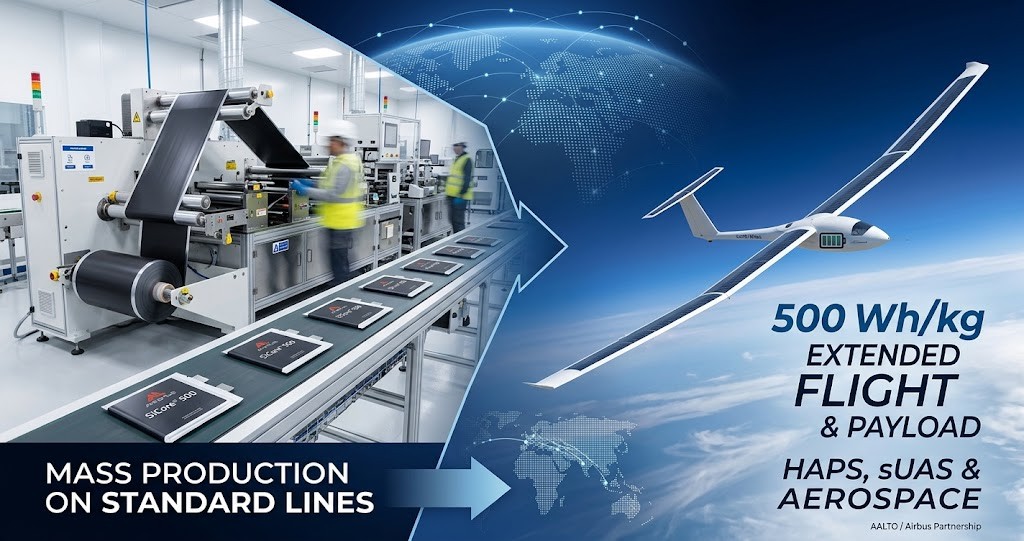
シリコン負極技術の先駆者である米Amprius Technologiesが、標準的なリチウムイオン電池製造ラインで生産可能な500 Wh/kgの高エネルギー密度セル「SiCore® 500」を発表しました。従来は特殊な試作工程に限られていた500 Wh/kg級セルを既存インフラで商業展開するための重要なブレイクスルーであり、主要な発表内容と技術的背景を以下に整理します。
主要発表内容の整理
- セル性能と仕様
- エネルギー密度: 500 Wh/kg(1C連続放電レートにて達成)
- セルフォーマット: SAE JA1016に準拠した小型無人航空機(sUAS)向け標準ポーチセル、および顧客専用カスタムフォーマット
- 製造プロセスの革新(量産化の容易性)
- 従来の500 Wh/kg級セルで不可欠だった特殊材料処理や専用装置を排除し、標準的なロール・トゥ・ロール型リチウムイオン電池製造ラインに完全適合。
- 特殊治具や設備投資が不要なため、顧客の認証取得から量産移行へのハードルを劇的に低減。
- ターゲット市場と用途
- 高高度プラットフォームステーション(HAPS)、固定翼ドローン、小型無人航空機システム(sUAS)、防衛・航空宇宙など「長時間飛行・低放電プロファイル」を要する用途に最適化。
- 比エネルギーの飛躍的向上により、機体重量を維持したまま飛行時間、航続距離、ペイロード(搭載重量)の拡張が可能。
- 主要顧客との実績(AALTO HAPS / Airbus)
- エアバス傘下のAALTO社が展開する太陽光発電式HAPS「Zephyr(ゼファー)」へ2018年よりセルを供給。
- 2025年には成層圏で67日間以上の連続飛行世界記録を達成。
- 商用ロードマップと生産体制
- 商用化時期: 2026年第4四半期に販売開始予定。
- 生産拠点: 初期生産は米国カリフォルニア州フレモント工場で実施し、量産フェーズではグローバルな受託製造(CMO)パートナーの既存ラインを活用して拡張。
関連情報・技術的背景(補足)
- シリコン負極(アノード)技術におけるSiCore®の位置付け
- シリコン負極は理論容量がグラファイト(372 mAh/g)の約10倍と極めて高い一方、充放電に伴う大きな体積膨張(約300%)による構造破壊やサイクル寿命の低下が課題。
- Ampriusは独自の超高エネルギー密度向けシリコンナノワイヤ技術に加え、従来型製造設備での量産性とコスト効率を重視したシリコンコンポジット負極プラットフォーム「SiCore®」を展開。今回の第2世代SiCoreにより、ファブレス/アセットライトな量産戦略が本格化する。
- HAPS(成層圏ドローン)における500 Wh/kgの定量的意義
- HAPSは日中に太陽光発電で充電し、夜間はバッテリー電力のみで成層圏(高度約20,000m)の同一位置に滞留し続ける必要がある。
- 電池セルのエネルギー密度が従来のEV向け(250〜300 Wh/kg)から500 Wh/kgへと向上することで、夜間電力を賄うためのバッテリー自重を劇的に軽量化でき、通信基地局機器や光学センサーなどの観測用ペイロード搭載能力の拡張に直結する。
Mass Production of 500 Wh/kg Cells on Existing Manufacturing Lines: Amprius to Commercialize High Energy Density Cells for HAPS and Drones in Q4 2026
Amprius Technologies, a US-based pioneer in silicon anode technology, has unveiled “SiCore® 500,” a high energy density cell capable of reaching 500 Wh/kg that can be manufactured on standard lithium-ion production lines. This marks a critical breakthrough for commercially deploying 500 Wh/kg-class cells—previously restricted to specialized prototype processes—using existing manufacturing infrastructure. Key announcement details and technical background are summarized below.
Summary of Key Announcements
- Cell Performance & Specifications
- Energy Density: 500 Wh/kg (achieved at a 1C continuous discharge rate)
- Cell Formats: Standard pouch format for small Unmanned Aircraft Systems (sUAS) compliant with SAE JA1016, as well as customer-specific custom formats
- Manufacturing Process Innovation (Ease of Mass Production)
- Eliminates the specialized material processing and dedicated equipment previously required for 500 Wh/kg-class cells, achieving full compatibility with standard roll-to-roll lithium-ion battery production lines.
- Eliminates the need for custom tooling or capital expenditure, drastically lowering the barrier for customers to transition from qualification to mass production.
- Target Markets & Applications
- Optimized for applications requiring long flight durations and low-discharge profiles, such as High-Altitude Platform Stations (HAPS), fixed-wing drones, small Unmanned Aircraft Systems (sUAS), and defense/aerospace sectors.
- The dramatic increase in specific energy enables extended flight times, operating range, and payload capacity without increasing aircraft weight.
- Track Record with Key Customer (AALTO HAPS / Airbus)
- Supplying cells since 2018 for the solar-powered HAPS “Zephyr,” developed by AALTO (an Airbus subsidiary).
- Contributed to achieving a reported world endurance record of over 67 continuous days of stratospheric flight in 2025.
- Commercial Roadmap & Production Setup
- Commercial Launch: Commercial availability planned for Q4 2026.
- Production Sites: Initial production will take place at the company’s Fremont, California facility, with high-volume scaling executed via existing lines of global contract manufacturing organization (CMO) partners.
Related Context & Technical Background
- Positioning of SiCore® in Silicon Anode Technology
- While silicon anodes offer an exceptionally high theoretical capacity roughly 10 times that of graphite (372 mAh/g), structural degradation and reduced cycle life caused by severe volume expansion (~300%) during charging and discharging remain major challenges.
- Alongside its proprietary silicon nanowire technology targeting ultra-high energy density, Amprius offers “SiCore®,” a silicon composite anode platform designed for scalability and cost efficiency on conventional manufacturing lines. The 2nd-generation SiCore accelerates Amprius’s fab-lite/asset-light commercialization strategy.
- Quantitative Significance of 500 Wh/kg in HAPS (Stratospheric Drones)
- HAPS must charge via solar panels during the day and rely entirely on battery power at night to maintain position in the stratosphere (altitude ~20,000 meters).
- Increasing cell energy density from conventional EV levels (250–300 Wh/kg) to 500 Wh/kg dramatically reduces the deadweight of nighttime energy storage batteries, directly expanding payload capacity for telecommunication base stations and optical observation sensors.

コメント