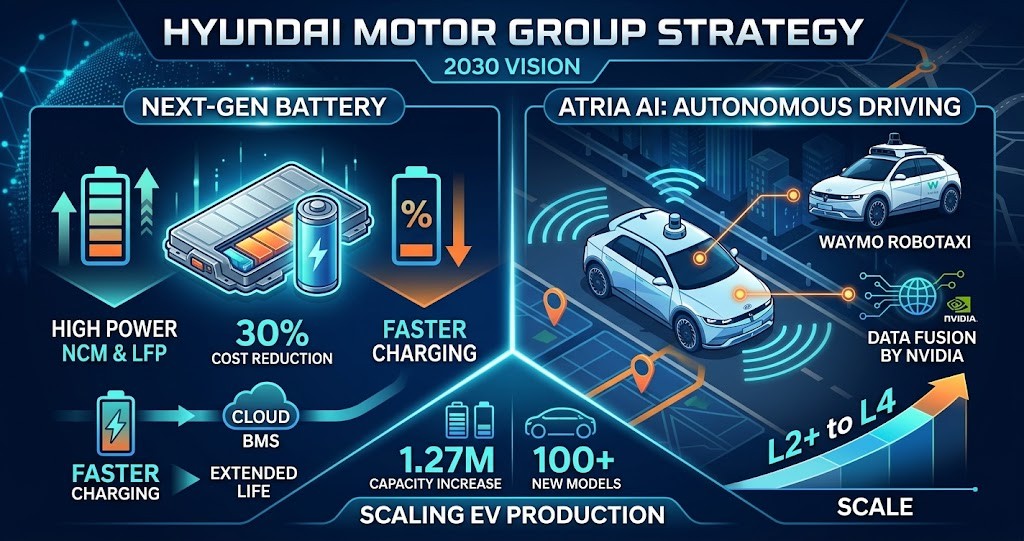
現代自動車グループは、EVのコスト競争力大幅向上に向けた自社開発バッテリー技術と、NVIDIAとの連携を軸とした自動運転AI「Atria AI(アトリアAI)」の展開計画を発表しました。生産能力を127万台増加させつつ、2030年までに100車種以上の新型車を投入する大規模な成長戦略の一環です。
1. 次世代バッテリー技術とEVの進化
- 独自開発の高出力セル: 従来の高ニッケルセルに比べ2倍以上の出力を実現し、充電時間を40%短縮。サンタフェやジェネシスブランドのレンジエクステンダー(EREV)搭載モデルへ初採用予定です。
- ミッドニッケルNCMセルの導入: 来年からEVに採用される新セルにより、バッテリーコストを約30%削減。同サイズのリン酸鉄リチウム(LFP)バッテリーと比較してエネルギー密度を30%向上させつつ、実走行での高い性能を維持します。
- クラウド型BMS(バッテリー管理システム)の刷新: 2028年までに高度化されたクラウドBMSを導入し、バッテリー寿命を平均で20%延長します。
2. 自動運転技術とロボタクシーの展開
- ロボタクシーの商業化: Waymo(ウェイモ)向けの「Ioniq 5」ロボタクシーを第4四半期に納車し、2027年のグローバル展開を目指します。また、傘下のMotional(モーショナル)も今年後半にラスベガスでIoniq 5ロボタクシーの商用サービスを開始し、2027年に他都市へ広げます。
- NVIDIA基盤のデータ統合: 現代、起亜、42dot、Motionalで取得するデータをNVIDIAのエコシステム上で共通の統一標準に統合し、グループ全体で相互活用します。
- Atria AIとレベル2+システムの投入: 自主開発の自動運転AI「Atria AI」を年内に展開。これを基盤として2028年にレベル2+の半自動運転システムを市販車へ導入し、将来的にはレベル4まで段階的に拡張します。年間数百万台の量産車から得られる膨大なデータを活用してAIを急速に進化させます。
【関連情報】現代自動車の戦略的背景と業界内での位置づけ
「ミッドニッケル(Mid-Ni)」正極の採用とコスト破壊
車載電池市場では、高価なコバルトやニッケルの使用量を抑えたLFP(リン酸鉄リチウム)電池がテスラや中国勢を中心に急速に普及しています。
- 戦略的意図: 現代自動車が採用する「ミッドニッケルNCM」は、高価格なハイニッケルとエネルギー密度の低いLFPの「いいとこ取り」を狙った材料構成です。
- 競争力: LFP並みの低価格化(30%コスト削減)を実現しながら、LFPより30%高いエネルギー密度を維持することで、航続距離と車両価格のバランスが最も取れた中間層EVの大量普及を狙っています。
自動運転におけるデータ主導型アプローチへの転換
自動運転分野において、現代自動車グループはソフトウェア中心の車両(SDV)転換を強烈に推し進めています。
- 42dotの役割: 2022年に買収した自律走行スタートアップ「42dot」をグループのSDV開発の中核に据え、自社製AI(Atria AI)の開発を加速させています。
- NVIDIAとのアライアンス: 統一されたセンサーアーキテクチャとデータプラットフォームを構築することで、Waymoとのロボタクシー事業で得た過酷な走行データや、何百万台もの市販車から吸い上げたデータをシームレスにAI学習にフィードバックできる強固なエコシステムを形成しています。
Towards 30% Battery Cost Reduction and 20% Life Extension: Hyundai Motor’s Proprietary Battery Technology and the Impact of Mid-Nickel Chemistries
Hyundai Motor Group announced deployment plans for its in-house developed battery technology aimed at significantly improving EV cost competitiveness, alongside its autonomous driving AI “Atria AI,” centered on collaboration with NVIDIA. This forms part of a large-scale growth strategy to launch over 100 new models by 2030 while increasing global production capacity by 1.27 million units.
- Next-Generation Battery Technology and EV Advancement
- In-House Developed High-Output Cells: Achieves more than twice the output of conventional high-nickel cells and reduces charging time by 40%. It is scheduled for first deployment in upcoming extended-range electric vehicle (EREV) models under the Santa Fe and Genesis brands.
- Introduction of Mid-Nickel NCM Cells: New cells to be adopted in EVs starting next year will reduce battery costs by approximately 30%. They improve energy density by 30% compared to same-sized lithium iron phosphate (LFP) batteries while maintaining high real-world driving performance.
- Overhaul of Cloud-Based BMS (Battery Management System): An upgraded cloud BMS will be introduced by 2028, extending average battery life by 20%.
- Autonomous Driving Technology and Robotaxi Deployment
- Commercialization of Robotaxis: “Ioniq 5” robotaxis for Waymo will be delivered in the fourth quarter, aiming for global rollout in 2027. Subsidiaries like Motional also plan to launch commercial Ioniq 5 robotaxi services in Las Vegas later this year, expanding to other cities in 2027.
- NVIDIA-Based Data Integration: Data collected across Hyundai, Kia, 42dot, and Motional will be unified under a single standardized framework on NVIDIA’s ecosystem for mutual cross-group utilization.
- Deployment of Atria AI and Level 2+ Systems: In-house developed autonomous driving AI “Atria AI” will be deployed within the year. Serving as a foundation, a Level 2+ semi-autonomous driving system will be introduced to mass-production vehicles in 2028, gradually expanding up to Level 4 in the future. The AI will rapidly evolve by utilizing vast data harvested from millions of mass-produced vehicles annually.
Related Information: Strategic Background and Industry Positioning of Hyundai Motor Group
Adoption of “Mid-Nickel” Cathodes and Cost Destruction
In the automotive battery market, LFP (lithium iron phosphate) batteries—which reduce usage of expensive cobalt and nickel—are spreading rapidly, driven mainly by Tesla and Chinese automakers.
- Strategic Intent: The “mid-nickel NCM” adopted by Hyundai Motor is a material chemistry engineered to combine the advantages of high-cost high-nickel and low-energy-density LFP formulations.
- Competitiveness: By achieving low costs comparable to LFP (30% cost reduction) while maintaining a 30% higher energy density than LFP, Hyundai targets mass adoption of mid-tier EVs that offer the optimal balance between driving range and vehicle price.
Shift Toward a Data-Driven Approach in Autonomous Driving
In the field of autonomous driving, Hyundai Motor Group is aggressively pursuing a transformation toward software-defined vehicles (SDVs).
- Role of 42dot: Autonomous driving startup “42dot,” acquired in 2022, serves as the core of the group’s SDV development, accelerating the development of in-house AI (Atria AI).
- Alliance with NVIDIA: By building a unified sensor architecture and data platform, Hyundai is forming a robust ecosystem capable of seamlessly feeding real-world driving data—harvested from demanding Waymo robotaxi operations and millions of mass-production vehicles—back into AI model training.

コメント