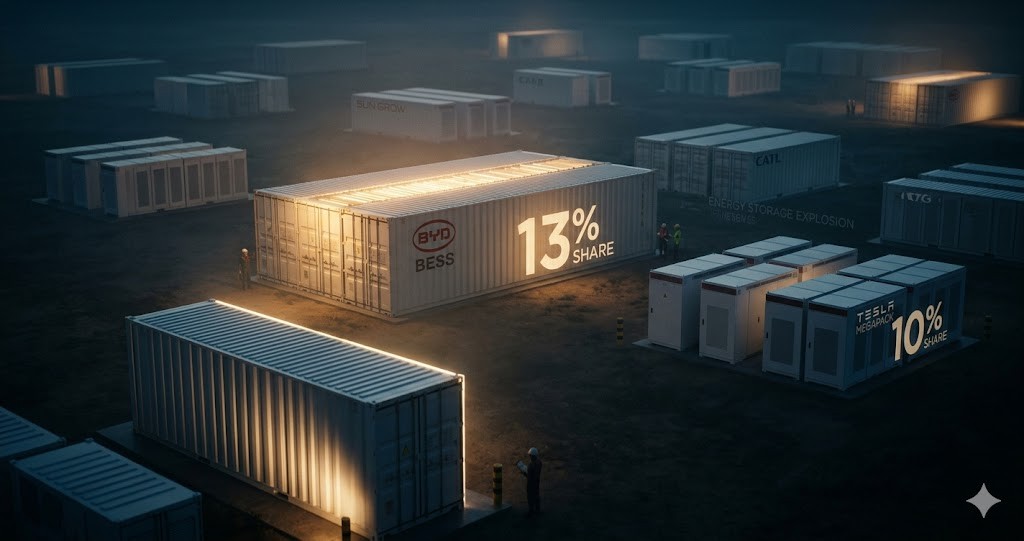
再生可能エネルギーの普及に伴い、電力を効率的に貯蔵するシステム(BESS)の需要が世界中で爆発的に高まっています。電気自動車(EV)市場で熾烈なシェア争いを繰り広げる中国のBYDと米国のテスラですが、その戦いの舞台は今や「エネルギー貯蔵分野」へと大きくシフトしています。2025年の最新データから、この巨大市場における主導権の交代と中国勢の圧倒的な躍進の全貌をまとめました。
世界のエネルギー貯蔵システム(BESS)市場の最新動向
英国の調査会社Benchmark Mineral Intelligenceが発表した2025年のデータにより、世界の定置型蓄電市場で大きな勢力図の変化が明らかになりました。
- 首位交代:BYDがテスラを追い抜き、世界最大のBESSインテグレーター(システム構築企業)となりました。テスラは2023年と2024年に保持していたトップの座を失いました。
- 市場シェア(2025年見込み):BYDが世界市場の13%を獲得したのに対し、テスラは10%にとどまりました。
- 出荷・導入量の比較:BYDが60GWh以上を出荷して首位に立ちました。テスラは前年比49%増となる46.7GWhを導入したものの、BYDの急拡大のペースには及びませんでした。
中国企業の圧倒的な支配力とトップ10企業
現在の定置型蓄電市場は中国メーカーが完全に支配しています。BESSインテグレーターの上位10社のうち、実に8社を中国企業が占めています。
- 3位:サングロウ(Sungrow) 9%
- 同率4位(各6%):CRRC株洲、CATL、ハイパーストロング(Hyper Strong)
- その他のトップ10:ファーウェイ(5%)、エンビジョン(Envision)(5%)、フルエンス(Fluence)(4%)、サンウォダ(Sunwoda)(4%)
- 欧米企業の動向:トップ10に入った欧米企業は、2位のテスラと、シーメンスとAESの合弁会社である8位のフルエンス(Fluence)の2社のみです。
わずか1年でほぼ倍増した巨大市場
世界のBESS設置量は2025年に前年比51%増の約315GWhに達し、定置型蓄電用のセル出荷量はほぼ倍増して600GWhを超えました。
この驚異的な成長を牽引しているのが中国国内市場です。2025年12月の1ヶ月間だけで、中国は65GWhの大規模蓄電池を設置しました。これは、米国全体が1年間で設置した総容量を上回る規模です。
BYDの強み:新システム「HaoHan」と垂直統合モデル
BYDがトップに躍進した背景には、積極的な製品投入とコスト優位性があります。
- 超大型システム「HaoHan(浩瀚)」の投入:2025年9月に発表されたこのシステムは、標準構成で14.5MWhの容量を持ち、テスラの「メガパック」の約3倍に相当します。20フィートコンテナ型でも10MWhの容量を提供し、エネルギー密度を従来より51%向上させました。すでにサウジアラビアでの12.5GWh規模の世界最大級プロジェクトなどに採用されています。
- 垂直統合によるコスト優位性:BYDは、自社開発の「ブレードバッテリー(LFP:リン酸鉄リチウムイオン電池)」を自社で製造し、システムまで一貫して組み立てる垂直統合型モデルを採用しています。これにより、他社が容易に模倣できない強固なコスト構造を築いています。
テスラの現状と構造的な弱点
テスラもエネルギー貯蔵事業を急速に成長させており、製品としての評価も高いものの、構造的な課題に直面しています。
- 競合からのセル調達:テスラは「メガパック」に使用する電池セルを、自社の直接的な競合相手であるCATLやBYDから調達しています。BESS市場で戦いながら、最大のライバルから心臓部を買い続けなければならない点が弱みとなっています。
- テスラの対抗策:テスラは1ユニットあたり約5MWhの容量を持つ「メガパック3」や「メガブロック」を発表。ヒューストンのメガファクトリーを拡張し、2026年末までに年間生産能力50GWhを目指しています。また、2027年8月からの供給に向けてLGエナジーソリューションズと43億ドルのLFPバッテリー契約を締結し、調達先の多様化とコスト削減を急いでいます。
業界のトレンド:垂直統合か、純粋インテグレーターか
Benchmarkのデータは、業界全体の興味深いトレンドも示しています。
- 純粋インテグレーターの躍進:電池セルを外部から調達してシステムを構築する企業(サングロウやCRRCなど)は、バッテリー価格の下落を背景に、シェアを2023年の20%から2025年前半には30%へと拡大させました。
- BYDの例外的な強さ:セル製造業界が拡大する中で垂直統合型メーカーは全体としてシェアを落としていますが、BYDだけはその例外です。EV事業とBESS事業の双方に大量のセルを自社供給(2025年1〜9月期だけで113GWhを生産)する圧倒的な製造規模により、トップの座へと上り詰めました。
出典:https://batteryindustry.net/byd-surpasses-tesla-as-worlds-top-energy-storage-deployer/
BYD Overtakes Tesla! Emerging as the World’s Largest Energy Storage (BESS) Company
With the widespread adoption of renewable energy, the global demand for Battery Energy Storage Systems (BESS) to efficiently store electricity is exploding. While China’s BYD and the US’s Tesla are locked in a fierce battle for market share in the electric vehicle (EV) sector, the battleground has now significantly shifted to the energy storage arena. Based on the latest 2025 data, here is a comprehensive overview of the changing leadership in this massive market and the overwhelming dominance of Chinese companies.
Latest Trends in the Global Battery Energy Storage System (BESS) Market
Data for 2025 released by the UK research firm Benchmark Mineral Intelligence reveals a major shift in the global landscape of the stationary energy storage market.
- Change at the Top: BYD has overtaken Tesla to become the world’s largest BESS integrator (system builder). Tesla has lost the top position it held in 2023 and 2024.
- Market Share (2025 Forecast): BYD is expected to capture 13% of the global market, whereas Tesla remained at 10%.
- Comparison of Shipments and Installations: BYD took the lead by shipping over 60 GWh. Tesla deployed 46.7 GWh, representing a 49% year-on-year increase, but it could not keep up with BYD’s aggressive pace of expansion.
Overwhelming Dominance of Chinese Companies and Top 10 Players
The current stationary energy storage market is completely dominated by Chinese manufacturers. Out of the top 10 BESS integrators, an astonishing eight are Chinese companies.
- 3rd Place: Sungrow (9%)
- Tied for 4th Place: CRRC Zhuzhou, CATL, and Hyper Strong (6% each)
- Other Top 10 Companies: Huawei (5%), Envision (5%), Fluence (4%), and Sunwoda (4%)
- Trends among Western Companies: The only Western companies to make the top 10 list are Tesla in second place and Fluence in eighth place, which is a joint venture between Siemens and AES.
A Massive Market That Nearly Doubled in Just One Year
Global BESS installations increased by 51% year-on-year to approximately 315 GWh in 2025, and cell shipments for stationary storage nearly doubled, exceeding 600 GWh.
This phenomenal growth is driven primarily by the Chinese domestic market. In the single month of December 2025, China installed 65 GWh of large-scale energy storage. This volume exceeds the total capacity installed by the entire United States over a full year.
BYD’s Strengths: The New “HaoHan” System and Vertical Integration Model
BYD’s surge to the top is underpinned by aggressive product rollouts and structural cost advantages.
- Introduction of the Ultra-Large “HaoHan” System: Announced in September 2025, this system boasts a capacity of 14.5 MWh in its standard configuration, which is roughly three times that of Tesla’s Megapack. It also offers a 10 MWh capacity in a 20-foot container variant, improving energy density by 51% compared to previous models. It has already been adopted for major projects, including a massive 12.5 GWh deployment in collaboration with the Saudi Electricity Company, making it one of the largest grid-scale battery projects in the world.
- Cost Advantage through Vertical Integration: BYD operates a vertically integrated model where it manufactures its proprietary Blade Battery (LFP: Lithium Iron Phosphate) in-house and assembles the final systems. This provides BYD with a robust cost structure that competitors cannot easily replicate.
Tesla’s Current Situation and Structural Weaknesses
While Tesla’s energy storage business is growing rapidly and its products are highly regarded, the company faces structural challenges.
- Procuring Cells from Competitors: Tesla sources the battery cells used in its Megapack from its direct competitors, CATL and BYD. Competing in the BESS market while having to purchase core components from its biggest rivals remains a major vulnerability.
- Tesla’s Countermeasures: Tesla has introduced Megapack 3 and Megablock, which achieve a capacity of approximately 5 MWh per unit. The company is expanding its Megafactory in Houston, aiming for an annual production capacity of 50 GWh by the end of 2026. Furthermore, Tesla recently signed a 4.3 billion dollar LFP battery contract with LG Energy Solution to supply cells starting in August 2027, moving quickly to diversify its supply chain and reduce costs.
Industry Trends: Vertical Integration vs. Pure-Play Integrators
The Benchmark data also highlights an interesting trend across the wider industry.
- The Rise of Pure-Play Integrators: Companies that source battery cells externally to build systems (such as Sungrow and CRRC) expanded their market share from 20% in 2023 to 30% in the first half of 2025, driven by falling battery cell prices.
- BYD’s Exceptional Strength: While vertically integrated manufacturers as a whole have lost market share amid the expansion of the broader cell manufacturing industry, BYD stands as the sole exception. By leveraging its massive manufacturing scale—producing 113 GWh in the first three quarters of 2025 alone to supply both its EV and growing BESS businesses—BYD successfully climbed to the top spot.
コメント