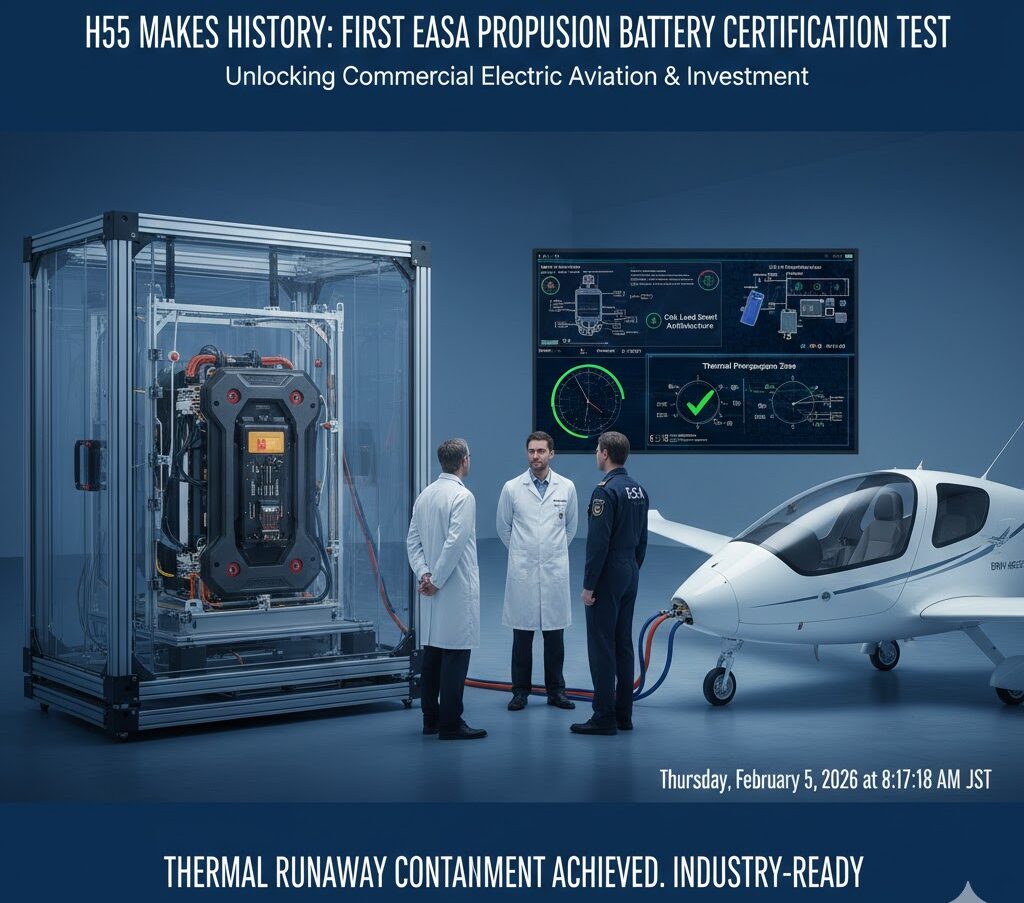
電動航空機(電気飛行機)の商業化において、最大の障壁となっていたのは「リチウムイオンバッテリーの火災をいかに安全に封じ込めるか」という規制当局(EASA/FAA)への証明でした。
スイスのH55は本日、欧州航空安全局(EASA)の立ち会いのもと、業界初となる推進バッテリーモジュールの認証試験シーケンスを完了したと発表しました。これにより、電動航空機は「実験段階」から、投資や保険の対象となる「産業段階」へと構造的な転換を迎えることになります。
■ 1. 今回の成果が「歴史的」である理由
これまで多くの電動航空機スタートアップが、プロトタイプの飛行には成功しながらも、商業化(型式認証)の段階で足踏みしてきました。その原因は、バッテリーの**「熱暴走(Thermal Runaway)」**のリスクを完全に排除・封じ込めるエビデンスが不足していたためです。
| 項目 | 従来の課題 | H55による突破口 |
| 安全性証明 | 単一セルの故障が火災として伝播するリスク。 | **「伝播ゼロ」**を当局立ち会いのもと、量産仕様で証明。 |
| 製造品質 | 研究室レベルの試作品でのテスト。 | 当局承認(POA/DOA)済みの生産ラインによる量産品で合格。 |
| 規制の壁 | 基準が曖昧でリスク評価が困難。 | EASAが合意した標準的な認証フレームワークを確立。 |
■ 2. 技術的コア:セルレベルの「スマート・アーキテクチャ」
H55の強みは、単に頑丈な箱を作るのではなく、「セルレベル」での監視と保護にあります。
- 個別監視と冗長性: すべてのバッテリーセルを個別に監視。異常の兆候を早期に検知し、システム全体に波及する前に隔離します。
- 熱暴走の封じ込め: 万が一、一つのセルが発火(最悪の故障)しても、隣接するセルに引火させない特許技術の設計を実証しました。
- スケーラビリティ: このモジュールは「航空機用エンジン」のように、小型機から中型機まで、様々なプラットフォームに横展開が可能です。
■ 3. 【関連情報】背景にある「ソーラー・インパルス」の遺伝子
H55を理解する上で欠かせないのが、その出自です。
- ソーラー・インパルスの遺産: 会長のアンドレ・ボルシュベルグ氏は、太陽光発電のみで世界一周飛行を成し遂げた「ソーラー・インパルス」の共同創設者です。
- 圧倒的な実績: 20年以上の経験、6機の設計実績、そして2,000時間以上の無事故飛行という、新興企業としては異例の信頼性を有しています。
- 主要パートナーシップ: 今回の認証データは、すでに以下の大手プロジェクトの基盤となっています。
- プラット・アンド・ホイットニー・カナダ: ハイブリッド電気飛行機「Dash 8」実証機。
- CAE: 全電気式パイロットトレーニングプラットフォーム。
- BRM Aero: B23 Energic(電動練習機)。
■ 4. 今後の展望:金融・保険・規制の「標準」へ
今回の試験完了により、H55のバッテリーシステムは「リスクが不透明なブラックボックス」から、**「保険数理的に評価可能な資産」**へと変わりました。
- FAA(米国連邦航空局)への波及: EASAでの結果はFAAにも共有され、米国市場での認証も加速します。
- 投資と保険の円滑化: 安全性が当局に担保されたことで、航空機メーカーへの融資や運航会社への保険適用が容易になり、資金調達のハードルが下がります。
- 2026年第1四半期の最終承認: 現在、最終レポートを作成中。数カ月以内には正式な承認が下りる見込みです。
💡 専門用語のワンポイント解説
- EASA (European Union Aviation Safety Agency): 欧州航空安全局。世界で最も厳しい航空安全基準を持つ機関の一つ。
- DOA/POA: 設計組織承認(Design Organization Approval)と製造組織承認(Production Organization Approval)。「航空機を設計・製造して良い」と当局が認めた証。
- 熱暴走 (Thermal Runaway): バッテリーが異常高温になり、制御不能な火災を引き起こす現象。電動航空機における最大の天敵。
From Vision to Venture: H55 Proves “Non-Propagating” Battery Safety, Shattering Electric Aviation Barriers
February 5, 2026
The greatest obstacle to the commercialization of electric aircraft has long been proving to regulators (EASA/FAA) that lithium-ion battery fires can be safely contained.
Swiss-based H55 announced today the completion of the industry’s first propulsion battery module certification test sequence, conducted in the presence of the European Union Aviation Safety Agency (EASA). This milestone marks a structural shift for electric aviation, moving it from an “experimental phase” to an “industrial phase” ready for serious investment and insurance underwriting.
1. Why This Achievement is “Historic”
While many electric aviation startups have successfully flown prototypes, most have stalled at the commercialization (Type Certification) stage. The primary culprit has been a lack of evidence regarding the containment of “Thermal Runaway” risks.
| Category | Conventional Challenges | H55 Breakthrough |
| Safety Validation | Risk of fire propagating from a single cell failure. | Proven “Zero Propagation” in production-spec hardware with regulators present. |
| Manufacturing Quality | Testing relied on lab-level prototypes. | Passed using production-fit hardware from POA/DOA approved lines. |
| Regulatory Barriers | Ambiguous standards made risk assessment difficult. | Established a standardized certification framework agreed upon by EASA. |
2. Technical Core: “Smart Architecture” at the Cell Level
H55’s strength lies not just in building a rugged enclosure, but in its sophisticated monitoring and protection at the individual cell level.
- Individual Monitoring & Redundancy: Every battery cell is monitored independently. Signs of anomaly are detected early and isolated before they can impact the entire system.
- Thermal Runaway Containment: H55 demonstrated a patented design that prevents a fire in one cell (the worst-case failure) from igniting adjacent cells.
- Scalability: Much like a traditional aircraft engine, these modules can be deployed across various platforms, from small trainers to mid-sized regional aircraft.
3. The “Solar Impulse” Heritage
To understand H55 is to understand its roots in pioneering aviation.
- Solar Impulse Legacy: Executive Chairman and Co-founder André Borschberg was the co-founder and pilot of Solar Impulse, the first aircraft to fly around the world powered only by the sun.
- Proven Track Record: With over 20 years of experience, 6 aircraft designs, and 2,000+ hours of accident-free electric flight, H55 possesses a level of operational depth rare for a tech firm.
- Key Partnerships: This certification data already serves as the foundation for major industry programs:
- Pratt & Whitney Canada: Hybrid-electric Dash 8 demonstrator.
- CAE: All-electric pilot training platform.
- BRM Aero: B23 Energic (electric trainer).
4. Future Outlook: Setting the Standard for Finance & Insurance
With these tests completed, H55’s battery system has evolved from a “risky black box” into an “actuarially transparent asset.”
- Global Impact (FAA): Results from the EASA campaign are being shared with the FAA, accelerating certification and market entry in the United States.
- Streamlined Investment: With safety verified by regulators, aircraft OEMs can more easily secure financing, and operators can obtain insurance, lowering the barrier for capital entry.
- Final Approval in Q1 2026: Final documentation is currently being finalized, with formal approval expected within the coming months.
💡 Technical Glossary
- EASA: European Union Aviation Safety Agency. One of the world’s most stringent aviation safety regulators.
- DOA/POA (Design/Production Organization Approval): Official certification that an organization is authorized by regulators to design and manufacture aerospace products.
- Thermal Runaway: A phenomenon where a battery cell enters an uncontrollable, self-heating state, often resulting in fire or explosion. It is the “arch-nemesis” of electric aviation.


コメント