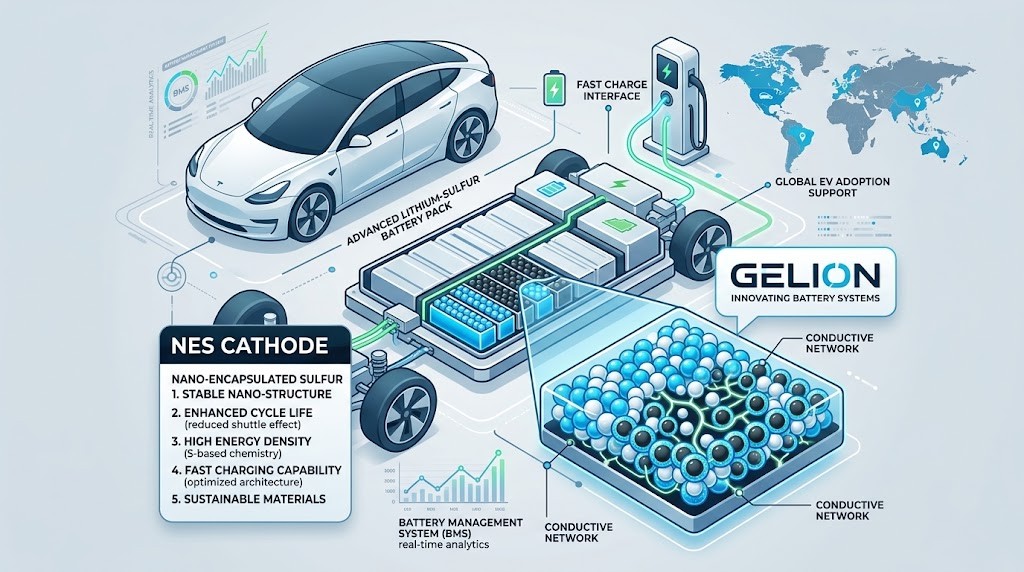
英豪系の電池テクノロジー企業であるGelion(ジェリオン)が、世界トップ5に入る大手自動車メーカー(OEM)と「ナノカプセル化硫黄(NES)」正極技術に関する概念実証(PoC)契約を締結しました。リチウム硫黄電池の長年の課題であった劣化要因の抑制と、既存リチウムイオン電池製造ラインへのドロップイン展開を両立する新技術として、EV市場における量産化への大きな一歩として期待されています。
【ニュースの概要と主要ポイント】
- 提携の発表: 英豪系Gelion社が、非公表の「世界トップ5に入る自動車OEM」と共同でNES(Nano-Encapsulated Sulfur)カソードの概念実証(PoC)を開始。
- ターゲット分野: 電気自動車(EV)用途を想定した実環境条件での性能評価および製造適合性の検証。
- OEM連携の意義: 大手自動車メーカーの先端エンジニアリング能力と大規模試験設備を活用することで、車載規格レベルでの実用化評価を加速。
【技術的特長と解決策】
- リチウム硫黄(Li-S)電池のメリット:
- 正極活物質にニッケルやコバルトなどの高価格・高リスクな金属を使用せず、地殻に豊富で低コストな硫黄を使用。
- 非常に高い理論比容量を持ち、既存リチウムイオン電池(LIB)を凌駕する重量エネルギー密度の実現が可能。
- 課題「ポリサルファイド・シャトル現象」の克服:
- 充放電時に中間生成物として生じる可溶性の多硫化リチウム(ポリサルファイド)が電解液に溶出し、負極側へ移動して副反応を起こすことで容量劣化と効率低下を引き起こす。
- Gelionの「NES(ナノカプセル化硫黄)」は、多孔質構造内に硫黄を閉じ込めるナノコンファインメント技術により、ポリサルファイドの電解液への流出を抑制。
- 優れた製造適合性(ドロップイン型):
- 既存のLIB製造設備やプロセスにそのまま適用できる「ドロップイン」仕様で開発されており、OEMや電池メーカーは莫大な新規設備投資を抑えて量産移行が可能。
【関連情報の補足】
- 車載用リチウム硫黄電池におけるナノコンファインメント技術の意義:
- 硫黄正極は、絶縁体である硫黄の導電性確保と、充放電に伴う大きな体積膨張、そしてポリサルファイド溶出の3点が技術的ボトルネックでした。炭素材料などのナノ構造内に硫黄を多孔閉じ込めする技術は、これらの課題を同時に緩和するアプローチとして世界の学術界・産業界で最も有力視されている手法の一つです。
- サプライチェーンとコバルトフリー・ニッケルフリーの潮流:
- 現在、コバルトやニッケルの採掘・精錬をめぐる環境・人権問題および地政学的リスクから、コバルトフリー化学への移行が加速しています。さらに硫黄は石油精製や工業副産物として各国で容易に入手できるため、国策レベルでのバッテリーサプライチェーン自給自足とも親和性が非常に高くなっています。
出典:https://news.yahoo.co.jp/articles/24d3b28f921c859ff69d7623ca1eae85620c9502
Advancing Toward Commercial Lithium-Sulfur Batteries: Gelion Begins Joint Validation of NES Cathodes with Major Automaker
Anglo-Australian battery technology company Gelion has signed a Proof of Concept (PoC) agreement for its Nano-Encapsulated Sulfur (NES) cathode technology with an undisclosed top-5 global automotive original equipment manufacturer (OEM). Combining the mitigation of long-standing degradation factors in lithium-sulfur batteries with drop-in compatibility for existing lithium-ion production lines, this new technology represents a major step forward toward mass production in the EV market.
News Overview and Key Highlights
- Partnership Announcement: Gelion has initiated a PoC for its NES (Nano-Encapsulated Sulfur) cathode jointly with an undisclosed top-5 global automotive OEM.
- Target Field: Performance evaluation under real-world operating conditions and manufacturing compatibility verification intended for electric vehicle (EV) applications.
- Significance of OEM Collaboration: Leveraging the advanced engineering capabilities and large-scale testing facilities of a major automaker to accelerate commercialization testing at automotive-grade standards.
Technical Features and Solutions
- Advantages of Lithium-Sulfur (Li-S) Batteries:
- Utilizes abundant, low-cost sulfur in place of high-cost, high-risk metals like nickel and cobalt in cathode active materials.
- Possesses extremely high theoretical specific capacity, capable of achieving gravimetric energy densities superior to conventional lithium-ion batteries (LIBs).
- Overcoming the Polysulfide Shuttle Phenomenon:
- Soluble lithium polysulfides generated as intermediate products during charge/discharge dissolve into the electrolyte and migrate to the anode, causing side reactions, capacity loss, and efficiency degradation.
- Gelion’s NES (Nano-Encapsulated Sulfur) employs a nano-confinement architecture that sequesters sulfur within porous structures, suppressing the dissolution of polysulfides into the electrolyte.
- Superior Manufacturing Compatibility (Drop-in Model):
- Developed as a drop-in cathode active material compatible with existing LIB manufacturing equipment and processes, enabling OEMs and battery manufacturers to transition to mass production without massive new capital expenditures.
Supplementary Context
- Significance of Nano-Confinement Technology in Automotive Li-S Batteries:
- Sulfur cathodes have faced three major technical bottlenecks: ensuring electrical conductivity for insulating sulfur, accommodating significant volume expansion during charge/discharge, and mitigating polysulfide dissolution. Sequestering sulfur inside nano-porous carbonaceous architectures is widely recognized across academia and industry as one of the most effective approaches to simultaneously address these challenges.
- Supply Chains and the Trend Toward Cobalt-Free and Nickel-Free Chemistry:
- Driven by environmental, human rights, and geopolitical concerns surrounding cobalt and nickel mining/refining, the shift toward cobalt-free battery chemistries is accelerating. Furthermore, sulfur is readily accessible in most regions as an industrial byproduct of petroleum refining, making it highly compatible with national initiatives for supply chain self-sufficiency.


コメント