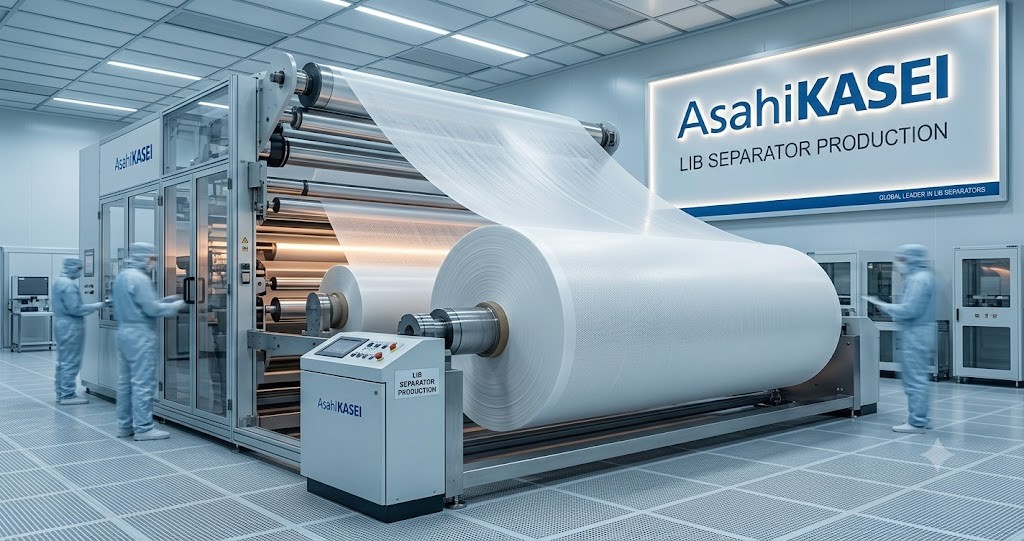
リチウムイオン電池(LiB)の主要4部材(正極材、負極材、電解液、セパレーター)の一つであるセパレーターにおいて、旭化成は独自の製法で世界市場をリードしています。現在、EV(電気自動車)市場の成長減速(踊り場)が見られるものの、生成AI普及に伴うデータセンター向けESS(電力貯蔵システム)需要の急増を背景に、同社は能力拡張を精力的に進めています。本レポートでは、旭化成バッテリーセパレータの最新動向と、同社の強みである製造技術について解説します。
1. 拠点動向と塗工能力の拡張
- 日向工場(宮崎県日向市)の増強 2025年12月に第4工場が完成。従来は守山工場(滋賀県)および韓国工場(京畿道平沢市)のみで展開していた「塗工(コーティング)工程」を日向工場にも導入し、供給体制を拡充しました。
- 稼働スケジュール 現在はサンプル出荷の準備段階であり、顧客による認定取得を経て2027年度中の本格稼働を目指しています。
- 市場背景 EV需要の減速に対し、AIデータセンターの電力供給を支えるESS(電力貯蔵システム)用途の需要が急拡大しており、生産能力増強の強力な推進力となっています。
2. 「ハイポア」の製造プロセスと優位性
旭化成の湿式ポリエチレン微多孔膜「ハイポア」は、基材膜単体および基材に耐熱性などを付与した塗工膜の2形態で展開されています。
- 同時二軸延伸プロセスの特徴
- 製法: ポリエチレンと流動パラフィンを高温高圧で均一混合・押出し後、縦横方向に「同時」に引き延ばします。
- 差別化: 韓国や中国の競合他社が主流とする「逐次二軸延伸(縦方向に延ばした後に横方向に延ばす)」と比べ技術的難易度が高いものの、小孔径で極めて均一な基材膜を成形可能です。
- 電池性能への貢献: リチウムイオンが均一に透過することで、電池反応のばらつきが抑えられ、LiBの長寿命化に寄与します。
- 開孔と環境配慮
- 延伸後に流動パラフィンを有機溶剤(塩化メチレン)で抽出・洗浄することで微細な孔を形成します。
- 法的規制を受ける塩化メチレンについて、同社は99.99%以上のリサイクル率を達成しており、高い環境サステナビリティを実現しています。
【関連情報・補足】セパレーターの市場と技術背景
- 乾式と湿式の違い セパレーターの製法には「乾式」と「湿式」があります。乾式はコスト面や熱安定性に優れ主にLFP(リン酸鉄リチウム)電池などに用いられる一方、旭化成が得意とする「湿式」は薄膜化・高強度化が容易で、ハイエンドEVや高エネルギー密度が求められる用途に適しています。
- 塗工技術(耐熱層・粘着層)の重要性 近年、LiBの安全性向上と高容量化に伴い、基材の上にセラミックやアラミド樹脂などを塗工する技術が不可欠となっています。日向工場への塗工ライン導入は、高付加価値製品の需要増加に直接対応する戦略的施策です。
- 北米・グローバル投資の展開 旭化成は国内や韓国での設備投資にとどまらず、カナダなどの北米地域においてもセパレーター新工場の建設計画を進めています。米国のIRA(インフレ削減法)等に伴う北米サプライチェーン構築の波に乗り、グローバルでの供給能力強化を図っています。
出典:https://newswitch.jp/p/49936
Asahi Kasei Stays on the Offense Amid EV Plateau: Capacity Expansion Strategy for “Hipore” Targeting Growing ESS Demand
Asahi Kasei leads the global market through its proprietary manufacturing processes in battery separators, one of the four main components of lithium-ion batteries (LiBs), along with cathodes, anodes, and electrolytes. While the electric vehicle (EV) market is currently experiencing a growth slowdown (plateau), the company is aggressively expanding its production capacity, driven by surging demand for energy storage systems (ESS) for data centers fueled by the rise of generative AI. This report outlines the latest developments at Asahi Kasei Battery Separator and highlights the manufacturing technologies that form the core of the company’s competitive advantage.
- Facility Trends and Expansion of Coating Capacity
- Expansion of the Hyuga Plant (Hyuga City, Miyazaki Prefecture): The No. 4 plant was completed in December 2025. By introducing a coating process—previously operated only at the Moriyama Plant (Shiga Prefecture) and the South Korea Plant (Pyeongtaek, Gyeonggi Province)—to the Hyuga Plant, the company has expanded its supply system.
- Operation Schedule: The facility is currently preparing for sample shipments, aiming for full-scale commercial operation within fiscal year 2027 following customer qualifications.
- Market Background: In contrast to the EV slowdown, demand for ESS applications powering AI data centers is surging, serving as a powerful catalyst for production capacity expansion.
- Manufacturing Process and Advantages of “Hipore” Asahi Kasei’s wet-process microporous polyethylene membrane, “Hipore,” is offered in two product types based on customer needs: base film alone, and coated film featuring added functions such as heat resistance on the base film.
- Features of the Simultaneous Biaxial Stretching Process
- Process: Polyethylene and liquid paraffin are uniformly mixed under high temperature and high pressure, extruded, and then stretched vertically and horizontally at the same time.
- Differentiator: Although technically more challenging than the “sequential biaxial stretching” (stretching vertically first, then horizontally) favored by competitors in South Korea and China, this process forms an extremely uniform base film with small pore sizes.
- Contribution to Battery Performance: Uniform permeation of lithium ions reduces variations in battery reactions, contributing to longer LiB lifespans.
- Pore Formation and Environmental Sustainability
- After stretching, micro-pores are formed by extracting and washing out liquid paraffin using an organic solvent (methylene chloride).
- Regarding methylene chloride, which is subject to strict legal regulations, Asahi Kasei achieves a recycling rate of over 99.99%, demonstrating high environmental sustainability.
[Related Information & Technical Background] Separator Market and Technology
- Difference Between Dry and Wet Processes: Separator manufacturing processes fall into “dry” and “wet” types. While the dry process offers cost advantages and thermal stability, making it common in LFP (lithium iron phosphate) batteries, the “wet” process excelled in by Asahi Kasei allows for easier thinning and higher strength, making it ideal for high-end EVs and applications requiring high energy density.
- Importance of Coating Technologies (Heat-Resistant and Adhesive Layers): In recent years, coating base films with materials such as ceramics or aramid resins has become essential to improve LiB safety and increase capacity. Introducing coating lines at the Hyuga Plant is a strategic move to directly meet growing demand for high-value-added products.
- Global Investment and Expansion in North America: Beyond domestic and South Korean capital investments, Asahi Kasei is advancing plans to build a new separator plant in North America (Canada). By riding the wave of North American supply chain localization driven by regulations such as the US Inflation Reduction Act (IRA), the company aims to strengthen its global supply capabilities.
コメント