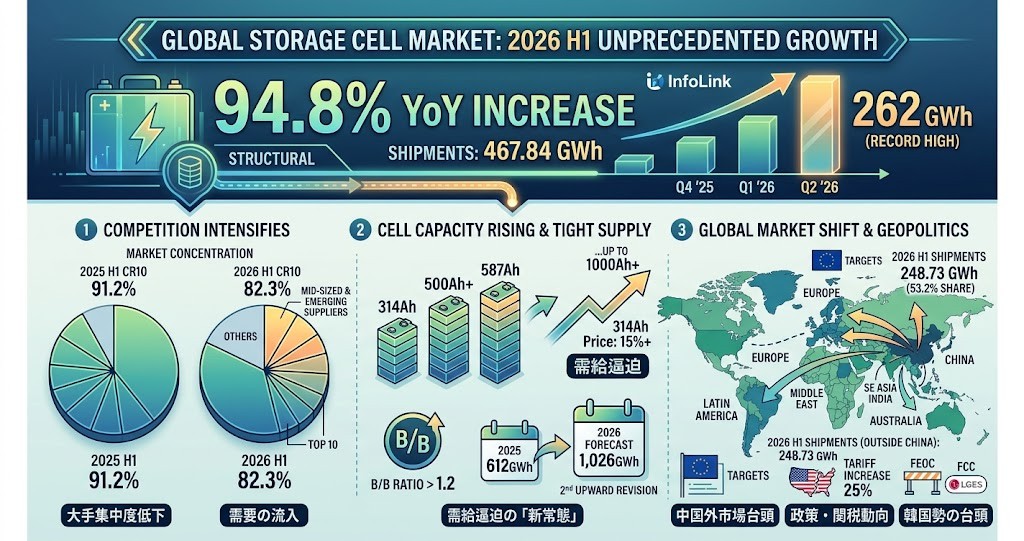
InfoLink Consultingが発表した2026年上半期(H1)の世界蓄電セル出荷データによると、出荷量は前年同期比94.8%増の467.84GWhに達し、異次元の成長を記録しました。四半期出荷量は3四半期連続で200GWhを超え、2026年第2四半期(Q2)には過去最高の262GWhに達しています。この急拡大の裏では、大手集中度の低下、大容量化に伴う需給逼迫の常態化、そして中国外市場へのシフトという3つの不可逆的な構造変化が起きています。太陽光発電産業が10年かけて経験した変化が、蓄電市場ではわずか1-2年で進行しており、市場のスピード感はかつてない領域に入っています。
1. 競争激化による大手集中度の低下(CR10・CR5の縮小)
- データと背景 上位10社(CR10)の市場シェアは、2025年上半期の91.2%から2026年上半期には82.3%へと約9ポイント急減しました。CATL、Hithium、EVE Energy、BYD、CALBの上位5社(CR5)の合計シェアも56.5%に低下しています。
- 構造的要因 世界的な需要爆発に対して上位メーカーの生産能力が追いつかず、溢れた需要が中堅・新興サプライヤー(SunwodaやGanfeng LiEnergyなど)に流入しました。中堅メーカーが顧客の品質審査(クオリフィケーション)を通過し納入実績を固めたことで、需要増が自動的に大手へ戻らない構造が形成されつつあります。
- 今後の展望 500Ah超などの超大容量セルの量産体制が本格化すれば、製造品質の安定性、スケールメリット、価格競争力を武器に大手メーカーが再びシェアを奪還するシナリオも予想されます。
2. セルフォーマットの急速な大容量化と需給逼迫の「新常態」
- 規格の乱立と価格動向 定置型蓄電池の主力を担ってきた314Ahセルは需要超過が続いており、過去6ヶ月で価格が15%以上上昇しました。一方で電力会社(ユーティリティ)向けでは500Ah以上の超大容量セルの普及率が10%を突破しています。現在、587Ah、588Ah、648Ah、684Ah、702Ah、さらには1000Ah超のフォーマットが混在する標準化の過渡期にあります。
- 家庭用蓄電池の動向 家庭用でも大容量化が急速に進み、280Ahと314Ahの合計普及率は30%近くに達しました。2026年下半期からは314Ahから392Ahへの移行スピードが注視されます。
- 年間予測の上方修正 受注残高対請求額比率(B/B比率)が複数のメーカーで1.2を超える状態が続いており、InfoLinkは2026年の通年出荷予測を1,026GWh(2025年の612.39GWhから約67.5%増)へ今期2度目の上方修正を行いました。下半期も需給の逼迫が継続する見通しです。
3. 海外市場の台頭と政策・関税動向(中国外シェア50%超)
- 中国外市場の急速な拡大 2026年上半期の中国国外向け出荷量は248.73GWhに達し、世界全体の53.2%を占めました。欧州の目標設定、オーストラリアでのメガソーラー・分散電源の成長、中東・ラテンアメリカでの大規模案件、東南アジア・インドなどの新興国の本格導入が成長を牽引しています。
- 中国の輸出還付金引き下げによる駆込み需要 中国政府による蓄電池の輸出税還付率引き下げ(2026年4月1日に9%から6%へ縮小、2027年1月1日に完全廃止)に伴い、年間を通じた駆け込み・前倒し出荷が発生し、上半期の季節的失速を防ぐ要因となりました。
- 米国市場の貿易障壁と韓国勢の台頭 米国は通商法301条に基づき中国製BESS関税を7.5%から25%に引き上げ、全体関税率は約40.9%に達しました。さらにFEOC(懸念外国機関)規制やFCC規制により中国勢の排除が進む中、ミシガン州工場でエネルギー貯蔵用LFPセルの量産を開始した韓国のLG Energy Solution(LGES)などがその需要の隙間を埋め、世界トップ10内に返り咲いています。
4. 補足・関連情報
- 太陽光発電(PV)の歴史的教訓との比較 PV産業におけるウェハーサイズの標準化競争(182mm vs 210mm)と同様に、蓄電セルも明確な勝者が決まるまではサプライチェーン全体の適合コストが規格収束の速度を左右します。それまでの短期的局面では、既存フォーマット(314Ah等)が強い市場シェアを維持します。
- 2027年に向けた市場の試練 2026年の需要増には中国の税制変更に伴う「需要の前倒し」が含まれています。還付金が完全に廃止され、中国メーカーのコスト構造が変化する2027年こそが、この急成長軌道が持続可能かどうかを試す本当の試練となります。
Structural Shift in the H1 2026 Energy Storage Cell Market: 94.8% Shipment Growth and Three Irreversible Trends
According to global energy storage cell shipment data for the first half of 2026 (H1) released by InfoLink Consulting, shipments reached 467.84GWh—a 94.8% year-over-year increase—recording unprecedented growth. Quarterly shipments exceeded 200GWh for three consecutive quarters, reaching an all-time high of 262GWh in Q2 2026. Beneath this rapid expansion lie three irreversible structural shifts: declining market concentration among top players, a new normal of supply-demand tightness driven by rapid cell capacity scaling, and a shift toward markets outside China. Transformations that took the solar PV industry a decade to experience are unfolding in just 1 to 2 years in the energy storage market, moving at an unprecedented pace.
1. Declining Concentration Among Top Manufacturers (CR10 and CR5 Contraction)
- Data and Background The market share of the top 10 manufacturers (CR10) dropped sharply by nearly 9 percentage points, from 91.2% in H1 2025 to 82.3% in H1 2026. The combined market share of the top 5 manufacturers (CR5)—CATL, Hithium, EVE Energy, BYD, and CALB—also fell to 56.5%.
- Structural Factors Top manufacturers’ production capacity failed to keep pace with the explosive global demand, causing spillover orders to flow to mid-tier and emerging suppliers such as Sunwoda and Ganfeng LiEnergy. As these mid-tier suppliers passed customer qualifications and established delivery track records, a market structure formed where gained shares do not automatically revert to top tier players.
- Future Outlook Once mass production of ultra-large cells exceeding 500Ah enters full swing, top manufacturers may regain market share leveraging manufacturing consistency, economies of scale, and price competitiveness.
2. Rapid Cell Capacity Scaling and the “New Normal” of Tight Supply and Demand
- Format Proliferation and Price Trends Demand continues to outpace supply for 314Ah cells, the long-standing mainstay for stationary storage, driving prices up by over 15% in the past six months. Meanwhile, penetration of ultra-large cells over 500Ah exceeded 10% in the utility-scale segment. The market is currently in a transition period toward standardization, with competing formats such as 587Ah, 588Ah, 648Ah, 684Ah, 702Ah, and even 1000Ah+ coexisting.
- Residential Storage Trends Capacity scaling is also accelerating in residential applications, where the combined penetration of 280Ah and 314Ah cells reached nearly 30%. Attention in H2 2026 will focus on the adoption rate of 392Ah cells as manufacturers push the shift from 314Ah to 392Ah.
- Upward Revision of Annual Forecast With book-to-bill (B/B) ratios exceeding 1.2 across multiple manufacturers for several consecutive months, InfoLink made its second upward revision this year for full-year 2026 global shipments to 1,026GWh (up approx. 67.5% from 612.39GWh in 2025). Tight supply-demand conditions are expected to persist into H2.
3. Rise of Overseas Markets and Policy/Tariff Dynamics (Non-China Share Exceeds 50%)
- Rapid Expansion of Non-China Markets Shipments to markets outside China reached 248.73GWh in H1 2026, accounting for 53.2% of global shipments. Growth is driven by European deployment targets, utility-scale and distributed storage expansion in Australia, large-scale projects across the Middle East and Latin America, and transitioning emerging markets like Southeast Asia and India into full-scale deployment phases.
- Pre-Emptive Demand Driven by Chinese Export Tax Rebate Reductions The Chinese government’s reduction of export tax rebates for energy storage batteries (reduced from 9% to 6% on April 1, 2026, with full elimination set for January 1, 2027) triggered year-round pre-emptive shipments, preventing the typical H1 seasonal slowdown.
- US Trade Barriers and the Resurgence of South Korean Manufacturers Under Section 301, the US raised tariffs on Chinese-made BESS products from 7.5% to 25%, bringing effective total tariff rates to approximately 40.9%. Coupled with non-tariff barriers like Foreign Entity of Concern (FEOC) and FCC regulations restricting Chinese vendors, South Korea’s LG Energy Solution (LGES)—which began mass production of energy storage LFP cells at its Michigan plant—filled the supply gap and returned to the global top 10 ranking.
4. Supplementary & Related Information
- Comparison with Historical Lessons from Solar PV Similar to the wafer size standardization battle in the PV industry (182mm vs 210mm), the adaptation cost across the broader supply chain will dictate the speed at which energy storage cell formats converge on a standard. Until a clear winner emerges, existing formats like 314Ah will maintain strong short-term market share.
- Market Test Facing 2027 Demand growth in 2026 includes significant “pull-forward” volume driven by Chinese tax policy changes. The year 2027—when tax rebates are fully eliminated and cost structures for Chinese manufacturers adjust—will serve as the true test of whether this rapid growth trajectory is sustainable.

コメント