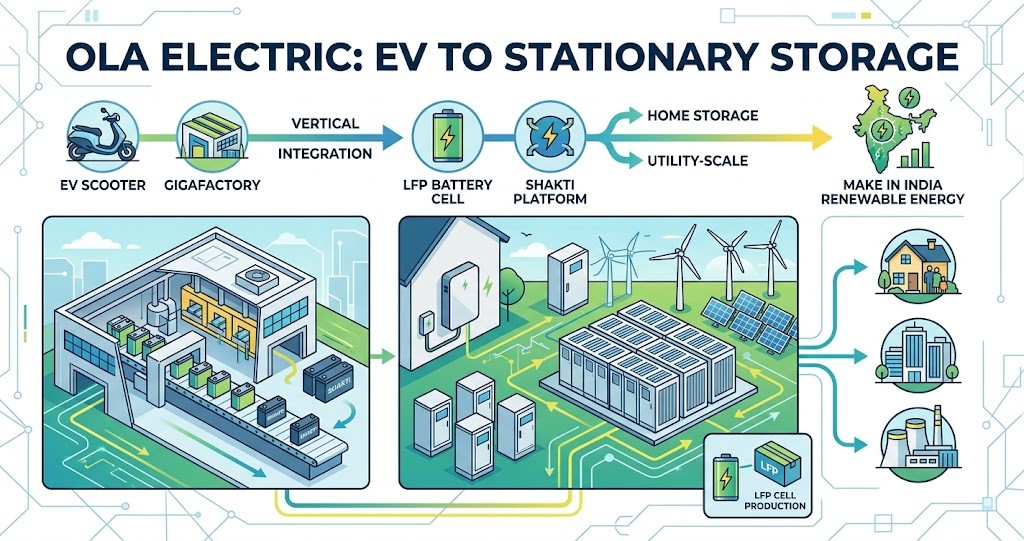
インドのEV二輪最大手であるOla Electricが、EV製造で培った技術と自社ギガファクトリーの生産基盤を活かし、定置型蓄電池(BESS)市場へ正式参入を果たしました。インド政府が推進する再生可能エネルギーの導入拡大や「Make in India」政策による国産化推進を背景に、同社は家庭用から電力会社向けの大規模系統用までを網羅する「Shakti」プラットフォームを展開します。本レポートでは、Ola Electricの定置型蓄電池事業への参入背景、製品ラインナップ、ならびに技術的・市場的コンテキストについて整理・解説します。
1. 概要と参入背景
インドの電動二輪車大手Ola Electric(2017年ベンガルール設立)は、自社開発のLFP(リン酸鉄リチウム)バッテリーを用いた包括的エネルギー貯蔵サービス「Shakti」を発表し、定置型蓄電池市場に正式参入しました。これまでEVスクーター用の電池セルをLG Energy SolutionやCATLなどの外部メーカーに依存していましたが、内製化を進めるためタミル・ナードゥ州クリシュナギリにギガファクトリーを建設。円筒形LFPセルを垂直統合で自社生産するインド唯一の大規模基盤を強みとしています。
2. 製品ラインナップ(Shaktiシリーズ)
- 住宅向け(Shakti Gen2)
- 家全体のバックアップ電源およびスマートソーラー連携機能を搭載。
- 4.6kWh / 3kWモデル:99,999インドルピー(約1,045米ドル)
- 9.2kWh / 6kWモデル:174,999インドルピー(約1,830米ドル)
- 出荷予定:2026年11月より開始。
- 産業・通信インフラ向け
- Shakti ACラック:73kWh(18-50kWインバーター内蔵)。ピークカットや施設バックアップ用途。
- 通信基地局等に向けたカスタマイズ可能なモジュール式DC製品もラインナップ。
- 出荷予定:2027年3月より順次展開。
- 電力会社・グリッド向け(Mahashakti)
- コンテナ1個あたり6.26MWhの容量と2.5MWの出力を誇る液冷式大規模蓄電システム。
- 2-4時間の稼働時間に対応し、再生可能エネルギーの出力変動緩和や系統安定化に貢献。
3. 市場環境と提携実績
インド政府は急速な電力需要の増加と再生可能エネルギーの導入拡大に伴い、2030年までに少なくとも44GWのBESS容量追加を目標として掲げています。国内生産比率規制(Make in India策)を活用することで設備投資コストを抑え、急速に拡大する国内需要を取り込む狙いです。なお、Ola Electricは再生可能エネルギー開発企業Axis Energyとの間で、2032年までに最大20GWhのBESSを導入する可能性に関する覚書(MoU)を締結しています。
4. 補足・関連情報
- LFP(リン酸鉄リチウム)採用の合理性 三元系(NMC)電池と比較して熱安定性が高く発火リスクが低いこと、サイクル寿命が長いこと、またコバルトやニッケルを使用しないためコストパフォーマンスに優れている点から、熱帯地域であるインドの定置型蓄電池において最適な化学組成とされています。
- 事業の多角化とリスク分散 EVスクーター市場での価格競争や補助金動向の変化の中で、定置型蓄電池市場への進出は自社ギガファクトリーの稼働率向上と収益構造の多角化を図る重要な戦略的ステップと位置づけられています。
Boosting India’s Renewable Energy Demand: Ola Electric’s Entry into the BESS Market and the Strengths of In-House LFP Cells
Ola Electric, India’s largest electric two-wheeler manufacturer, has officially entered the stationary Battery Energy Storage System (BESS) market by leveraging its EV manufacturing technology and Gigafactory production base. Against the backdrop of the Indian government’s push for renewable energy expansion and local manufacturing under the “Make in India” policy, the company is deploying its “Shakti” platform, covering applications from residential backup to large-scale utility grid storage. This report outlines Ola Electric’s market entry background, product portfolio, and technical and market context.
1. Overview and Entry Background
Ola Electric, a major Indian electric two-wheeler maker founded in Bengaluru in 2017, officially entered the stationary energy storage market with the launch of “Shakti,” a comprehensive energy storage service using internally developed Lithium Iron Phosphate (LFP) batteries. While previously reliant on external suppliers such as LG Energy Solution and CATL for EV scooter cells, the company built a Gigafactory in Krishnagiri, Tamil Nadu, to localize production. Its competitive edge lies in operating India’s only large-scale facility for vertically integrated, in-house production of cylindrical LFP cells.
2. Product Lineup (Shakti Series)
- Residential (Shakti Gen2)
- Features whole-home backup power and smart solar integration.
- 4.6kWh / 3kW model: Starting at 99,999 INR (approx. 1,045 USD)
- 9.2kWh / 6kW model: Starting at 174,999 INR (approx. 1,830 USD)
- Shipments scheduled to begin in November 2026.
- Commercial & Telecom Infrastructure
- Shakti AC Rack: 73kWh capacity with built-in 18-50kW inverter for peak shaving and facility backup.
- Customized modular DC equivalent products offered for telecom infrastructure.
- Rollout scheduled to begin sequentially from March 2027.
- Utility & Grid Scale (Mahashakti)
- Liquid-cooled, utility-scale system boasting 6.26MWh capacity and 2.5MW power output per container.
- Configurable for 2-4 hour durations to support renewable energy integration and grid stabilization.
3. Market Environment and Partnerships
To meet rapidly growing power demand and expand renewable energy integration, the Indian government aims to add at least 44GW of BESS capacity by 2030. By leveraging domestic content regulations under the “Make in India” initiative, Ola Electric aims to lower capital expenditure costs and capture expanding domestic demand. Furthermore, Ola Electric has signed a Memorandum of Understanding (MoU) with renewable energy developer Axis Energy regarding the potential deployment of up to 20GWh of BESS by 2032.
4. Supplementary & Related Information
- Rationale for LFP Adoption Compared to Nickel Manganese Cobalt (NMC) chemistries, LFP offers higher thermal stability, lower fire risk, longer cycle life, and superior cost-performance due to the absence of cobalt and nickel, making it the optimal chemistry for stationary storage in tropical regions like India.
- Business Diversification and Risk Mitigation Amid price competition and changing subsidy dynamics in the EV scooter market, entering the stationary energy storage market serves as a strategic move to increase Gigafactory utilization rates and diversify revenue streams.

コメント