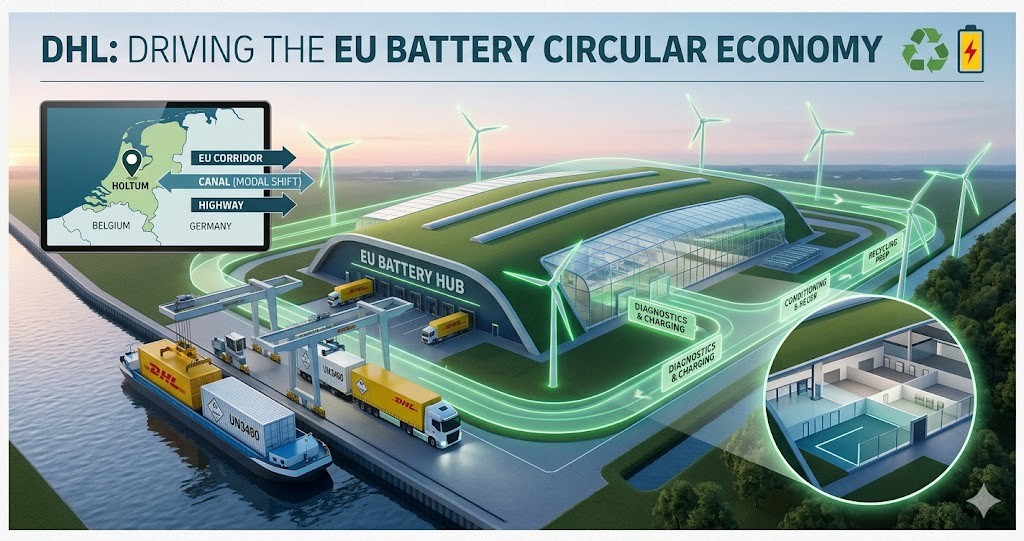
欧州連合(EU)では、脱炭素化に向けたEVの普及促進と同時に、製品の全ライフサイクルにおけるサステナビリティを義務付ける「EUバッテリー規則」の適用が段階的に進んでいます。これにより、バッテリーの製造から回収、再資源化(リサイクル)に至るトレーサビリティの確保と、安全かつ効率的なサプライチェーンの構築が自動車メーカーや物流企業に強く求められるようになりました。
このような背景の中、国際物流大手のDHLグループがオランダに新設するEVバッテリー特化型の物流拠点は、単なる「保管場所」としての倉庫を超え、欧州の次世代エネルギーインフラを支える戦略的コア施設として位置づけられます。
- DHLによるオランダ・高電圧バッテリー物流拠点の概要
- 関連情報・市場における重要性(技術的・戦略的背景の補足)
- DHL to Construct 17000 m2 EV and Stationary Battery Logistics Hub in the Netherlands
- Overview of DHL’s High-Voltage Battery Logistics Hub in the Netherlands
- Related Information and Market Significance (Supplementary Technical and Strategic Background)
DHLによるオランダ・高電圧バッテリー物流拠点の概要
DHLグループが発表した新施設の計画概要および機能は以下の通りです。
1. 施設規模と稼働予定
- 所在地: オランダ・リンブルフ州ホルタム
- 敷地面積: 1万7000 m2(高電圧バッテリー専用の保管・サービススペース)
- 稼働時期: 2027年初頭を予定
2. 対象となる製品分野
- 電気自動車(EV)用高電圧バッテリー
- 定置用蓄電システム(家庭用蓄電池、太陽光発電関連システムなどのBESS分野)
3. 提供される一貫サービス
隣接する既存の自動車物流拠点と密接に連携し、物流機能と高度な技術サービスを一体化して提供します。
- 基本物流: 適正な温度・安全管理下での高電圧バッテリー保管、輸送
- 付加価値技術サービス: バッテリーの診断・試験、充電、コンディショニング、再生(リユース対応)
- 循環型物流(リバースロジスティクス): 使用済みバッテリーの回収、リサイクルに向けた準備処理
関連情報・市場における重要性(技術的・戦略的背景の補足)
1. 抜群の立地条件と「モーダルシフト」によるCO2削減
ホルタムはオランダ、ドイツ、ベルギーの3国を結ぶ「欧州輸送回廊」の要衝に位置しています。主要高速道路だけでなく、ユリアナ運河沿いのコンテナバージ(内航はしけ)ターミナルに近接している点が大きな強みです。
重量物であり、かつ危険物(国連番号:UN3480/UN3481など)に指定されるリチウムイオンバッテリーの輸送において、トラックから水上輸送(バージ)への「モーダルシフト」を活用することは、輸送コストの削減だけでなく、サプライチェーン全体のCO2排出量を劇的に抑える持続可能な物流モデルに直結します。
2. バッテリー物流における「技術サービス一体化」の必然性
リチウムイオンバッテリーは、長期間放置されると過放電により劣化・不活性化するリスクがあります。また、市場から回収された使用済みバッテリーは、セルの健全度(SoH:State of Health)を正確に診断しなければ、再利用(セカンドライフ)かリサイクルかの判断ができません。
DHLの新施設が「保管」だけでなく「充電、診断、コンディショニング、リサイクル準備」までを一箇所で行う背景には、これまで分断されがちだった「物流」と「技術メンテナンス」を統合し、バッテリーの寿命を最大化させつつ、安全な廃棄・再資源化ルートへシームレスに繋ぐという明確な狙いがあります。
3. DHLの成長戦略「Strategy 2030」と市場への影響
欧州ではEV市場の拡大や、風力・太陽光などの再生可能エネルギーを安定運用するための大型蓄電システム(BESS)の導入が急ピッチで進んでいます。
DHLグループはこの新エネルギー分野を最重点領域と定め、長期成長戦略「Strategy 2030」のもとでインフラ投資を実行しています。荷主である自動車メーカーやエネルギー企業にとっては、法規制をクリアした安全かつ効率的なバッテリーマネジメントを包括的に委託(3PL/4PL)できる体制が整うことになり、欧州全域における新エネルギービジネスの加速を後押しするとみられます。
出典:https://www.logi-today.com/954670
DHL to Construct 17000 m2 EV and Stationary Battery Logistics Hub in the Netherlands
In the European Union (EU), the phased implementation of the “EU Battery Regulation” is underway. This regulation mandates sustainability across the entire product lifecycle while simultaneously promoting the adoption of EVs to achieve decarbonization. As a result, automotive manufacturers and logistics companies are now strongly required to ensure traceability—from battery manufacturing to collection and recycling—and to establish safe and efficient supply chains.
Against this backdrop, the EV battery-specialized logistics hub to be newly established in the Netherlands by international logistics giant DHL Group is positioned as more than just a warehouse for “storage.” Instead, it is recognized as a strategic core facility supporting Europe’s next-generation energy infrastructure.
Overview of DHL’s High-Voltage Battery Logistics Hub in the Netherlands
The planning overview and functions of the new facility announced by DHL Group are as follows:
1. Facility Scale and Operational Schedule
- Location: Holtum, Limburg Province, Netherlands
- Site Area: 17000 m2 (Dedicated storage and service space for high-voltage batteries)
- Operational Timeline: Scheduled to begin operations in early 2027
2. Target Product Sectors
- High-voltage batteries for electric vehicles (EVs)
- Stationary energy storage systems (BESS sector, including residential storage batteries and solar power-related systems)
3. Integrated Services Provided
Operating in close coordination with the adjacent existing automotive logistics hub, the facility will provide integrated logistics functions and advanced technical services.
- Core Logistics: Storage and transportation of high-voltage batteries under appropriate temperature and safety management.
- Value-Added Technical Services: Battery diagnosis and testing, charging, conditioning, and refurbishment (for reuse compatibility).
- Circular Logistics (Reverse Logistics): Collection of used batteries and preparatory processing for recycling.
Related Information and Market Significance (Supplementary Technical and Strategic Background)
1. Outstanding Location and CO2 Reduction via “Modal Shift”
Holtum is positioned at a strategic nexus of the “European Transport Corridor” connecting three nations: the Netherlands, Germany, and Belgium. Its proximity not only to major highways but also to a container barge terminal along the Juliana Canal serves as a major strength.
Lithium-ion batteries are heavy and classified as dangerous goods (such as UN3480/UN3481). In transporting these items, utilizing a “modal shift” from trucks to water transport (barges) directly leads to a sustainable logistics model. This shift not only reduces transportation costs but also drastically lowers CO2 emissions across the entire supply chain.
2. The Necessity of “Technical Service Integration” in Battery Logistics
If left unattended for extended periods, lithium-ion batteries run the risk of degrading or becoming inactive due to over-discharging. Furthermore, for used batteries recovered from the market, it is impossible to determine whether they should be repurposed (second-life) or recycled without accurately diagnosing the cell’s State of Health (SoH).
The reason DHL’s new facility handles everything from “storage” to “charging, diagnosis, conditioning, and recycling preparation” in a single location is its clear objective: to integrate “logistics” and “technical maintenance”—fields that have traditionally been fragmented. This approach maximizes battery lifespan while seamlessly connecting them to safe disposal and recycling routes.
3. DHL’s Growth Strategy “Strategy 2030” and Market Impact
In Europe, the expansion of the EV market and the introduction of large-scale battery energy storage systems (BESS) to stably operate renewable energy sources like wind and solar are progressing at a rapid pace.
DHL Group has designated this new energy sector as a top priority domain and is executing infrastructure investments under its long-term growth strategy, “Strategy 2030.” For shippping clients such as automotive manufacturers and energy companies, this establishes a framework to comprehensively outsource (3PL/4PL) safe and efficient battery management that fully complies with legal regulations.

コメント