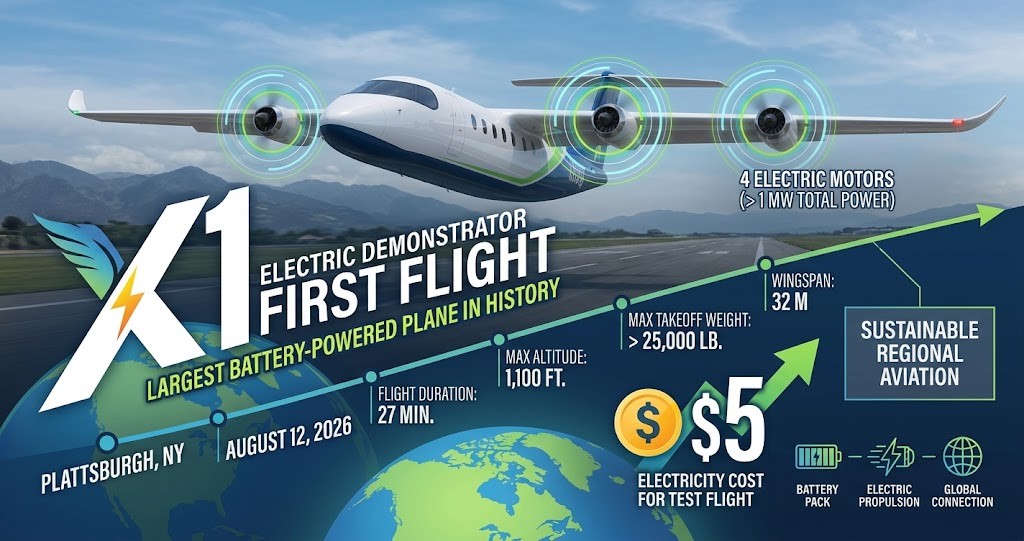
スウェーデン発で米国を拠点とするHeart Aerospace社は、2026年8月12日にニューヨーク州プラッツバーグ国際空港にて、実物大の電動実証機「X1」の初飛行に成功しました。これはバッテリー駆動の電動航空機としては史上最大規模となります。
今回の試験飛行は、排出ガスを削減する持続可能な地域航空(リージョナル航空)の実現に向けた重要なマイルストーンです。1メガワットを超える高出力の電気推進システムを搭載した11トン超級の航空機が実際に稼働・飛行できることが実証されました。
初飛行の主な実績・仕様
- 初飛行日: 2026年8月12日
- 飛行時間: 27分間
- 到達高度: 335メートル(1100フィート)
- 消費電気代: 約5ドル
- 最大離陸重量: 2万5000ポンド(11.34トン)以上
- 翼幅: 32メートル(106フィート)
- 推進システム: 翼に配置された4基の電気モーター(出力1メガワット以上)
「電気代5ドル」の意味 話題となった5ドルという数値は、27分間の飛行で直接消費された電力コストのみを示しています。実際の航空運用にはパイロットの人件費、整備費、空港使用料、バッテリーの減価償却費・交換費、保険料などが加わるため、実際の運行コスト全体を表すものではありません。しかし、従来のジェット燃料と比較した際のエネルギー効率の高さを示す象徴的な指標といえます。
実証機「X1」から商用機「ES-30」へ
今回飛行した「X1」は市販される旅客機ではなく、将来の商用機「ES-30」向けにシステムや製造技術を検証するための実証機です。
量産計画機「ES-30」の仕様
- 座席数: 30席
- 動力方式: ハイブリッド電気推進(バッテリーと予備タービン generator を併用)
- 航続距離: ピュアEVモードで約200km、ハイブリッドモードで最大800km
- 急速充電時間: 約30分
開発タイムラインと今後の展望
- 2019年: Y Combinatorの支援を受け会社設立。
- 2021年7月: Breakthrough Energy Venturesやユナイテッド航空などから3500万ドルを調達。
- 2022年9月: 30人乗り「ES-30」構想を発表。
- 2024年2月: シリーズBで1億700万ドルを追加調達。
- 2026年7月: 米国連邦航空局(FAA)より特別耐空証明を取得。
- 2026年8月: X1の初飛行に成功。
- 2028年(予定): 量産前モデル「ES-30 / X2」の飛行試験フェーズへ移行。
- 2031年(予定): 型式認証(TC)の取得および商業運航の開始。
関連情報・背景解説
1. 地域航空市場における電動化の強み 電動航空機は、騒音が非常に少なく滑走路長が短い地方空港での運用に適しています。特に数百km程度の短距離都市間路線において、運航コストの削減とCO2排出削減を両立させる手段として期待されています。
2. バッテリー重量とハイブリッド化の現実 現在の標準的なリチウムイオン電池のエネルギー密度(約250〜300 Wh/kg)では、航空機を完全にバッテリーのみで長距離飛行させることは困難です。そのため、Heart Aerospace社をはじめとする航空スタートアップは、短距離を純電動で飛び、非常時や長距離航続にはバイオ燃料等を併用できるハイブリッド推進を採用する手法が現実的な選択肢となっています。
3. 空港インフラとメガワット充電(MCS) 航空機の運用間隔を維持するためには短時間での急速充電が必須となります。30分での充電を実現するためには、メガワット級の充電スタンド(MCS: Megawatt Charging System)といった新たな地上基盤整備が世界各地の空港で求められます。
World’s Largest Electric Aircraft “X1” Successfully Completes First Flight! The $5 Electricity Cost Shock
On August 12, 2026, Heart Aerospace, a Swedish-founded company based in the United States, successfully conducted the first flight of its full-scale electric demonstrator, the “X1,” at Plattsburgh International Airport in New York. This marks the largest battery-electric aircraft ever flown.
This test flight represents a major milestone toward achieving sustainable regional aviation with reduced emissions. It demonstrated that an aircraft weighing over 11 tons and equipped with a high-power electric propulsion system exceeding 1 megawatt can operate and fly in real-world conditions.
Key Achievements and Specifications of the First Flight
- First Flight Date: August 12, 2026
- Flight Duration: 27 minutes
- Altitude Reached: 335 meters (1,100 feet)
- Electricity Cost: Approximately $5
- Maximum Takeoff Weight: Over 25,000 pounds (11.34 tons)
- Wingspan: 32 meters (106 feet)
- Propulsion System: 4 wing-mounted electric motors (power output over 1 megawatt)
The Meaning Behind the “$5 Electricity Cost” The widely discussed $5 figure refers solely to the direct cost of electricity consumed during the 27-minute flight. It does not represent the overall operating cost, as actual commercial flights include pilot salaries, maintenance fees, airport landing fees, battery depreciation and replacement costs, and insurance. However, it serves as a symbolic metric demonstrating superior energy efficiency compared to traditional jet fuel.
From the “X1” Demonstrator to the Commercial “ES-30”
The “X1” flown in this test is not a commercial passenger aircraft, but a full-scale demonstrator designed to test systems and manufacturing processes for the planned commercial aircraft, the “ES-30.”
Specifications of the Planned Commercial Aircraft “ES-30”
- Seating Capacity: 30 seats
- Powertrain: Hybrid-electric propulsion (combining batteries with reserve turbine generators)
- Range: Approximately 200 km in fully electric mode; up to 800 km in hybrid mode
- Fast Charging Time: Approximately 30 minutes
Development Timeline and Future Outlook
- 2019: Founded with support from Y Combinator.
- July 2021: Raised $35 million in Series A funding led by Breakthrough Energy Ventures, United Airlines, and others.
- September 2022: Announced the 30-passenger “ES-30” concept.
- February 2024: Raised an additional $107 million in Series B funding.
- July 2026: Received a Special Airworthiness Certificate from the US Federal Aviation Administration (FAA).
- August 2026: Successfully completed the first flight of the X1.
- 2028 (Target): Transition to the flight testing phase for the pre-production model “ES-30 / X2.”
- 2031 (Target): Obtain Type Certification (TC) and commence commercial service.
Related Information and Background
1. Advantages of Electrification in the Regional Aviation Market Electric aircraft produce minimal noise and are well-suited for operations at regional airports with shorter runways. They offer strong potential to simultaneously reduce operating costs and CO2 emissions, particularly on short-haul intercity routes of a few hundred kilometers.
2. The Reality of Battery Weight and Hybridization Given the energy density of current standard lithium-ion batteries (approx. 250 to 300 Wh/kg), flying long distances purely on battery power remains difficult. Consequently, aviation startups like Heart Aerospace are adopting hybrid propulsion systems as a practical solution—flying short distances on pure electric power while utilizing biofuels or reserve generators for emergencies and extended range.
3. Airport Infrastructure and Megawatt Charging Systems (MCS) Maintaining practical turn-around times for commercial aircraft requires rapid charging capabilities. Achieving a 30-minute charge time will necessitate the deployment of new ground infrastructure, such as Megawatt Charging Systems (MCS), at airports worldwide.

コメント