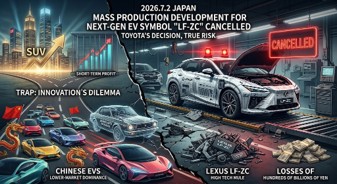
2026年7月2日、日本の自動車産業に激震が走りました。トヨタ自動車が、2027年に発売を予定していた次世代EVの象徴「レクサス LF-ZC」の量産開発を突如中止したのです。
世界的なEV需要の減退や、高級セダン市場の縮小を踏まえれば、これは「傷口を広げないための正しい経営判断」に見えます。しかし、経済評論家の鈴木貴博氏は、この決定の裏に「数百億円の損失よりも恐ろしい戦略的代償」が潜んでいると警告します。
安価な中国製EVとの直接対決を避け、利益率の高い上位市場(SUVなど)へ逃れる判断は、ビジネススクールで誰もが習う致命的な罠「イノベーションのジレンマ」そのものだからです。本記事では、この開発中止が意味する真のリスクと、日本メーカーが生き残るための「絶対条件」を整理・解説します。
- 1. トヨタ「LF-ZC」開発中止の概要と直接的影響
- 2. 潜む罠:自動車業界を襲う「イノベーションのジレンマ」
- 3. 【関連情報】2026年現在、激変するグローバルEV市場のリアル
- 4. 生き残りをかけた絶対条件:「開発4年」の呪縛を解け
- 総括
- 1. Overview and Direct Impact of the LF-ZC Cancellation
- 2. The Hidden Trap: “The Innovator’s Dilemma” Gripping the Auto Industry
- 3. Contextual Data: The Realities of the 2026 Global EV Market
- 4. The Survival Blueprint: Unlearning “Four-Year Development” Cycles
- Conclusion
1. トヨタ「LF-ZC」開発中止の概要と直接的影響
「LF-ZC」は、テスラ「モデル3」の対抗馬として期待された次世代EVセダンでした。
- 異例の開発中止すでにサプライヤーを含めた生産設備投資が始まっている段階での中止は、トヨタの歴史上でも極めて異例です。
- 発生する損失トヨタおよび協力部品メーカーを合わせ、数百億円規模の損失が出ると試算されています(一部の部品メーカーは単独で100億円規模の影響)。
- 中止の「表向きな」3つの理由
- 世界的なEV需要の想定以上の鈍化。
- 高級セダン市場自体の縮小傾向。
- 想定以上のコスト上昇(販売価格の高騰懸念)。
- 「経営判断」としての合理性開発された次世代技術(次世代電池、ギガキャスト、車載ソフトウェア「アリーン」など)は、今後のSUV開発などに引き継がれます。人員と資金を利益率の高い北米向けSUV等に再配分する意思決定は、財務的な視点(CFO出身の近健太副社長らの主導)としては合理的です。
2. 潜む罠:自動車業界を襲う「イノベーションのジレンマ」
戦略的な視点で見ると、今回の開発中止は日本車が「中国車に敗北する未来」を決定づけかねないリスクを孕んでいます。
イノベーションのジレンマのメカニズム
- 市場の逃避:安価な中国車が「下位市場(低価格帯)」を支配し始めたとき、日米欧の既存メーカーは、利益を守るために「より高価格な上位市場」へターゲットをシフトします。
- 一時的な安泰:中流層以上の顧客は品質を重視するため、既存メーカーは一時的に高い利益を維持できます。
- 中国車の進化と逆転:下位市場で圧倒的な数量(シェア)を得た中国メーカーは、量産効果でさらにコストを下げ、同時に品質を急激に向上させます。かつて1970〜80年代に「安かろう悪かろう」から世界の覇者へと登り詰めた日本車と、全く同じメカニズムです。
2つの対照的な戦略
- 日本メーカー:採算性と売れる見込みを慎重に見極め、「今利益が出る車」を作る。
- 中国メーカー:将来の覇権を見据え、赤字を恐れず多数の車種を投入して「市場シェア」を獲りにいく。
【結果】
このままでは、日本メーカーは「向こう5年の利益」を得る代わりに、「5年後の世界市場の支配権」を中国メーカーに奪われることになります。
3. 【関連情報】2026年現在、激変するグローバルEV市場のリアル
鈴木氏の指摘を裏付ける、現在の世界市場の客観的なデータを補足します。
① 「中国車1,000万台輸出」時代の到来
世界市場において、中国車の輸出の勢いは止まりません。
- 欧州での逆転:2026年5月、欧州市場において中国車のシェアが初めて日本車を上回りました。欧州連合(EU)が中国製EVに最大45.3%の追加関税を課し、EV補助金を縮小している逆風下での逆転劇です。
- BYDのグローバル化:中国EV最大手のBYDは、すでに生産車両の4割以上を海外へ輸出。2026年の中国車全体の輸出台数は1,000万台規模に達すると予測されており、これは日本の輸出量の約2.5倍に相当します。
② 進化する「ギガキャスト」とソフトウェア定義車両(SDV)
今回のトヨタ「LF-ZC」でも採用予定だった「ギガキャスト」や「車載OS(アリーン)」は、中国メーカーが最も得意とする領域です。中国勢はハードウェアをシンプルに作り(ギガキャストによる一体成形)、中身のソフトウェアをスマホのようにネット経由(OTA)でアップデートする思想(SDV)で、圧倒的な低コスト・短期間での車両開発を実現しています。
4. 生き残りをかけた絶対条件:「開発4年」の呪縛を解け
イノベーションのジレンマから脱出し、中国メーカーに対抗するために必要な対策は「下位市場から逃げないこと」です。そのためには、日本メーカーに染み付いた「常識」を捨てる(アンラーニングする)必要があります。
開発プロセスの根本的な違い
| 項目 | 日本メーカー(従来型) | 中国EVメーカー(新型) |
| 開発期間 | 約4年 | 1.5〜2年 |
| 設計思想 | ガソリン車の振動や静粛性を極限まで高める「すり合わせ技術」を重視。時間と手間をかけてバランス調整を行う。 | 車を「大画面テレビやスマホ」と同類の電気製品と捉える。共通プラットフォームにモジュールを積み上げる。 |
| 検証方法 | 実車の試作とテストを繰り返す。 | AIシミュレーションと「デジタルツイン(仮想空間での再現)」で、試作前にバグを徹底修正。 |
トヨタが取るべき「LF-ZC(改)」というシミュレーション
もしトヨタが、開発中止した「LF-ZC」の技術を使って本気で中国勢に立ち向かうなら、以下のような割り切ったスピード開発が必要です。
- ボディをアルミから安価な鋼板に変え、次世代電池ではなく既存の普及型電池を載せる。
- 内装は「ヤリス」並みに簡素化し、テスラ「モデル3」と同等の低価格に設定。
- OS(アリーン)を搭載し、性能や機能は発売後のソフトウェアアップデートでカバーする。
- これを2028年初頭までに市場へ投入する。
総括
トヨタのマルチパスウェイ戦略(全方位戦略)において、欧米で高級SUV路線にシフトしつつ、中国や新興国では低価格なEVで対峙するという二面作戦は、十分に戦略的整合性があります。
現在、このイノベーションのジレンマに対して先進国メーカーで唯一、対抗措置をとれているのは韓国勢(現代・起亜グループ)のみに見えます。
「LF-ZC」の開発中止という経営判断自体は合理的であっても、それを理由に「低価格・急速開発」のノウハウ習得から逃げてしまえば、未来の市場は失われます。これからの数年間、トヨタがボリュームゾーン(下位〜中堅市場)のEV開発において、どれだけ「中国スピード」に追いつき、泥臭く戦い続けられるか。そこに日本自動車産業の命運がかかっています。
The Worst-Case Scenario Born from a “Sound Business Decision”: The Heavy Price Toyota Pays for Canceling the “LF-ZC” EV
On July 2, 2026, a shockwave rippled through the Japanese automotive industry. Toyota Motor Corporation abruptly halted the mass-production development of the Lexus LF-ZC—the sleek, next-generation electric sedan that was supposed to be the flagship icon of its future EV lineup.
At first glance, given the cooling global demand for EVs and the shrinking premium sedan segment, this appears to be a “sound business decision” to cut losses early. However, economic analyst Takahiro Suzuki warns that hidden beneath this choice is a strategic price far more terrifying than any multi-billion-yen write-off.
By avoiding a direct confrontation with low-cost Chinese EV manufacturers and retreating into high-margin upper markets (such as SUVs), Japanese automakers are walking straight into a classic, fatal trap taught in every business school: The Innovator’s Dilemma. This article analyzes the true risks of this cancellation and outlines the absolute conditions Japanese automakers must meet to survive.
1. Overview and Direct Impact of the LF-ZC Cancellation
The LF-ZC was a next-generation luxury EV sedan positioned to go head-to-head with the Tesla Model 3.
- An Unprecedented Halt: Canceling a project at this stage—when production equipment investments with suppliers had already begun—is highly anomalous in Toyota’s history.
- Heavy Losses: Combined losses for Toyota and its partner suppliers are estimated to reach tens of billions of yen (with some individual parts manufacturers facing hits of around 10 billion yen).
- Three “Official” Reasons for the Cancellation:
- Slower-than-anticipated global EV demand growth.
- A contraction in the premium sedan market.
- Higher-than-expected production costs, which threatened to inflate the retail price.
- The Rationality of the Decision: The advanced technologies developed for the vehicle—such as next-generation prismatic batteries, gigacasting, and the “Arene” proprietary software platform—will be transferred to future projects. Under the leadership of President Kenta Goto (formerly CFO), reallocating resources and personnel to high-margin North American SUVs makes logical financial sense.
2. The Hidden Trap: “The Innovator’s Dilemma” Gripping the Auto Industry
Through a strategic lens, this cancellation risks cementing a future where Japanese automakers ultimately lose to Chinese competitors.
How the Innovator’s Dilemma Works
- Market Flight: When cheap Chinese vehicles begin dominating the “low-end market” (budget segments), legacy automakers in Japan, the US, and Europe pivot toward higher-priced, high-margin premium segments to protect their profits.
- Temporary Comfort: Because middle-and-high-income consumers prioritize premium quality, legacy brands can maintain solid profits in the short term.
- The Chinese Over-and-Under: Leveraging massive volume and market share in the low-end segment, Chinese manufacturers rapidly scale up, reducing costs and dramatically upgrading quality. This is the exact mechanism Japanese automakers used in the 1970s and 80s to transition from “cheap, low-quality imports” to global conquerors.
Two Conflicting Strategies
- Japanese Automakers: Focus heavily on immediate profitability, carefully assessing market demand before launching new models. The LF-ZC cancellation is a textbook product of this cautious strategy.
- Chinese Automakers: Prioritize capturing global market share. They flood the market with dozens of new models to secure future dominance, even if it means weathering short-term losses.
The Ultimate Outcome:
If this trend continues, Japanese automakers will enjoy healthy profits for the next five years, only to hand over global market hegemony to Chinese rivals five years from now.
3. Contextual Data: The Realities of the 2026 Global EV Market
To ground Suzuki’s warning, we must look at the data shaping the global landscape in 2026.
① The Era of “10 Million Chinese Vehicle Exports”
The global momentum of Chinese automotive exports is relentless.
- Overtaking in Europe: In May 2026, Chinese manufacturers’ market share in Europe surpassed Japanese brands for the first time. This occurred despite massive headwinds, including the EU scaling back EV subsidies and slapping tariff rates of up to 45.3% on Chinese imports.
- BYD’s Global Footprint: BYD, China’s largest EV maker, now exports over 40% of its domestic production. Total Chinese vehicle exports are projected to hit 10 million units in 2026—roughly 2.5 times the export volume of Japan.
② Gigacasting and the Rise of SDVs (Software-Defined Vehicles)
The ultra-efficient manufacturing and software integration that Toyota hoped to showcase with the LF-ZC—specifically gigacasting and the “Arene” OS—are areas where Chinese EV makers already hold a commanding lead. By simplifying hardware (such as casted frames) and managing vehicle features via over-the-air (OTA) software updates, Chinese firms are developing cars at a fraction of the cost and time of traditional legacy players.
4. The Survival Blueprint: Unlearning “Four-Year Development” Cycles
To break out of the Innovator’s Dilemma and successfully counter Chinese competition, legacy automakers must refuse to abandon the low-end volume market. This requires a complete unlearning of traditional corporate habits.
The Clash of Product Development Philosophies
| Metric | Legacy Japanese Automakers | Chinese EV Manufacturers |
| Development Cycle | Approx. 4 Years | 1.5 to 2 Years |
| Design Philosophy | Focuses on meticulous “harmonization” (suriawase). Engineers spend years fine-tuning engine vibration, cabin noise, and long-term mechanical balance. | Treats the car as a consumer electronic, similar to a smart TV or smartphone. Standardized modules are layered onto a unified platform. |
| Testing & Validation | Relies on extensive, physical prototyping and iterative real-world track testing. | Uses highly advanced AI simulations and “digital twin” technology to iron out engineering flaws virtually before a physical prototype is built. |
The “LF-ZC (Modified)” Thought Experiment
If Toyota were to truly weaponize the technology developed for the LF-ZC to combat Chinese dominance, it would require a radical shift toward rapid, cost-optimized development:
- Swap the expensive aluminum body parts for budget-friendly steel, and replace the high-cost next-gen batteries with mass-produced, standard battery packs.
- Strip down the interior to a basic level similar to a Toyota Yaris, pricing the vehicle to compete directly with the Tesla Model 3.
- Equip it with the “Arene” OS and trust that over-the-air (OTA) software updates will improve the car’s performance and features post-purchase.
- Commit to launching this vehicle by early 2028.
Conclusion
Within Toyota’s “multi-pathway” strategy, shifting premium EV efforts toward SUVs in the West while relying on hybrids makes undeniable commercial sense in the near term. Currently, among legacy manufacturers, only the South Korean brands (Hyundai/Kia) appear to be actively tackling the threat of the Innovator’s Dilemma head-on.
While canceling the LF-ZC is financially justifiable today, using it as an excuse to retreat from the high-speed, low-cost EV learning curve will lead to a loss of the future market. The ultimate fate of the Japanese auto industry hinges on whether Toyota can match the “China speed” and fight in the trenches of the high-volume, mass-market EV segment over the next few crucial years.


コメント