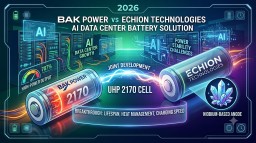
中国のバッテリー大手BAK Powerと、英国の先端材料スタートアップEchion Technologiesによる画期的な共同開発について、2026年現在のAI・データセンター市場の爆発的な成長背景(関連情報)を補足しながら、分かりやすく整理・解説します。
- イントロダクション
- 1. 新型「UHP 21700セル」を支える2つのコア技術
- 2. 従来品を圧倒する「4つの革新的メリット」
- 3. 【関連情報】なぜ今、この技術が渇望されているのか?
- 4. 今後のロードマップと展望
- Introduction
- 1. Two Core Technologies Powering the New “UHP 2170 Cell”
- 2. Four Revolutionary Advantages Over Conventional Cells
- 3. Contextual Insights: Why This Technology Is Highly Coveted in 2026
- 4. Roadmap and Future Outlook
イントロダクション
AI(人工知能)の急速な普及に伴い、世界中でデータセンターの建設ラッシュが続いています。しかし、AI処理を行うサーバーは莫大な電力を消費し、その負荷変動も極めて激しいため、データセンターの「電源の安定化」が世界的な大課題となっています。
こうした中、2026年7月15日、リチウムイオン電池大手のBAK Power(比克電池)と、ニオブ系アノード技術の先駆者であるEchion Technologiesが、AIデータセンターのバックアップ電源(BBU)に特化した新型円筒形電池「UHP(超高出力)2170セル」を発表しました。
画期的な新素材と構造技術を組み合わせたこのセルは、従来のバッテリーが抱えていた「寿命」「発熱」「充電速度」の限界を突破し、次世代AIインフラの心臓部を支える技術として大きな注目を集めています。
1. 新型「UHP 21700セル」を支える2つのコア技術
この新型セルは、両社の強みを融合させることで、これまでにない超高出力と長寿命を両立しています。
- Echion社の「XNO®」アノード(負極)技術従来のグラファイト(黒鉛)に代わり、酸化ニオブをベースとした独自の負極材を採用。これにより、極めて高速な充放電が可能になり、熱安定性と安全性が飛躍的に向上しています。
- BAK社の「タブレス(Tabless)」高出力セル構造電極から電流を取り出す「タブ」をなくし、端面全体を集電体とする構造です。内部抵抗を極限まで下げることで、大電流を流した際の発熱を劇的に抑えることに成功しました。
2. 従来品を圧倒する「4つの革新的メリット」
AIデータセンターの電源バックアップユニット(BBU)用途において、従来の21700(2170)型セルと比較して以下の劇的な進化を遂げています。
| 特徴 | 従来の超高出力セル | BAK × Echion 新型UHP 21700セル |
| 充放電の対称性 | 「放電」は早いが「充電」に時間がかかる(非対称)。 | 10C(容量の10倍の電流)以上の対称充放電が可能。超高速で放電し、超高速で再充電できる。 |
| サイクル寿命 | 頻繁な急充放電により劣化が早い。 | 既存のUHP基準より1桁(約10倍)長いサイクル寿命を実現。資産としての寿命が大幅に延びる。 |
| 熱安定性・安全性 | 高温環境での性能低下や、最悪の場合に熱暴走のリスク。 | XNO®の特性により本質的に安全。 耐衝撃性に優れ、サーバーのすぐ近くに設置しても極めて安全。 |
| 高負荷環境への耐性 | AIの高負荷による周囲温度の上昇で、早期劣化しやすい。 | 低内部抵抗と優れた熱安定性により、AIデータセンター特有の高熱環境でも性能が低下しない。 |
💡 システム設計への影響:
従来のセルでは「充電速度の遅さ」をカバーするために、システム(ラック数)を必要以上に大きく設計(過剰設計)する必要がありました。この新型セルの「対称設計」により、限られたラックスペースを100%有効活用できるようになります。
3. 【関連情報】なぜ今、この技術が渇望されているのか?
この技術提携の背景にある、2026年現在のデータセンター市場のリアルな動向を補足します。
① 「液冷式BBUサイドカー」という最新トレンド
AI処理に特化したGPU(NvidiaのBlackwellやその後継アーキテクチャなど)は、従来の空冷では冷やしきれず、液冷式(水冷など)への移行が急速に進んでいます。 これに伴い、バックアップ電源(BBU)もサーバーラックの横に「サイドカー」として高密度に設置され、±400Vといった高電圧モジュールで稼働する設計が主流になりつつあります。新型UHP 2170は、まさにこの「次世代液冷BBUアーキテクチャ」に最適化して設計されています。
② なぜ「ニオブ(XNO®)」なのか?
Echion社が誇るニオブ系アノードは、リチウムイオン電池の宿命である「リチウムデンドライト(急速充電時に発生し、ショートや発火の原因となる結晶)」の形成を本質的に防ぐ特性を持っています。
これにより、「超急速充電」を何千回繰り返しても壊れないため、AIの予期せぬ電力ピークに即座に対応しなければならないBBUにとって、夢の素材とされています。
4. 今後のロードマップと展望
- サンプルの配布開始BBU(バッテリーバックアップユニット)の試験用サンプルは、2026年後半から入手可能になる予定です。
- パートナーシップの募集BAK Powerは現在、評価サンプルの早期検証、共同での規格認証、および長期的な供給契約を希望する大手BBUシステムインテグレーター(データセンター向け電源システム構築企業)を対象に、早期アクセスプログラムを開始しています。
この技術が実用化されれば、データセンターの設置面積を縮小しつつ、停電や電力瞬低に対する堅牢性を大幅に高めることができるため、AI時代のインフラを支える強力なゲームチェンジャーとなるでしょう。
出典:https://www.bestmag.co.uk/bak-and-echion-partner-on-uhp-cell/
Breaking Through AI Data Center Power Limits: The Impact of BAK × Echion’s “Niobium-Based Anode” Cell
This report details and analyzes the groundbreaking joint development between Chinese battery giant BAK Power and British advanced materials startup Echion Technologies, supplemented with contextual insights regarding the explosive growth of the AI and data center markets in 2026.
Introduction
With the rapid proliferation of artificial intelligence (AI), a boom in data center construction is sweeping the globe. However, the servers handling AI workloads consume astronomical amounts of electricity and experience highly volatile load fluctuations. Consequently, stabilizing the power supply has become a major global challenge for data center operators.
Against this backdrop, on July 15, 2026, lithium-ion battery giant BAK Power (比克電池) and Echion Technologies, a pioneer in niobium-based anode technology, announced a new cylindrical ultra-high power (UHP) 2170 cell specifically designed for battery backup units (BBUs) in AI data centers.
By combining an innovative new material with advanced structural engineering, this cell shatters the traditional battery limitations of lifespan, heat generation, and charging speed, drawing significant industry attention as a technology poised to power the heart of next-generation AI infrastructure.
1. Two Core Technologies Powering the New “UHP 2170 Cell”
By fusing the respective strengths of both companies, this new cell achieves unprecedented ultra-high power output and an exceptionally long operating life.
- Echion’s “XNO®” Anode (Negative Electrode) TechnologyInstead of conventional graphite, the cell utilizes a proprietary anode material based on niobium oxide. This enables extremely fast charging and discharging while dramatically improving thermal stability and safety.
- BAK’s “Tabless” High-Power Cell StructureThis design eliminates the traditional “tabs” used to draw current from the electrodes, using the entire end surface as a current collector instead. By reducing internal resistance to the absolute minimum, it successfully and drastically suppresses heat generation when discharging large currents.
2. Four Revolutionary Advantages Over Conventional Cells
For battery backup unit (BBU) applications in AI data centers, this cell represents a massive leap forward compared to traditional 21700 (2170) cells:
| Feature | Conventional UHP Cells | BAK × Echion New UHP 2170 Cell |
| Symmetric Charge/Discharge | Fast discharge, but slow and restricted recharge (asymmetrical). | Symmetric charge/discharge rates of 10C+ (current at 10x capacity). Enables ultra-fast discharging and equally rapid recharging. |
| Cycle Life | Degrades rapidly due to frequent, rapid charge/discharge cycles. | Achieves a cycle life one order of magnitude (approx. 10x) longer than standard UHP benchmarks, significantly extending asset life. |
| Thermal Stability & Safety | Performance drops in high-heat environments; risks thermal runaway in worst-case scenarios. | Inherently safe thanks to XNO® properties. Superior performance in impact tests, making it exceptionally safe for installation right next to servers. |
| Resilience to High-Load Environments | Prone to premature degradation as heavy AI workloads drive up ambient and rack temperatures. | Low internal resistance and XNO® thermal stability ensure full performance even in the high-temperature environments typical of AI data centers. |
💡 System Design Impact:
With conventional cells, system integrators had to over-engineer BBU systems (requiring more rack space) simply to compensate for slow recharge speeds. The “symmetric design” of this new cell eliminates this bottleneck, allowing operators to utilize 100% of available rack space efficiently.
3. Contextual Insights: Why This Technology Is Highly Coveted in 2026
The following trends in the 2026 data center market highlight the urgent need for this technological breakthrough:
① The Rising Trend of “Liquid-Cooled BBU Sidecars”
AI-specific GPUs (such as Nvidia’s Blackwell and its successor architectures) generate too much heat for conventional air cooling, sparking a rapid industry-wide transition to liquid cooling.
Consequently, BBUs are increasingly deployed as high-density “sidecars” mounted next to server racks, operating on high-voltage configurations like ±400V. The new UHP 2170 cell has been optimized specifically to fit these next-generation liquid-cooled BBU architectures.
② Why “Niobium (XNO®)”?
Echion’s signature niobium-based anode inherently prevents the formation of “lithium dendrites”—microscopic, needle-like lithium crystals that form during rapid charging and cause short circuits or fires.
Because it can withstand thousands of ultra-fast charging cycles without degrading, niobium is considered the ultimate material for BBUs, which must respond instantly to unpredictable AI power spikes.
4. Roadmap and Future Outlook
- Sample Availability: Evaluation samples for BBU testing are scheduled to become available in the late second half of 2026.
- Partnership Opportunities: BAK Power is currently launching an early-access program for select BBU system integrators (companies building power systems for data centers) looking for early sample evaluation, joint qualification, and long-term supply partnerships.
Once commercialized, this technology will allow data centers to shrink their physical footprint while vastly improving resilience against power outages and voltage sags, making it a powerful game-changer for AI-era infrastructure.


コメント