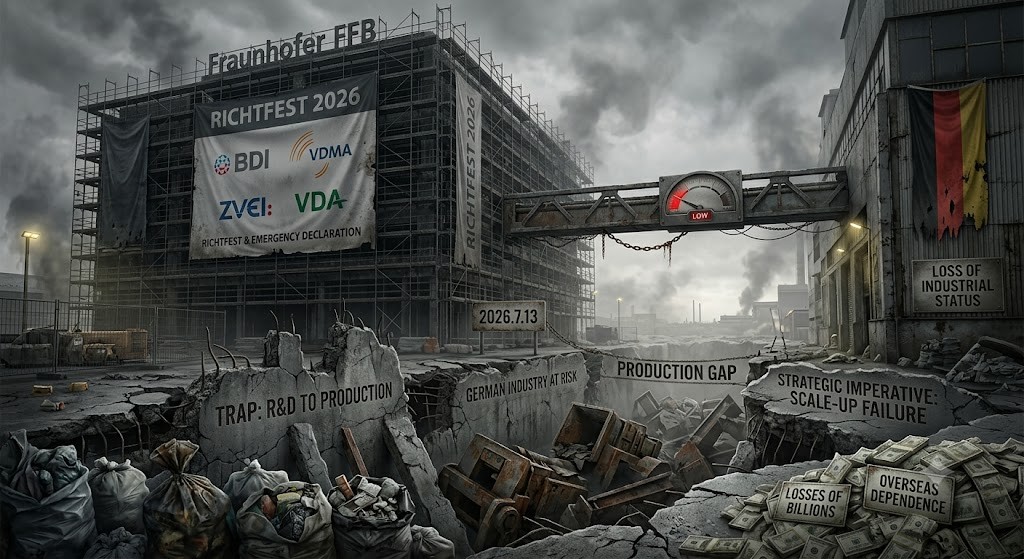
2026年7月13日、ドイツの未来を担う「フラウンホーファー・バッテリーセル研究製造センター(FFB)」の棟上げ式(Richtfest)が執り行われました。この節目となる日に、ドイツの主要な4つの産業団体は共同で、政府に対して極めて強い警戒感を示す声明を発表しました。
彼らが訴えるのは、「優れた研究成果があるにもかかわらず、量産(スケールアップ)のフェーズで後れを取っている」という冷酷な現実です。このまま適切な産業政策が打ち出されなければ、ドイツは安全保障や重要インフラにおける海外依存を固定化させ、産業大国としての地位を失うリスクがあります。
以下に、声明の要点と、それを理解する上で不可欠な関連情報を整理しました。
1. 共同声明の核心:ドイツが直面する危機
産業団体は、ドイツ政府(特に連邦経済・気候行動省:旧BMWi/BMWE)に対し、単なる研究支援にとどまらず、「産業政策としての具体的な支援」への移行を強く求めています。
- 「発明はドイツ、利益は世界へ」という危機感: ドイツは長年の投資により、世界屈指のバッテリー研究環境を構築しました。しかし、革新的な技術を持つ企業が市場に参入し、規模を拡大(スケーリング)しようとする段階で、ことごとく壁にぶつかっています。
- 構造的な立地環境の弱点: 参入失敗の原因は「技術力不足」や「不運」ではありません。他国に比べ、高コストなエネルギー、複雑な規制、不十分なスケーリング支援、そして野心に欠ける産業政策といった構造的な立地デメリットが企業の足を引っ張っています。
- 知財と技術の流出: 量産化がドイツ国内で進まなければ、国内で培われた貴重なノウハウや特許が、容易に他国(米国やアジア)へと流出することになります。
2. バッテリー技術が左右する「超重要分野」
バッテリーは単なる「電気自動車(EV)の部品」ではありません。産業団体は、以下の分野において自国(欧州内)でサプライチェーンを掌握することが不可欠であると強調しています。
| 分野 | 具体的な影響と重要性 |
| 国防・防衛技術 | 有事における防衛力を維持するため、バッテリーの供給網を完全に管理することは安全保障上の「義務」である。 |
| 重要インフラ | エネルギー供給網、データセンター、通信ネットワークのバックアップ電源として不可欠。 |
| 先進モビリティ | EV(電気自動車)だけでなく、鉄道技術、E-Bike、ドローン、宇宙航空分野。 |
| 産業用ロボティクス | 自律型ロボットや電動工具(Power Tools)の競争力を左右する。 |
3. 【関連情報】理解を深めるための補足コンテキスト
この問題をより深く理解するために、声明の背景にある重要なプレイヤーや世界情勢のデータを補足します。
① 声明を発表した「4つの産業団体」とは?
ドイツの産業界を代表する非常に影響力の強いロビー団体です。
- KLiB(リチウムイオン電池コンピテンスネットワーク):バッテリー技術に特化した産学連携ネットワーク。
- VCI(ドイツ化学工業協会):バッテリー材料(正極材・電解液など)を供給する化学大手の代表。
- VDMA(ドイツ機械プラント建設連盟):世界最強を誇るドイツの製造装置メーカーの集まり。
- ZVEI(ドイツ電気・デジタル業界連盟):電気・電子部品、制御技術などを担う業界団体。
② 「フラウンホーファーFFB」の役割
ミュンスターに建設中の FFB(Forschungsfertigung Batteriezelle) は、ラボでの研究成果を「工場規模での大量生産」へとシームレスに移行させるための実証施設です。今回の声明がこの施設の式典に合わせて行われたのは、「ハコモノ(研究施設)はできた。あとはここで生まれた技術を、ドイツ国内の工場で実際に量産化するための『産業支援』が必要だ」と政府に迫るためです。
③ グローバル市場の現実(データの補足)
- 市場の急成長:本文にある「過去5年で年平均43%成長」という数字が示す通り、世界的なバッテリー需要は爆発的に増加しています。
- 中米との覇権争い:現在、車載用バッテリー市場は中国勢(CATL、BYD等)や韓国勢が圧倒的なシェアを握っています。また、米国はインフレ抑制法(IRA)によって莫大な補助金を提示し、欧州のバッテリー関連投資を自国へ吸い上げています。ドイツ国内での生産コスト(特に高い電気代)が改善されなければ、ドイツ企業は米国やアジアでの生産を選ばざるを得ない状況です。
4. 総括と今後の課題
ドイツ政府は「高科技術戦略(HTAD)」などでバッテリーを重要技術に指定しているものの、業界側は「ビジョン(研究)から実行(量産化の支援・エネルギーコストの低減)への移行が遅すぎる」と痺れを切らしています。
防衛やインフラといった「主権に関わる分野」を他国(特に欧州外のアクター)に依存するリスクを回避するためには、単なる研究費の助成ではなく、「エネルギー価格の安定化」「スケーリングのための迅速な資金調達スキーム」「安価なアジア製に対抗できる公平な競争環境(課税や炭素国境調整など)」といった、より踏み込んだ産業政策が急務となっています。
出典:https://klib-org.de/wp-content/uploads/2026/07/Pressemitteilung-KLiB-VCI-VDMA-ZVEI.pdf
“At Risk of Losing Technological Sovereignty”: Four Major German Industrial Associations Urge Government to Strongly Support Mass Battery Production
On July 13, 2026, the topping-out ceremony (Richtfest) was held for the Fraunhofer Research Institution for Battery Cell Production (FFB), a key pillar for Germany’s industrial future. On this milestone day, four of Germany’s leading industrial associations jointly issued a statement expressing deep concern to the federal government.
Their message highlights a harsh reality: “Despite outstanding research achievements, Germany is lagging behind in the mass production (scaling) phase.” They warn that without the swift implementation of appropriate industrial policies, Germany risks locking in its dependence on foreign suppliers for national security and critical infrastructure, ultimately jeopardizing its status as an industrial powerhouse.
Below is an overview of the key points of their statement, along with vital contextual information to help understand the situation.
1. The Core of the Joint Statement: The Crisis Facing Germany
The industrial associations are strongly urging the German government (particularly the Federal Ministry for Economic Affairs and Climate Action—formerly BMWE/BMWi) to shift from merely funding research to providing “concrete, targeted support through active industrial policy.”
- Growing Anxiety: “Invented in Germany, Monetized Abroad”Thanks to years of investment, Germany has built a world-class battery research ecosystem. However, innovative companies consistently hit a brick wall when attempting to enter the market and scale up their production.
- Structural Disadvantages of Germany as a Business LocationThe failure of companies to scale is not due to a lack of technical expertise or bad luck. Instead, they are held back by structural domestic disadvantages, including high energy costs, bureaucratic regulations, insufficient scale-up support, and a lack of ambition in industrial policy compared to other nations.
- Drain of Intellectual Property and TechnologyIf mass production does not establish a foothold within Germany, the valuable know-how and patents developed domestically will easily bleed out to other regions, such as the US and Asia.
2. “Ultra-Critical Sectors” Hinged on Battery Technology
Batteries are far more than just “components for electric vehicles (EVs).” The associations emphasize that securing domestic (European) control over the supply chain is absolutely critical in the following sectors:
| Sector | Specific Impact and Importance |
| Defense & Military Technology | To maintain defense readiness in emergencies, complete control over the battery supply chain is an absolute security “must.” |
| Critical Infrastructure | Indispensable as backup power sources for energy grids, data centers, and telecommunications networks. |
| Advanced Mobility | Vital not only for EVs, but also for railway technology, e-bikes, drones, and aerospace applications. |
| Industrial Robotics | A decisive factor in the competitiveness of autonomous robots and power tools. |
3. Supplementary Context: Deepening the Understanding
To better grasp the gravity of this statement, here is a look at the key organizations involved and the broader global market landscape.
① Who Are the “Four Major Industrial Associations”?
These are highly influential lobby groups representing the backbone of German industry:
- KLiB (Competence Network for Lithium-Ion Batteries): A joint industry-academic network specializing in battery technology.
- VCI (German Chemical Industry Association): Representing chemical giants that supply battery materials (such as cathode active materials and electrolytes).
- VDMA (German Mechanical Engineering Industry Association): Representing Germany’s world-leading production equipment and machinery manufacturers.
- ZVEI (German Electro and Digital Industry Association): Representing the electrical, electronic component, and control technology sectors.
② The Role of “Fraunhofer FFB”
Located in Münster, the FFB (Forschungsfertigung Batteriezelle) is a pilot facility designed to seamlessly transition laboratory-scale research into factory-scale mass production. The associations timed their joint statement with this ceremony to make a point: “The physical facility is ready. Now, the government must provide the ‘industrial support’ needed to scale these technologies in actual German factories.”
③ Global Market Realities (Data Overview)
- Exponential Market Growth: As noted in the original text, global battery demand has grown at an average of 43% per year over the past five years.
- The US-China Hegemony Battle: Currently, Chinese players (such as CATL and BYD) and South Korean manufacturers dominate the EV battery market. Meanwhile, the US is aggressively drawing battery investments away from Europe using massive subsidies under the Inflation Reduction Act (IRA). Unless Germany addresses its domestic production costs—especially high electricity prices—German firms will be forced to manufacture in the US or Asia.
4. Conclusion and Future Challenges
While the German government has identified batteries as an essential key technology in its “High-Tech Agenda for Germany (HTAD)” and various recovery programs, the industry is running out of patience, stating that the “transition from vision (research) to execution (production scaling and lowering energy costs) is taking far too long.”
To mitigate the risk of relying on foreign actors for sovereign domains like national security and infrastructure, Germany must move beyond mere research grants. It urgently needs a more decisive industrial policy that offers stabilized energy prices, rapid financing schemes for scaling up, and a level playing field to counter cheap Asian imports (e.g., through carbon border adjustments and targeted taxation).

コメント