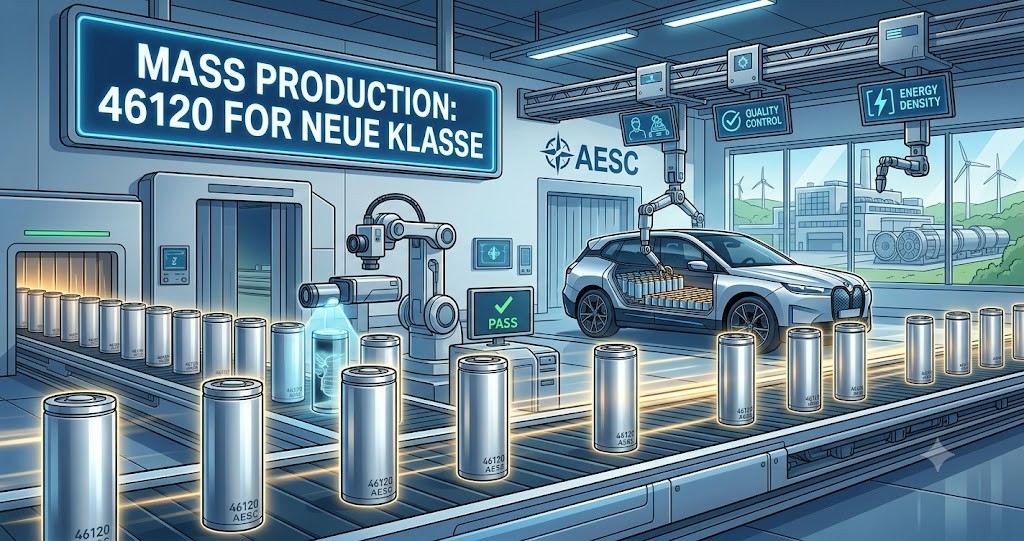
車載用バッテリー大手のAESCが、BMWグループの次世代電気自動車(EV)専用プラットフォーム「ノイエ・クラッセ(Neue Klasse)」向けに、新型の大型円筒形バッテリー「46120」の量産を開始しました。これは、EVの航続距離や生産効率を大幅に向上させる重要なマイルストーンとなります。本記事では、この発表の概要と、技術的な背景や関連情報を交えて解説します。
発表の概要と主なポイント
- BMWの次世代EVへ供給開始 AESCは、BMWの新型EVプラットフォーム「ノイエ・クラッセ」を採用した世界展開モデル向けに、「46120」セルの量産を開始しました。先日発表された完全電気自動車「BMW iX5」が、このプラットフォームと46120大型円筒形バッテリーを搭載する最初のモデルとなります。
- AESC CEOのコメント デビッド・ワン(David Wang)グローバルCEOは、長年の研究開発の成果により量産・世界供給が可能になったことを強調。大手自動車メーカー(OEM)からの高い信頼を背景に、今後も次世代EVの市場投入を支援していく姿勢を示しました。
- 圧倒的な品質管理体制 量産ラインには、製造工程全体で1000箇所以上のCCD画像検査チェックポイントを配置。さらに全数(100パーセント)へのX線スキャンによる異物検出を実施しています。リニアモーター(磁気浮上式)を用いた高速搬送と高精度な製造プロセスにより、0.01mm(ミリメートル)以内という極めて高い寸法精度と一貫した品質を維持しています。
技術的特徴:新型バッテリー「46120」とは?
「46120」という数字は、直径46mm、高さ120mmというセルのサイズを表しています。テスラが提唱した「4680」規格(直径46mm、高さ80mm)などと同様、現在のEV業界でトレンドとなっている「大型円筒形(タブレス)バッテリー」の延長線上にある規格です。
従来型(角型や小型円筒形)との比較メリット
- エネルギー量の増加: セル1個あたりの使用可能エネルギーが従来の形式に比べて約30パーセント向上。
- コスト削減と効率化: セル自体が大型化したことで、バッテリーパック全体に必要な部品点数が減少。これにより、システム統合効率が向上し、車両設計の柔軟性が高まりました。
- 高いエネルギー密度: 正極に「高ニッケル」、負極に「シリコン添加」の素材を採用。エネルギー密度は最大310Wh/kg(ワット時毎キログラム)に達し、大型SUVなどの高級EVが求める「長い航続距離」と「高い動力性能」を両立します。
- 優れた安全性: 独自の構造設計と熱管理(冷却)設計により、システムレベルでの安全性と長期的な信頼性を確保しています。
関連情報・補足:BMWとAESCのグローバル戦略
1. BMWの「ノイエ・クラッセ(Neue Klasse)」とは
BMWが2025年以降の次世代EVに向けて開発した専用プラットフォーム(車台)の名称です。1960年代にBMWを財政危機から救った名車シリーズにあやかって命名されました。このプラットフォームでは、従来の角型バッテリーから、今回の「第6世代」と呼ばれる円筒形バッテリーへの移行が宣言されており、充電速度の30パーセント高速化や航続距離の30パーセント向上、コストの大幅削減を目指しています。
2. 供給を支えるAESCの「地産地消」ネットワーク
AESC(旧日産系の中央電気自動車用バッテリー会社がルーツ、現在は中国・遠景グループ傘下などを含むグローバル企業)は、世界中にある主要な自動車市場での「現地生産」を強みとしています。 現在、以下の6カ国に先進的な製造拠点を構築しています。
- 日本
- 中国
- 米国
- 英国
- フランス
- スペイン
この強固なグローバル・サプライチェーン能力により、各地域の通商規制(米国のIRA法や欧州のバッテリー法など)に対応しながら、BMWをはじめとするグローバル自動車メーカーへ安定して次世代バッテリーを供給できる体制を整えています。
AESC Begins Mass Production of “46120” Large Cylindrical Batteries for BMW Next-Generation EVs — Achieving an Energy Density of 310 Wh/kg
Introduction
AESC, a leading automotive battery manufacturer, has commenced mass production of its new “46120” large cylindrical battery cells for the BMW Group’s next-generation electric vehicle (EV) dedicated platform, “Neue Klasse.” This marks a major milestone that will significantly enhance EV driving range and production efficiency. This article provides an overview of the announcement, along with its technical background and related insights.
Overview and Key Points
- Commencing Supply for BMW’s Next-Generation EVs AESC has started mass production of the “46120” cells for globally deployed models utilizing BMW’s new EV platform, “Neue Klasse.” The recently announced all-electric BMW iX5 will be the first model to feature this platform and be equipped with the 46120 large cylindrical batteries.
- Comment from AESC CEO David Wang, Global CEO of AESC, emphasized that years of research, development, and manufacturing expertise have made mass production and global supply possible. Backed by high trust from major automakers (OEMs), he expressed commitment to supporting customers in bringing more competitive next-generation EVs to market.
- Uncompromising Quality Control System The production lines integrate more than 1,000 CCD image inspection checkpoints throughout the manufacturing process. Furthermore, a 100 percent X-ray scan is conducted on every cell for foreign matter detection. By combining a high-speed magnetic levitation transport system with high-precision manufacturing processes, the company achieves an extremely tight dimensional accuracy within 0.01 mm, maintaining consistent quality even at mass-production scale.
Technical Features: What is the New “46120” Battery?
The numbers “46120” represent the cell size: a diameter of 46 mm and a height of 120 mm. Similar to the “4680” standard (46 mm diameter, 80 mm height) championed by Tesla, this format represents the latest evolution in “large cylindrical (tabless) batteries,” which is currently a major trend in the EV industry.
Advantages Compared to Conventional Formats (Prismatic or Small Cylindrical)
- Increased Energy Capacity: The usable energy per cell has increased by approximately 30 percent compared to conventional formats.
- Cost Reduction and Efficiency: The larger cell size reduces the number of components required in the overall battery pack. This improves system integration efficiency and enhances flexibility in vehicle design.
- High Energy Density: By utilizing a high-nickel cathode and a silicon-added anode, the cell achieves an energy density of up to 310 Wh/kg. This balances the long driving range and high dynamic performance demanded by premium EVs, such as large SUVs.
- Excellent Safety: Its structural and thermal management designs further elevate system-level safety and long-term reliability.
Related Insights & Context: BMW and AESC’s Global Strategy
1. What is BMW’s “Neue Klasse”?
“Neue Klasse” (New Class) is the name of the dedicated platform developed by BMW for its next-generation EVs from 2025 onward. It was named after the legendary vehicle series that saved BMW from a financial crisis in the 1960s. For this platform, BMW has announced a transition from conventional prismatic batteries to these “sixth-generation” cylindrical batteries, aiming for 30 percent faster charging speeds, a 30 percent increase in driving range, and a significant reduction in production costs.
2. AESC’s “Local Production for Local Consumption” Network Supporting Supply
AESC (which originated from Nissan’s automotive battery joint venture and is now a global enterprise under China’s Envision Group and other stakeholders) leverages “local production” in major automotive markets worldwide as a core strength. The company currently establishes advanced manufacturing footprints in the following six countries:
- Japan
- China
- United States
- United Kingdom
- France
- Spain
This robust global supply chain capability enables AESC to maintain a stable supply of next-generation batteries to global automakers like BMW, while effectively adapting to regional trade regulations such as the US Inflation Reduction Act (IRA) and the EU Battery Regulation.

コメント