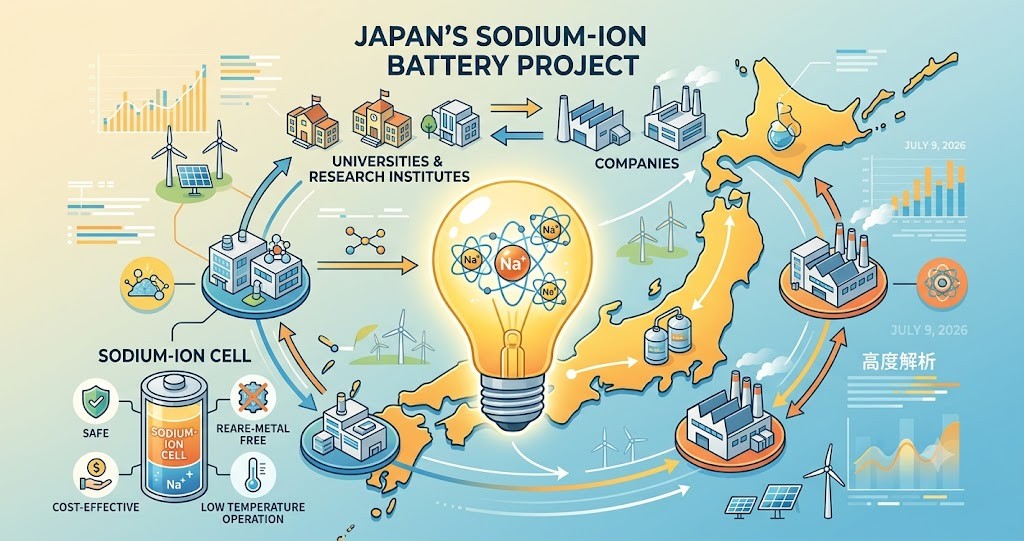
2026年7月9日、次世代蓄電池として世界中から注目を集める「ナトリウムイオン電池」の実用化に向け、日本の産学官が連携した大規模な技術開発プロジェクトが始動したことが発表されました。カーボンニュートラル社会の実現に不可欠な蓄電池技術において、日本独自の強みを生かしたサプライチェーンの構築が期待されています。
以下に、発表されたニュースの要点と、技術的な背景などの関連情報をまとめました。
【ニュースのまとめ】 東京理科大学の駒場慎一教授が代表を務める研究課題「ナトリウムイオン電池の技術開発」が、NEDO(新エネルギー・産業技術総合開発機構)の「革新型蓄電池技術開発・高度解析」事業に採択されました。
このプロジェクトには、東京理科大学をはじめ、GSユアサ、武蔵エナジーソリューションズ、クラレ、東亞合成、MUアイオニックソリューションズ(三菱ケミカル)、東北大学、東京大学、早稲田大学、東京農工大学、群馬大学、大阪大学産業科学研究所、物質・材料研究機構(NIMS)という計13の企業・大学・研究機関が共同で参画します。
15年以上にわたり蓄積されてきた学術的知見と技術基盤をもとに、今後は部材開発から電池セルの設計、さらには量産プロセスの検討までを一体となって進め、日本発の次世代技術であるナトリウムイオン電池の早期実用化を目指します。
【関連情報と技術的背景】
1. なぜ「ナトリウムイオン電池」が求められているのか 現在、電気自動車(EV)やスマートフォンなどで広く用いられているリチウムイオン電池(LIB)は、エネルギー密度が高い反面、リチウム、コバルト、黒鉛といった特定の資源に依存しています。これらの材料は産出や精製が一部の国に偏在しているため、地政学的な資源調達リスクが大きな課題となっています。
一方、ナトリウムイオン電池は、2011年に駒場教授が世界で初めてレアメタルフリー構成での安定作動を実証した技術です。海水などに無尽蔵に含まれるナトリウムを利用するため、資源枯渇の心配や調達リスクが極めて低く、蓄電池供給網の自律性を飛躍的に高めることができます。さらに、低温環境下での動作特性に優れ、急速充放電がしやすく、発火リスクが低い(安全性が高い)といった運用上のメリットも注目されています。
2. NEDO事業の狙いと「高度解析」の導入 今回のNEDO事業(期間は2026年度から2027年度を予定)は、蓄電池材料の資源リスクを低減しつつ、日本の蓄電池産業の競争力を強化することが目的です。 このプロジェクトの大きな特徴は、開発と並行して「高度解析」を行う点にあります。例えば、参画機関である東北大学は、次世代放射光施設「NanoTerasu(ナノテラス)」などを活用し、充放電中の電極材料の構造変化や反応メカニズムをその場で可視化・解析します。このような最先端の分析技術を用いることで、性能向上のボトルネックを解消し、技術のブレークスルーを加速させます。
3. 今後の市場展望 2050年のカーボンニュートラル(CO2などの温室効果ガス排出実質ゼロ)の達成に向けて、再生可能エネルギーの電力需給調整やデータセンター向けのバックアップ電源など、大型定置用を中心とした蓄電池の需要は急増しています。エネルギー密度においてまだリチウムイオン電池に及ばない部分を補うためにも、コスト競争力と安全性に優れるナトリウムイオン電池の実用化は、多様化する蓄電池ニーズに応える重要な鍵となります。
【総括】 今回のNEDO事業への採択は、資源を持たない日本が、自国の技術力と豊富に存在するナトリウムを用いてエネルギー安全保障を確立するための重要なマイルストーンです。基礎研究を牽引してきた大学と、製造・社会実装を担う企業群が強力なタッグを組むことで、次世代蓄電池の分野で日本が再び世界をリードしていくことが強く期待されます。
出典:https://www.excite.co.jp/news/article/Prtimes_2026-07-09-102047-263/
“Technology Development of Sodium-ion Batteries,” a Joint Proposal by Tokyo University of Science and 12 Organizations, Selected for NEDO’s “Development of Inovative Next-Generation Electricity Storage Technology / Advanced Analysis” Project
On July 9, 2026, it was announced that a large-scale technological development project collaborating among Japan’s industry, academia, and government has been launched to commercialize sodium-ion batteries, which are drawing global attention as next-generation energy storage systems. In the field of battery technology, which is indispensable for achieving a carbon-neutral society, there are high expectations for building a supply chain that leverages Japan’s unique strengths.
Below is a summary of the key points of the announced news along with relevant information, including the technical background.
[Summary of the News]
The research project “Technology Development of Sodium-ion Batteries,” led by Professor Shinichi Komaba of Tokyo University of Science, has been selected for the “Development of Innovative Next-Generation Electricity Storage Technology / Advanced Analysis” project by the New Energy and Industrial Technology Development Organization (NEDO).
A total of 13 companies, universities, and research institutions will jointly participate in this project. These include Tokyo University of Science, GS Yuasa, Musashi Energy Solutions, Kuraray, Toagosei, MU Ionic Solutions (Mitsubishi Chemical), Tohoku University, The University of Tokyo, Waseda University, Tokyo University of Agriculture and Technology, Gunma University, the Institute of Scientific and Industrial Research at Osaka University, and the National Institute for Materials Science (NIMS).
Based on the academic knowledge and technological foundations accumulated over more than 15 years, the participants will work together from component development to battery cell design, and even the evaluation of mass production processes, aiming for the early commercialization of sodium-ion batteries—a next-generation technology originating in Japan.
[Related Information and Technical Background]
1. Why Sodium-ion Batteries Are in Demand Lithium-ion batteries (LIBs), currently widely used in electric vehicles (EVs) and smartphones, offer high energy density but rely heavily on specific resources such as lithium, cobalt, and graphite. Because the extraction and refinement of these materials are concentrated in a limited number of countries, geopolitical risks regarding resource procurement have become a major issue.
In contrast, sodium-ion batteries are a technology whose stable operation in a rare-metal-free configuration was demonstrated for the first time in the world by Professor Komaba in 2011. Since they utilize sodium, which is inexhaustibly available in places like seawater, the concerns over resource depletion and procurement risks are extremely low, vastly enhancing the autonomy of the battery supply chain. Furthermore, they are attracting attention for their operational advantages, including excellent performance under low-temperature environments, capability for fast charging and discharging, and low ignition risks (high safety).
2. Objectives of the NEDO Project and Introduction of “Advanced Analysis” This NEDO project (scheduled for fiscal years 2026 to 2027) aims to strengthen the competitiveness of Japan’s battery industry while reducing resource risks associated with battery materials. A major feature of this project is that it conducts “advanced analysis” in parallel with development. For example, Tohoku University, one of the participating institutions, will utilize the next-generation synchrotron radiation facility “NanoTerasu” to visualize and analyze the structural changes and reaction mechanisms of electrode materials in real-time during charging and discharging. Using such state-of-the-art analytical techniques will help resolve performance bottlenecks and accelerate technological breakthroughs.
3. Future Market Outlook Toward achieving carbon neutrality by 2050 (net-zero emissions of greenhouse gases like CO2), the demand for batteries—particularly large stationary systems—is surging for applications such as supply-and-demand adjustment of renewable energy and backup power sources for data centers. Even though sodium-ion batteries do not yet match lithium-ion batteries in terms of energy density, their commercialization, backed by excellent cost-competitiveness and safety, will serve as a vital key to meeting diversifying battery needs.
[Conclusion]
This selection for the NEDO project marks a critical milestone for resource-scarce Japan to establish energy security by leveraging its own technological capabilities and abundant sodium. With universities that have led fundamental research teaming up strongly with corporate groups responsible for manufacturing and social implementation, there are high expectations for Japan to lead the world once again in the field of next-generation energy storage.

コメント