自動車業界が次世代の電動化へ向かう中、固体電池の「パイロット生産から量産化(ギガファクトリー規模)への移行」が最大の焦点となっています。
米国の固体電池開発企業であるFactorial社のCTO、アレックス・ユー(Alex Yu)博士へのインタビューから、欧州がアジアや米国などの競合に対抗し、この次世代技術で世界のトップに立つための具体的な戦略が見えてきました。ユー博士は、もはや課題は「化学(技術開発)」ではなく「工業化(大量生産)」のフェーズに移っていると指摘します。
本記事では、Factorial社が提示する製造インフラの革新、サプライチェーン戦略、独立試験と標準化の重要性に加え、欧州の現在の立ち位置や競合状況などの関連情報を交えて分かりやすく解説します。
- 1. 製造インフラの革新:既存設備との互換性とAIの活用
- 2. 欧州がサプライチェーンで主導権を握るための戦略
- 3. 徹底した検証と国際標準化:市場の信頼獲得
- 💡 関連情報・補足
- まとめ
- Europe’s Path to Solid-State Battery Dominance: Factorial Insights on the Shift to Mass Production and Supply Chain Strategy
1. 製造インフラの革新:既存設備との互換性とAIの活用
固体電池を大規模かつ安定的に製造するためには、莫大な投資を伴う「工場の全面刷新」を避けることが最優先事項となります。
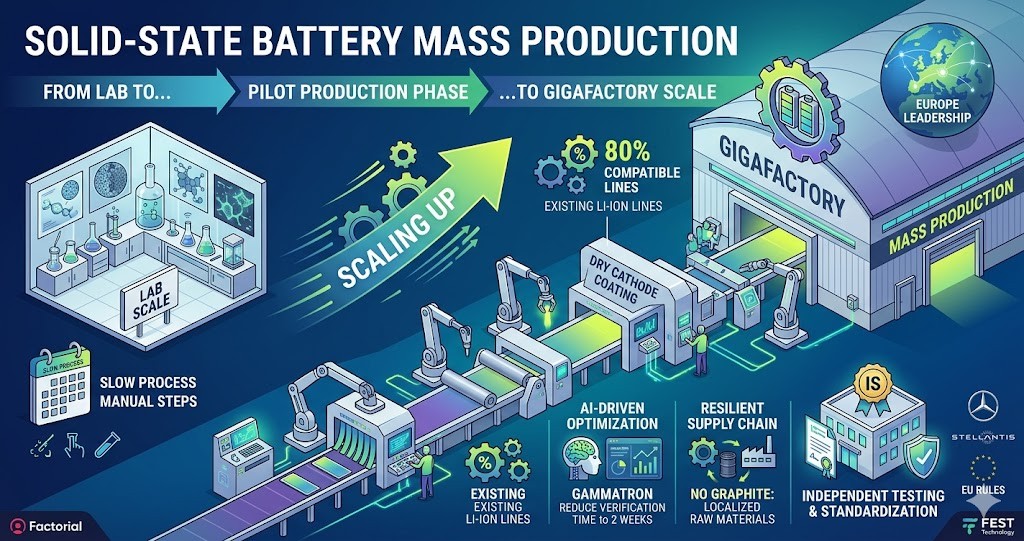
- 既存ラインとの高い互換性 Factorial社の独自技術「FEST(Factorial Electrolyte System Technology)」は、従来のリチウムイオン電池組立ラインの最大80%をそのまま活用できるように設計されています。これにより、既存のギガファクトリーの大規模な改修による固体電池への移行が可能になります。
- ドライコーティング技術によるプロセスの簡素化 次世代の「Solstice」プラットフォームでは、ドライカソードコーティング技術を採用しています。これにより、従来の電池製造で最もエネルギーを消費していた「溶剤の使用」と「大型乾燥炉」が不要になり、工程の簡素化とコスト削減を同時に実現します。
- AIと高度なインライン計測による品質管理 固体電池は従来よりもはるかに厳しい公差(制度の許容範囲)が求められます。Factorial社は、AIを活用した最適化プラットフォーム「ガンマトロン」を導入し、従来は3カ月から6カ月かかっていた長期性能の検証期間を「2週間(最大80%短縮)」にまで短縮しています。
2. 欧州がサプライチェーンで主導権を握るための戦略
ユー博士は、欧州が既存の自動車エコシステム(自動車メーカーや部品サプライヤーの強固なネットワーク)を活かせば、固体電池の製造・実証の世界的中心地になれると強調します。
- グラファイト不使用によるボトルネックの解消 Factorial社のアーキテクチャは、アノード(負極)にグラファイト(黒鉛)を使用しません。これにより、現在の世界のバッテリーサプライチェーンにおいて政治的・地政学的に最もデリケートなボトルネック(中国への依存など)を回避できます。
- 上流・中流プロセスの国内回帰(ローカライズ) 欧州が長期的なパートナーシップを通じて、リチウム金属や固体電解質などの主要原料の生産能力を域内に確保することが求められます。
- 独自の設備エコシステムの構築 コーティング、積層、成形、そしてリサイクルといった高精度な製造ノウハウと設備を欧州独自に構築・管理することで、中国中心のサプライチェーンとは明確に差別化された「信頼性の高いネットワーク」を構築できます。
3. 徹底した検証と国際標準化:市場の信頼獲得
CESなどの展示会では「エネルギー密度の飛躍的向上」や「数分でのフル充電」といった大胆な主張が飛び交いますが、ユー博士は「誇張された主張は業界全体の信頼を失墜させる」と警鐘を鳴らします。
- 多層的な検証プロセスの重要性 Factorial社は、社内データだけでなく、第三者機関による独立したラボテスト、そして実世界でのシステムレベルの実証(マルチレイヤー検証)を重視しています。実際に、メルセデス・ベンツのEQSテスト車両に同社のセルを搭載し、1回の充電で1200kmの走行を実証したほか、ステランティス社との共同で車載用全固体電池の認証を取得しています。
- 欧州が主導する国際標準化 エネルギー密度、サイクル寿命、安全性、急速充電に関する共通の試験プロトコル(標準規格)が必要です。欧州が国際標準化団体において、試験方法やデータ報告のフレームワーク策定をリードすることで、世界のルールブックを自国に有利に形成し、導入リスクを軽減することができます。
💡 関連情報・補足
① 欧州のバッテリー政策と競合環境
欧州連合(EU)は「欧州バッテリー同盟(EBA)」などを通じて、域内でのギガファクトリー建設を強力に支援しています。特にサステナビリティ(持続可能性)やリサイクルに関する厳しい規制(欧州バッテリー規制)を設けることで、環境性能を武器にアジア勢(中国のCATLやBYD、韓国のLGなど)に対抗しようとしています。Factorial社のドライコーティング技術などは、EUの厳しい環境基準に適合する強力な武器となります。
② 米国での展開(Karma Automotiveとの連携)
Factorial社は欧州だけでなく、米国市場においても高級EVメーカーのKarma Automotiveと提携し、米国初となる全固体電池の生産プログラムを発表するなど、グローバルに工業化の実証を進めています。
まとめ
欧州が固体電池の開発・普及競争でリードするためには、以下の3つの柱を連動させた産業政策が必要です。
- 既存工場の改修(80%の設備互換性)とドライコーティングなどのプロセス簡素化による「コストの抑制」
- グラファイト排除や主要原料の域内確保による「中国依存からの脱却とサプライチェーンの多様化」
- 第三者機関による厳格なテストと、欧州主導の「国際標準化によるルールの掌握」
見出しを飾るスペック競争ではなく、地道で規律ある製造プロセスのイノベーションと、自動車OEM(メルセデス・ベンツやステランティスなど)との強固なパートナーシップを実証し続けた地域が、次世代EV市場の覇権を握ることになります。
Europe’s Path to Solid-State Battery Dominance: Factorial Insights on the Shift to Mass Production and Supply Chain Strategy
As the automotive industry charges toward next-generation electrification, the transition of solid-state batteries from pilot production to mass deployment at gigafactory scale has become the ultimate focal point.
An interview with Dr. Alex Yu, CTO of US-based solid-state battery developer Factorial, reveals a concrete strategy for Europe to counter competitors in Asia and the US and secure a global leadership position in this next-generation technology. Dr. Yu points out that the industry’s primary challenge has shifted away from chemistry (technological development) and firmly into the phase of industrialization (mass production).
This article provides an easy-to-understand breakdown of Factorial’s insights on manufacturing infrastructure innovation, supply chain strategies, and the critical importance of independent testing and standardization, while integrating relevant context regarding Europe’s current positioning and competitive landscape.
1. Innovation in Manufacturing Infrastructure: Compatibility with Existing Equipment and AI Utilization
To manufacture solid-state batteries stably and at scale, avoiding a complete factory overhaul—which requires astronomical capital investment—is the highest priority.
- High Compatibility with Existing Lines Factorial’s proprietary FEST (Factorial Electrolyte System Technology) is designed to utilize up to 80% of existing lithium-ion battery assembly lines. This compatibility allows for a seamless transition to solid-state batteries via the retrofitting of current gigafactories.
- Process Simplification via Dry Coating Technology The next-generation Solstice platform adopts dry cathode coating technology. This eliminates the need for solvents and massive drying ovens—the most energy-intensive steps in traditional battery manufacturing—simultaneously simplifying the process and slashing costs.
- Quality Control through AI and Advanced In-Line Metrology Solid-state batteries require much tighter tolerances than conventional lithium-ion cells. Factorial has introduced Gammatron, an AI-powered optimization platform that accelerates long-term performance validation, compressing the timeline from the traditional 3 to 6 months down to just 2 weeks (an 80% reduction).
2. Strategy for Europe to Seize Supply Chain Leadership
Dr. Yu emphasizes that by leveraging its existing automotive ecosystem—a robust network of automakers and component suppliers—Europe can establish itself as the premier global hub for manufacturing and validating solid-state technology.
- Eliminating Bottlenecks by Going Graphite-Free Factorial’s architecture does not use graphite in the anode. This bypasses one of the most politically and geopolitically sensitive bottlenecks in today’s global battery supply chain, namely the heavy reliance on China.
- Reshoring Upstream and Midstream Processes (Localization) Europe must secure regional production capacity for key raw materials, such as lithium metal and solid-state electrolytes, through long-term strategic partnerships.
- Building a Proprietary Equipment Ecosystem By independently developing and managing high-precision manufacturing expertise and equipment for coating, stacking, formation, and recycling, Europe can establish a reliable network that clearly differentiates itself from China-centric supply chains.
3. Rigorous Validation and International Standardization: Building Market Trust
While trade shows like CES are flooded with bold claims of quantum leaps in energy density and full charges in minutes, Dr. Yu warns that unverified hype risks setting the reputation of the entire industry back.
- The Critical Importance of Multi-Layered Validation Factorial prioritizes a multi-layered verification process that combines internal data, independent third-party laboratory testing, and real-world system-level demonstrations. In real-world applications, Mercedes-Benz demonstrated a range of 1200 km on a single charge using Factorial’s cells in a modified EQS test vehicle, and Stellantis has jointly validated their automotive-scale solid-state cells.
- European-Led International Standardization The industry requires unified testing protocols for energy density, cycle life, safety, and fast charging. By taking an active role in international standardization bodies to establish testing methods and data-reporting frameworks, Europe can de-risk adoption and ensure its own technological assumptions shape the global rulebook.
💡 Related Information and Insights
I. European Battery Policy and Competitiveness
Through initiatives like the European Battery Alliance (EBA), the European Union aggressively supports the construction of regional gigafactories. By implementing strict regulations on sustainability and recycling (such as the EU Battery Regulation), Europe aims to counter Asian heavyweights (like China’s CATL and BYD, and South Korea’s LG) using environmental performance as a competitive edge. Factorial’s dry coating technology serves as a powerful tool that aligns perfectly with these stringent European environmental standards.
II. US Expansion: Collaboration with Karma Automotive
Factorial’s industrialization efforts extend beyond Europe. In the US market, the company has partnered with luxury EV manufacturer Karma Automotive to announce the country’s first solid-state battery production program, demonstrating the global scale of their manufacturing deployment.
Summary
For Europe to lead the race in solid-state battery development and adoption, it must deploy a cohesive industrial policy built on three core pillars:
- Cost Suppression: Retrofitting existing factories (80% equipment compatibility) and simplifying processes via technologies like dry coating.
- Supply Chain Diversification: Eliminating graphite and securing key raw materials regionally to break free from Chinese dependencies.
- Rule Dominance: Securing strict third-party testing and leading international standardization efforts to control global benchmarks.
The ultimate winners of the next-generation EV market will not be the teams chasing the flashiest specs for headlines, but rather the region that delivers disciplined, iterative innovations in manufacturing processes while validating them through rock-solid partnerships with automotive OEMs like Mercedes-Benz and Stellantis.
コメント