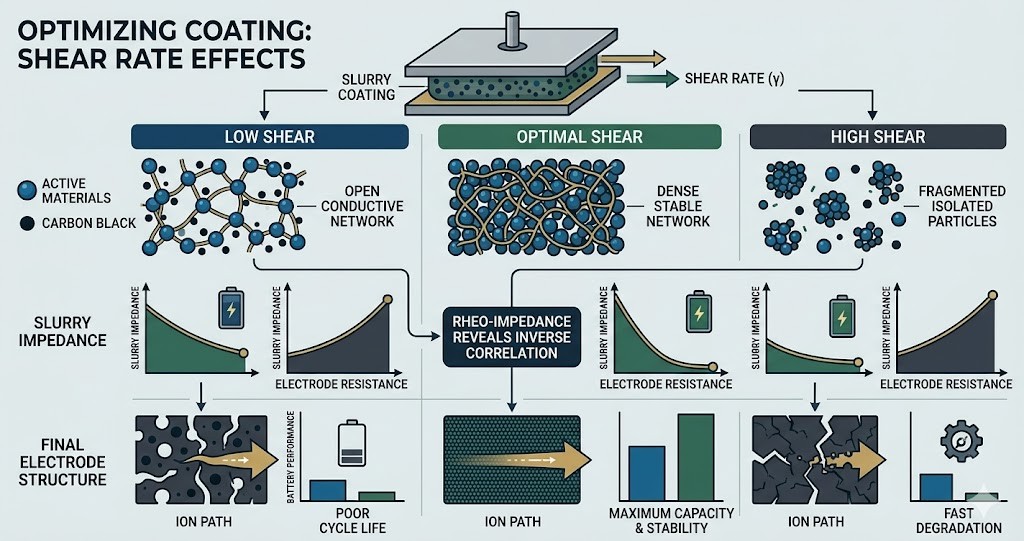
本報告では、リチウムイオン電池(LIB)の製造プロセス、特に正極スラリーのコーティング工程におけるせん断速度(γ)が、最終的な電極構造および電池性能に与える影響を、最新のレオインピーダンス分光法を用いて解析した研究結果をまとめます。
リチウムイオン電池の電極性能は、スラリー中の活物質や導電助剤(カーボンブラック)の分散状態に大きく左右されます。従来、この状態をリアルタイムで把握することは困難でしたが、レオロジー(流動性)とインピーダンス(電気抵抗)を同時に測定する本手法により、製造現場に近い動的な条件下での評価が可能となりました。
1. レオインピーダンス分光法によるスラリー評価
レオインピーダンス測定では、回転レオメーターの電極板間にスラリーを保持し、実際のコーティング条件を模したせん断速度を加えながら電気抵抗を測定します。
- Rスラリー(スラリー抵抗)の挙動:せん断速度(γ)に対して非単調な変化を示します。
- 低せん断: カーボンブラックが大きな凝集体として存在し、一時的な「導電ブリッジ」を形成するため、抵抗は比較的低くなります。
- 中せん断: 凝集体が適度に解け、分散が進む過程でネットワークが複雑化(曲がりくねり度が増加)し、一時的に抵抗が増大します(Rスラリーが最大化)。
- 高せん断: 粒子が過度に断片化され、粒子同士の衝突頻度が増えることで、再び抵抗が減少します。
2. スラリー特性と電極性能の逆相関
本研究の最も重要な発見は、流動状態のRスラリーと、乾燥・作製後のR電極(電極抵抗)の間に強い逆相関(負の相関)が見られたことです。
- 相関のメカニズム:
- Rスラリーが最大となる「中せん断領域」で、乾燥後のR電極は最小となります。
- これは、動的な流動下で抵抗が高い状態(適度な分散状態)こそが、静止した固体電極において最も効率的で安定した「電子伝導ネットワーク」を形成できることを示唆しています。
3. 電池性能への影響
コーティング時のせん断速度(=コーティング速度)を最適化することで、電池の諸特性が顕著に向上することが確認されました。
3.1 電圧ヒステリシスと抵抗
- 中せん断(約 5.0 x 10^1 s^-1)でコーティングした電極は、充放電時の電位差(ヒステリシス)が最小となり、リチウムイオンの挿入・脱離がスムーズに行われます。
- 逆に、極端に低い速度や高い速度では、カーボンブラックの配置が不均一または断片的になり、抵抗が増大します。
3.2 サイクル安定性とレート特性
- プレス前電極: 最適なせん断速度で塗工された電極のみが安定したサイクル寿命を示しました。不適切な条件では、数サイクルで急激な容量劣化が起こります。
- ロールプレス後: プレス工程により粒子間距離が縮まり、全体的な性能は向上しますが、それでも高せん断(過分散)で塗工された電極は、微細なカーボン粒子が電気的接点を失いやすく、長期サイクルにおける劣化が早い傾向にあります。
4. 結論:製造プロセスの最適化に向けて
本研究により、レオインピーダンス分光法を用いることで、実際に電池を組み立てて試験することなく、スラリーの段階で最適なコーティング速度を予測できる可能性が示されました。
| せん断速度 (γ) | スラリーの状態 | Rスラリー | R電極 | 電池性能 |
| 低 (1.2 x 10^0) | 粗大凝集体が残存 | 低い | 高い | 悪い (低寿命) |
| 中 (5.0 x 10^1) | 最適分散・安定ネットワーク | 高い (最大) | 低い (最小) | 最高 (安定寿命) |
| 高 (2.0 x 10^2) | 過度な断片化・孤立 | 低い | 高い | 悪い (高速劣化) |
ポイント:
コーティング速度を単に速くするのではなく、レオインピーダンス特性から導き出される「抵抗最大点」付近の条件を選択することが、高品質な LiFePO4 正極製造の鍵となります。これにより、データ駆動型の電極製造最適化と、開発期間の短縮が期待されます。
この解析結果は、今後の電池製造におけるインラインモニタリングや、新規材料のスラリー設計における重要な指針となります。
出典:https://www.sciencedirect.com/science/article/pii/S0378775326009250?via%3Dihub
Moving Beyond Trial and Error: Optimizing Lithium-Ion Battery Electrode Manufacturing via Rheo-Impedance Spectroscopy
This report summarizes research results analyzing the impact of shear rate (gamma) during the cathode slurry coating process on the final electrode structure and battery performance, utilizing state-of-the-art Rheo-Impedance Spectroscopy.
The electrode performance of lithium-ion batteries (LIBs) heavily depends on the dispersion state of active materials and conductive additives (carbon black) within the slurry. While monitoring this state in real-time was previously difficult, this method—which simultaneously measures rheology (flow properties) and impedance (electrical resistance)—enables evaluation under dynamic conditions that closely mimic actual manufacturing environments.
1. Slurry Evaluation via Rheo-Impedance Spectroscopy
In rheo-impedance measurements, slurry is held between the electrode plates of a rotational rheometer. Electrical resistance is measured while applying shear rates that simulate actual coating conditions.
- Behavior of Slurry Resistance (R_slurry):R_slurry exhibits a non-monotonic response to the shear rate (gamma).
- Low Shear: Carbon black exists as large aggregates, forming temporary “conductive bridges,” resulting in relatively low resistance.
- Moderate Shear: Aggregates are moderately broken down. As dispersion progresses, the network becomes more complex (increased tortuosity), causing a temporary increase in resistance (R_slurry peaks).
- High Shear: Particles become excessively fragmented. Increased collision frequency between particles causes the resistance to decrease again.
2. Inverse Correlation Between Slurry Properties and Electrode Performance
The most significant finding of this study is the strong inverse correlation (negative correlation) observed between R_slurry in the fluid state and R_electrode (electrode resistance) after drying and fabrication.
- Correlation Mechanism:
- At the “Moderate Shear Region” where R slurry is at its maximum, the dried R_electrode reaches its minimum.
- This suggests that a high-resistance state under dynamic flow (representing an optimal dispersion state) is precisely what forms the most efficient and stable electron-conduction network in the static solid electrode.
3. Impact on Battery Performance
Optimizing the shear rate during coating (i.e., the coating speed) significantly improves various battery characteristics.
3.1 Voltage Hysteresis and Resistance
- Electrodes coated at moderate shear (approx. 5.0 x 10^1 s^-1) exhibit the minimum potential difference (hysteresis) during charging and discharging, facilitating smooth lithium-ion insertion and extraction.
- Conversely, at extremely low or high speeds, the distribution of carbon black becomes either non-uniform or fragmented, leading to increased resistance.
3.2 Cycle Stability and Rate Capability
- Unpressed Electrodes: Only electrodes coated at the optimal shear rate demonstrated stable cycle life. Under inappropriate conditions, rapid capacity degradation occurred within a few cycles.
- Post-Roll Pressing: While the pressing process compacts the layer and improves overall performance, electrodes coated at high shear (over-dispersed) still tend to degrade faster during long-term cycling because fine carbon particles easily lose electrical contact.
4. Conclusion: Toward Manufacturing Process Optimization
This research demonstrates that rheo-impedance spectroscopy makes it possible to predict the optimal coating speed at the slurry stage, without the need to assemble and test actual batteries.
| Shear Rate (γ) | Slurry State | Rslurry | Relectrode | Battery Performance |
| Low (1.2 x 10^0) | Coarse aggregates remain | Low | High | Poor (Short life) |
| Mid (5.0 x 10^1) | Optimal dispersion / Stable network | High (Max) | Low (Min) | Best (Stable life) |
| High (2.0 x 10^2) | Excessive fragmentation / Isolation | Low | High | Poor (Rapid degradation) |
Key Takeaway:
The key to high-quality LiFePO4 cathode manufacturing is not simply increasing coating speed, but selecting conditions near the “resistance maximum” derived from rheo-impedance characteristics. This approach enables data-driven optimization of electrode manufacturing and is expected to shorten development cycles.
These analytical results serve as a vital guideline for future in-line monitoring in battery production and slurry design for next-generation materials.


コメント