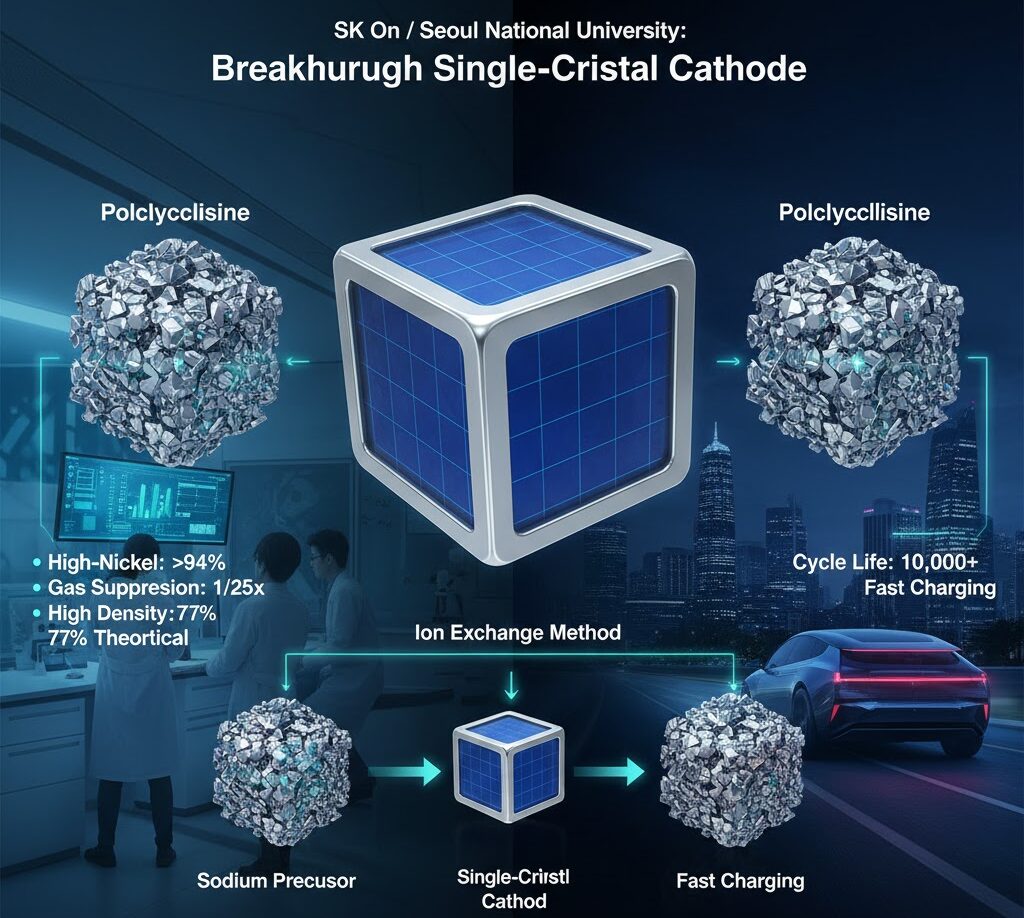
2026年1月8日、韓国のバッテリー大手SKオンは、ソウル国立大学のカン・キスク教授チームとの共同研究により、電池の寿命、安定性、エネルギー密度を劇的に向上させる高密度大型単結晶正極材の開発に成功したと発表しました。この内容は世界的な学術誌「Nature Energy」に掲載されました。
1. 従来の「多結晶」から「単結晶」への転換
現在、電気自動車(EV)用リチウムイオン電池の主流は多結晶(Polycrystalline)構造です。
- 課題: 複数の小さな結晶が集まっているため、充放電を繰り返すと結晶間の境界が割れ(クラック)、そこからガスが発生して電池が膨張・劣化する原因となっていました。
- 解決策(単結晶): 粒子全体を一つの結晶として形成する単結晶(Single-crystal)構造にすることで、物理的な割れに強く、安定性と寿命が大幅に向上します。
2. 画期的な新合成法:「イオン交換法」の採用
従来、単結晶を作るには高温・長時間の熱処理が必要で、その過程でリチウムイオンとニッケルイオンが混ざり合う「陽イオンの無秩序性(Cation Disorder)」が発生し、性能が低下するのが課題でした。
- 新手法: まず、結晶成長が容易な「ナトリウム系」の正極材を作成。その後、ナトリウムをリチウムに置き換えるイオン交換プロセスを採用しました。
- 成果: 陽イオンの乱れがない、粒子径 10マイクロメートル(従来の約2倍)の超大型単結晶の合成に成功しました。
3. 主要な性能向上データ
- 超高ニッケル: ニッケル含有量 94% 以上を実現(1回の充電での走行距離が延長)。
- ガスの抑制: 従来の多結晶カソードと比較して、ガス発生量を 25分の1 に低減。
- 高密度: 理論結晶密度の最大 77% という高いエネルギー密度を達成。
【関連情報】背景と業界動向の補足
ハイニッケル(High-Nickel)化の競争
EVの航続距離を伸ばすためには、正極材に含まれるニッケルの比率を高める必要があります。しかし、ニッケル比率が高まるほど熱安定性が低下し、寿命が短くなるというジレンマがあります。今回のSKオンの技術は、この「高エネルギー密度」と「安定性」の両立を、構造レベルから解決した点に大きな意義があります。
ナトリウムイオン電池技術の応用
今回の研究で興味深いのは、次世代電池として注目される「ナトリウムイオン電池」の製造プロセスを、リチウムイオン電池の高性能化に応用した点です。これにより、既存の製造技術の枠を超えた新しい材料工学の道が開かれました。
韓国勢の技術的リード
テスラが提唱する「4680電池」などの大型円筒形セルにおいても、単結晶正極材の採用は不可欠とされています。LGエナジーソリューションやエコプロビーエムといった韓国勢も単結晶化を急いでおり、今回のSKオンの成果は、韓国のバッテリー業界が次世代材料分野で世界的な主導権を握り続けるための強力な武器となります。
まとめ表:次世代正極材の比較
| 項目 | 従来の多結晶(Polycrystalline) | 新開発の大型単結晶(Single-crystal) |
| 粒子構造 | 複数の微細な結晶の集合体 | 1つの巨大な結晶(10マイクロメートル) |
| 物理的安定性 | 圧力や熱で割れやすく、ガスが発生しやすい | 割れにくく、ガス発生を 25分の1 に抑制 |
| ニッケル含有量 | 段階的に向上中 | 94% 以上の「超高ニッケル」を実現 |
| 主なメリット | 製造コストが比較的安い | 圧倒的な長寿命、高密度、安全性 |
視点: 単なる素材の改良ではなく、合成プロセスそのものを根本から変えた(ナトリウム経由のイオン交換)ことが、今回のブレイクスルーの鍵となっています。
出典:https://askinno.com/global/archives/153680
On January 8, 2026, the South Korean battery giant SK On announced that it has successfully developed high-density, large single-crystal cathode materials that dramatically improve battery life, stability, and energy density. This achievement was made through joint research with Professor Kang Kisuk’s team at Seoul National University and has been published in the world-renowned academic journal, Nature Energy.
1. Shift from “Polycrystalline” to “Single-crystal”
Currently, the mainstream structure for lithium-ion batteries in electric vehicles (EVs) is polycrystalline.
- The Challenge: Polycrystalline structures consist of clusters of many small crystals. During repeated charge and discharge cycles, the boundaries between these crystals can crack. This leads to gas generation, which causes the battery to swell and degrade.
- The Solution (Single-crystal): By forming the entire particle as a single, continuous crystal, the structure becomes resistant to physical cracking. This significantly enhances both stability and lifespan.
2. Innovative Synthesis: The “Ion Exchange Method”
Traditionally, creating single crystals required high-temperature, long-duration heat treatment. This often caused “cation disorder”—a process where lithium and nickel ions mix—resulting in reduced battery performance.
- New Method: The researchers first created “sodium-based” cathode materials, which are easier to grow into stable single crystals. They then used an ion-exchange process to replace the sodium with lithium.
- Result: They successfully synthesized ultra-large single crystals with a particle size of 10 micrometers (about twice the size of conventional particles) without any cation disorder.
3. Key Performance Data
- Ultra-High Nickel: Achieved a nickel content of 94% or higher, extending the driving range per charge.
- Gas Suppression: Reduced gas generation to 1/25th (one-twenty-fifth) compared to conventional polycrystalline cathodes.
- High Density: Achieved an energy density of up to 77% of the theoretical crystal density.
[Related Information] Background and Industry Trends
The Race for “High-Nickel” Chemistry
To increase EV range, the proportion of nickel in cathode materials must be raised. However, higher nickel content typically leads to lower thermal stability and shorter lifespans. SK On’s technology is significant because it solves this dilemma—balancing high energy density with stability—at the structural level.
Application of Sodium-ion Battery Technology
A unique aspect of this research is applying the manufacturing process of sodium-ion batteries (currently a focus for next-generation energy storage) to improve lithium-ion batteries. This opens a new path in materials engineering that goes beyond existing manufacturing boundaries.
South Korea’s Technical Leadership
Large single-crystal cathodes are considered essential for large cylindrical cells, such as the “4680 battery” promoted by Tesla. Other South Korean players like LG Energy Solution and EcoPro BM are also racing to commercialize single-crystal technology. This breakthrough by SK On serves as a powerful tool for the Korean battery industry to maintain its global leadership in next-generation materials.
Summary Table: Comparison of Cathode Materials
| Item | Conventional Polycrystalline | New Large Single-crystal |
| Particle Structure | Aggregates of many fine crystals | Single large crystal (10 micrometers) |
| Physical Stability | Prone to cracking and gas generation | Resists cracking; gas reduced to 1/25th |
| Nickel Content | Increasing in stages | “Ultra-high” (94% or higher) |
| Main Advantage | Relatively lower manufacturing cost | Exceptional life, density, and safety |
Perspective: The key to this breakthrough is not just a material improvement, but a fundamental change in the synthesis process (ion exchange via sodium).

コメント