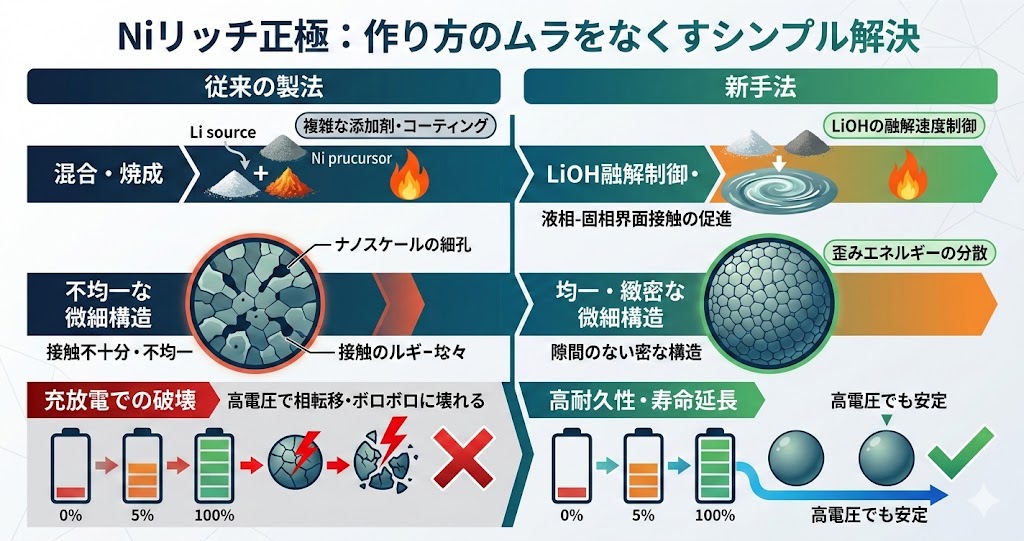
リチウムイオン電池のさらなる高容量化(EVの航続距離延長など)に向けて、世界中で「Niリッチ層状酸化物正極」の研究が加速しています。しかし、この材料には「高電圧でボロボロに壊れやすい」という致命的な弱点があり、これまでは複雑な添加剤や特殊なコーティングで無理やり補強するのが常識でした。
今回ご紹介する研究は、その常識を根本から覆すものです。「壊れる原因は材料の性質そのものではなく、作り方のムラにある」という新たな視点から、極めてシンプルな解決策を提示しています。
1. 背景:従来の課題と一般的見解
リチウムイオン電池のエネルギー密度を高めるため、ニッケル(Ni)含有量を増やした「Niリッチ正極」の開発が不可欠です。しかし、これには以下の課題が伴います。
- 化学機械的破壊: 充放電の際、結晶構造が変化する過程で体積が激しく膨張・収縮し、粒子内に亀裂(クラック)が生じる現象。
- 高電圧相転移: 高電圧状態での相転移が、この破壊の主因であると広く信じられてきました。
- 既存の対策: 元素ドーピング、表面コーティング、濃度勾配制御などの複雑な工程が必要とされ、製造コストやプロセス難易度の上昇を招いていました。
2. 本研究の革新的な発見
本研究は、「相転移そのものを止める」のではなく、「相転移に耐えうる微細構造をどう作るか」に焦点を当てています。
- 真の原因の特定: 破壊の根本原因は、焼成工程における「固体反応物間の接触不十分」から生じるナノスケールの細孔(微細構造の不均一性)にあることを突き止めました。
- 解決手法: LiOH(水酸化リチウム)の融解速度を制御。
- 液相-固相界面接触の促進: リチウム源を素早く溶かすことで、前駆体同士が均一に混ざり合い、隙間のない密な微細構造を形成します。
- 結果: この均一な構造により、激しい相転移が起きても歪みエネルギーを分散・解消できるようになり、亀裂の発生(化学機械的破壊)が抑制されました。
関連情報の補足:技術的キーワード解説
| 用語 | 補足説明 |
| Niリッチ正極 | 一般にNi含有率が80%以上の材料(NCM811など)。高容量だが、熱安定性とサイクル寿命に課題がある。 |
| H2-H3相転移 | 充電末期(高電圧時)に起こる相変化。c軸方向の急激な収縮を伴い、これが粒子破壊を誘発する。 |
| 液相焼成 (Liquid-phase sintering) | 本研究の核。液体成分を介することで物質の移動速度が上がり、緻密で欠陥の少ない結晶が得られる。 |
| 歪みエネルギーの消散 | 均一な微細構造を持つことで、特定の箇所に応力が集中するのを防ぎ、エネルギーを逃がす仕組み。 |
まとめ
本研究は、「複雑な添加物や多段階の工学設計を行わずとも、合成プロセスの最適化(LiOHの融解制御)だけでNiリッチ正極の寿命を劇的に延ばせる」ことを証明しました。
これは、「相転移の抑制こそが安定化の鍵である」という従来の定説を覆すものであり、低コストかつ高性能な次世代電池の製造に向けた、極めて実用的でエレガントなアプローチと言えます。
出典:https://www.nature.com/articles/s41560-026-01988-w
Chemo-mechanical Failure of Ni-rich Layered Oxide Cathodes and a New Mitigation Strategy
Research into Ni-rich layered oxide cathodes is accelerating worldwide to achieve higher capacity in lithium-ion batteries (e.g., extending the range of EVs). However, this material has a fatal weakness: it is prone to severe structural degradation at high voltages. Until now, the conventional wisdom was to “forcefully” reinforce the material using complex additives or special coatings.
This study fundamentally challenges that status quo. By shifting the perspective to the idea that “the cause of failure is not the inherent nature of the material, but rather inconsistencies in the manufacturing process,” it presents an extremely simple yet effective solution.
1. Background: Conventional Challenges and General Views
To increase the energy density of lithium-ion batteries, developing Ni-rich cathodes (increasing nickel content) is essential. However, this comes with the following challenges:
- Chemo-mechanical Failure: A phenomenon where the crystal structure undergoes intense volume expansion and contraction during charge/discharge, leading to cracks within the particles.
- High-Voltage Phase Transition: It has been widely believed that phase transitions at high voltages are the primary cause of this destruction.
- Existing Mitigation Strategies: Approaches such as elemental doping, surface coating, and concentration gradient control have been required. These increase manufacturing complexity and production costs.
2. Innovative Discovery of This Research
Instead of focusing on “stopping the phase transition itself,” this research focuses on “how to create a microstructure that can withstand the phase transition.”
- Identification of the True Cause: The study found that the root cause of failure is microstructural heterogeneity (specifically nanoscale pores) resulting from limited contact between solid reactants during calcination.
- The Solution: Controlling the melting rate of LiOH (Lithium Hydroxide).
- Promoting Liquid-Solid Interfacial Contact: By melting the lithium source quickly, the precursors mix uniformly, forming a dense microstructure without gaps.
- Results: This uniformity allows strain energy to dissipate even during severe phase transitions, mitigating chemo-mechanical failure and achieving superior cycle life.
Supplementary Information: Technical Keywords
| Term | Supplemental Explanation |
| Ni-rich Cathode | Generally refers to materials with Ni content of 80% or higher (e.g., NCM811). They offer high capacity but face challenges in thermal stability and cycle life. |
| H2-H3 Phase Transition | A phase change occurring at the end of charging (high voltage). It involves a sudden contraction along the c-axis, which triggers particle destruction. |
| Liquid-phase Sintering | The core of this research. By utilizing a liquid phase, the movement of matter is accelerated, resulting in dense crystals with fewer defects. |
| Dissipation of Strain Energy | A mechanism where a uniform microstructure prevents stress from concentrating at specific points, allowing the energy to be released safely. |
Summary
This research proves that the lifespan of Ni-rich cathodes can be dramatically extended simply by optimizing the synthesis process (LiOH melting control), without the need for complex additives or multi-step engineering designs.
This challenges the long-held belief that suppressing phase transitions is the only key to stabilization. It represents an extremely practical and elegant approach toward the manufacturing of low-cost, high-performance next-generation batteries.


コメント