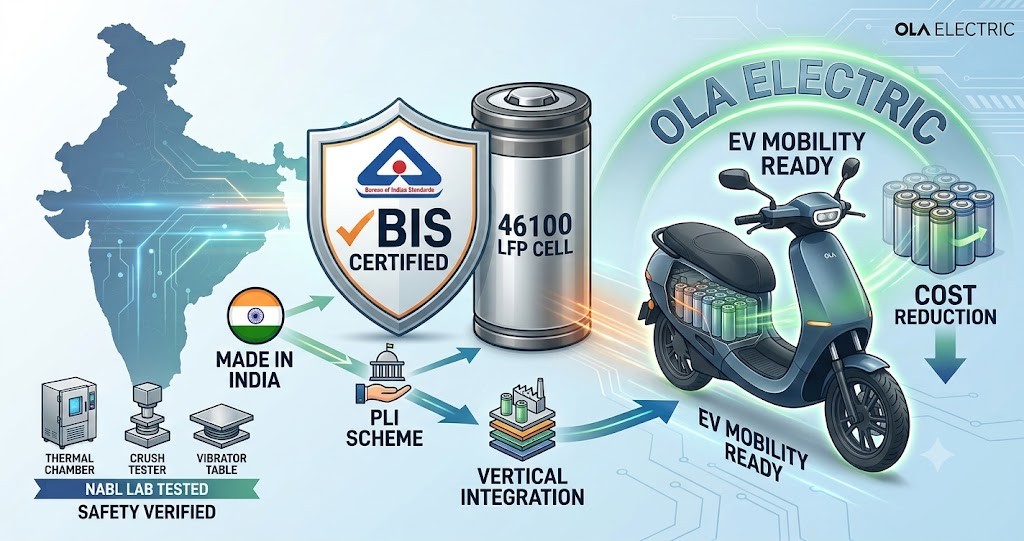
南アジア最大の電動モビリティ市場として急速な成長を遂げるインドにおいて、車載用バッテリーセルの「完全国産化」は、コスト削減とサプライチェーンの安全保障を左右する最重要課題です。インドの電動二輪車大手Ola Electricの完全子会社であるOla Cell Technologies(OCT)は、自社開発した46100規格のリン酸鉄リチウム(LFP)円筒形セルについて、インド規格局(BIS)の認証を国内企業として初めて取得したと発表しました。本報告書では、この最新の成果を要約するとともに、バッテリーのフォームファクター(形状・サイズ規格)およびインド市場におけるセル国産化の背景情報を補足・解説します。
1. 最新発表内容の要約
Ola Electricは、自社開発のLFP 46100円筒形セルにおいて、インド規格局(BIS)の安全・品質基準である「IS 16046(パート2):2018/IEC 62133-2:2017」の認証を取得しました。
- 試験と適合規格: 本セルは、国家試験・校正機関認定委員会(NABL)の認定試験所において、外部短絡、熱的過酷条件、強制放電、異常充電、圧壊、振動、自由落下といった厳格な安全・耐久性試験をクリアしました。また、国際的な輸送安全基準である「UN 38.3」や「IS 16893(パート2および3)」にも適合しています。
- セルの性能特性: 170 Wh/kgを超えるエネルギー密度、幅広い動作温度範囲、そして4,000回以上の充放電サイクルに耐えうるライフサイクルを備えており、モビリティだけでなく定置型エネルギー貯蔵システム(ESS)への応用も視野に入れています。
- マルチ・ケミストリー戦略: Ola Electricは、すでに数千台の市販車両に電力を供給しているニッケル・マンガン・コバルト(NMC)系の「4680 Bharatセル」に加え、今回のLFP系の「46100セル」をポートフォリオに導入しました。共通の「46シリーズ」という大口径円筒形アーキテクチャ上で、特性の異なる2つの化学組成(NMCとLFP)を使い分ける独自の体制を確立しています。
2. 関連技術情報の補足(背景と重要性)
Ola Electricのこの成果を評価する上で、以下の技術的および市場的背景が極めて重要となります。
- 大口径円筒形セル(46シリーズ)のトレンドと「46100」の意味: 電気自動車(EV)業界では、テスラが提唱した「4680(直径46mm、高さ80mm)」に代表される大口径円筒形セルへの移行が世界的な潮流となっています。従来の小型円筒形(2170など)に比べてセル1個あたりの容量が大幅に増えるため、バッテリーパックに組み込む際の接続部品や制御システムを簡素化でき、パック全体のコスト削減とエネルギー密度向上を両立できます。Ola Electricが採用した「46100」は、直径46mm、高さ100mmというさらに縦に長い形状であり、限られたスペースにより多くの電極材料を詰め込むことで、コストパフォーマンスに優れたLFP化学組成でも170 Wh/kgという高いエネルギー密度を達成する構造的要因となっています。
- インドにおけるLFPセルの現地化とPLIスキームの背景: インド政府は、気候変動対策と輸入依存(特に中国製セルへの依存)からの脱却を目指し、国内での先進化学セル(ACC)製造を支援する「生産連動型インセンティブ(PLI)スキーム」を推進しています。特にLFP(リン酸鉄リチウム)は、コバルトやニッケルといった高価で地政学的リスクの高い鉱物を使用しないため、コストに極めて敏感なインドの二輪車・三輪車市場において最適な化学組成とされています。材料、部品、エンジニアリングの大部分をインド国内で現地化した上でのBIS認証取得は、インドのモビリティ産業における「サプライチェーンの主権(自給自足)」に向けた大きな一歩となります。
3. 結論と今後の展望
Ola ElectricがNMC系の4680セルに続き、LFP系の46100セルでもインド国内の認証・工業化ルートを確保したことは、同社が「モビリティ企業」から「垂直統合型のエネルギー・テクノロジー企業」へと進化していることを明確に示しています。4,000回以上のサイクル寿命と170 Wh/kgを超えるエネルギー密度を両立したLFP 46100プラットフォームは、インド特有の過酷な熱環境下でも高い安全性とコスト競争力を発揮することが期待されます。共通の46シリーズ・プラットフォームを活用することで、乗用車・二輪車向けのハイパフォーマンス需要(NMC)から、商用車・安価なスクーターおよび定置型蓄電池(LFP)に至るまで、同一の製造ラインの知見を活かした柔軟な市場展開が可能となり、インドのクリーンエネルギー移行を牽引する強固な技術基盤となる見通しです。
The Dawn of Indian-Made EV Batteries: Ola Electric Becomes First to Secure BIS Certification for 46100 LFP Cells
In India, which is experiencing rapid growth as South Asia’s largest electric mobility market, the complete localization of automotive battery cells is a paramount challenge that directly affects cost reduction and supply chain security. Ola Cell Technologies (OCT), a wholly owned subsidiary of the major Indian electric two-wheeler manufacturer Ola Electric, has announced that it has become the first domestic company to receive Bureau of Indian Standards (BIS) certification for its self-developed 46100-standard lithium iron phosphate (LFP) cylindrical cells. This report summarizes this latest achievement while providing supplementary information and analysis on the battery form factor (shape and size standards) and the background of cell localization in the Indian market.
1. Summary of the Latest Announcement
Ola Electric has secured IS 16046 (Part 2): 2018/IEC 62133-2: 2017 certification, the safety and quality standard of the Bureau of Indian Standards (BIS), for its self-developed LFP 46100 cylindrical cells.
- Testing and Compliant Standards: The cell successfully cleared rigorous safety and durability tests—including external short circuits, thermal abuse, forced discharge, abnormal charging, crush, vibration, and free fall—at a laboratory accredited by the National Accreditation Board for Testing and Calibration Laboratories (NABL). It also complies with the international transportation safety standard UN 38.3 as well as IS 16893 (Parts 2 and 3).
- Cell Performance Characteristics: Featuring an energy density exceeding 170 Wh/kg, a wide operating temperature range, and a development pathway targeted at a lifecycle of over 4,000 charge-discharge cycles, the cell is designed for applications in both mobility and stationary energy storage systems (ESS).
- Multi-Chemistry Strategy: In addition to its nickel-manganese-cobalt (NMC)-based “4680 Bharat cell,” which already powers thousands of vehicles on Indian roads, Ola Electric has introduced the LFP-based “46100 cell” to its portfolio. By leveraging a common “46-series” large-diameter cylindrical architecture, the company has established a unique system to deploy two distinct chemical compositions (NMC and LFP) optimized for different applications.
2. Supplementary Technical Information (Background and Importance)
To evaluate this achievement by Ola Electric, the following technical and market backgrounds are extremely critical:
- The Trend of Large-Diameter Cylindrical Cells (46-Series) and the Significance of “46100”: In the electric vehicle (EV) industry, transitioning to large-diameter cylindrical cells, represented by the “4680” format (46 mm diameter, 80 mm height) pioneered by Tesla, has become a global trend. Compared to conventional small cylindrical cells (such as the 2170 format), the capacity per single cell increases substantially. This simplifies interconnecting components and management systems when assembling battery packs, simultaneously achieving pack-level cost reductions and energy density improvements. The “46100” format adopted by Ola Electric features an even taller design with a 46 mm diameter and 100 mm height. Packing more electrode materials into a limited space serves as a structural factor that enables a high energy density of over 170 Wh/kg, even when utilizing the highly cost-effective LFP chemistry.
- Localization of LFP Cells in India and the Background of the PLI Scheme: The Indian government is promoting the Production Linked Incentive (PLI) scheme to support domestic manufacturing of Advanced Chemistry Cells (ACC), aiming to combat climate change and reduce import dependency (particularly on Chinese-made cells). LFP (lithium iron phosphate) is considered the optimal chemical composition for India’s highly cost-sensitive two-wheeler and three-wheeler markets, as it does not rely on expensive minerals with high geopolitical risks, such as cobalt and nickel. Securing BIS certification after localizing the vast majority of materials, components, engineering, and manufacturing processes marks a major milestone toward “supply chain sovereignty (self-sufficiency)” in India’s mobility industry.
3. Conclusion and Future Outlook
Following the NMC-based 4680 cell, Ola Electric’s successful establishment of a domestic certification and industrialization pathway for the LFP-based 46100 cell clearly demonstrates the company’s evolution from a “mobility company” into a “vertically integrated energy technology enterprise.” The LFP 46100 platform, which balances a cycle life of over 4,000 cycles with an energy density exceeding 170 Wh/kg, is expected to deliver high safety and cost competitiveness even under India’s uniquely harsh thermal environments. By utilizing the shared 46-series platform, the company can flexibly deploy its technology across various segments—ranging from high-performance demands in passenger cars and premium two-wheelers (NMC) to commercial vehicles, affordable scooters, and stationary storage batteries (LFP)—utilizing insights from the same manufacturing line. This is poised to serve as a robust technical foundation driving India’s clean energy transition.

コメント