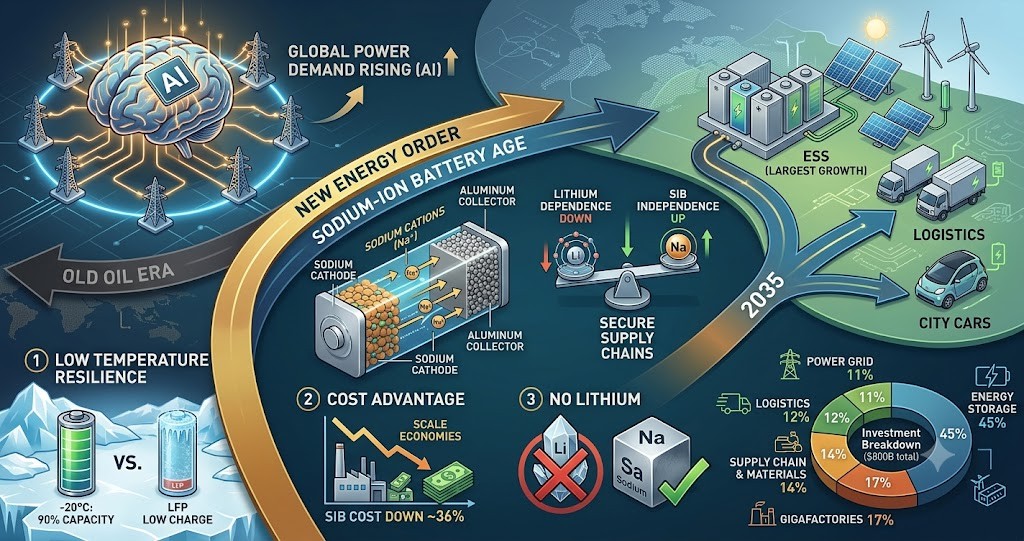
人工知能(AI)の爆発的な発展に伴う電力需要の急増と、国家レベルでのエネルギー安全保障への意識の高まりが交差する中、次世代の蓄電技術が世界的な注目を集めています。米大手金融機関モルガン・スタンレーは最新のリポートにおいて、ナトリウムイオン電池(Sodium-ion Battery: SIB)を「新たな石油時代」の中核資産と定義しました。本報告書では、同リポートが示す2035年に向けた市場予測や技術的優位性を整理し、材料科学およびグローバルなサプライチェーンの観点から関連する背景情報を補足・解説します。
1. 最新研究・市場予測の要約
モルガン・スタンレーは、ナトリウムイオン電池の世界展開シェアが2027年の2%から2035年には37%へと急上昇し、年間導入量は2.4テラワット時(楽観シナリオでは3.7テラワット時)に達すると予測しています。これにより、エコシステム全体で約8000億ドル(約129.4兆円)の巨額投資が喚起される見通しです。
- 3つの技術的優位性: 1. リチウム資源に依存しない高いサプライチェーン主権。 2. 優れた耐低温性(マイナス20度でも容量の約90%を維持。これに対しリン酸鉄リチウム(LFP)電池は50%から60%に低下)。 3. 規模の経済による低コスト化(セルコストは現在の0.35人民元/Whから0.22人民元/Whへ約36%低下予測)。
- 市場浸透のロードマップ: * エネルギー貯蔵(ESS): 2035年までに新設容量の60%を占める最大の爆発分野。太陽光発電との組み合わせで経済性を書き換えます。
- 商用車: 冬季の航続距離減少に悩む寒冷地域の小型商用車を中心に、2035年までに普及率66%に達すると予測。
- 小型乗用車: エネルギー密度が175Wh/kgに達しLFPに接近。BYDやCATLが量産・工場建設を進め、低価格な都市型EV向けに2035年までに普及率18%を予測。
- 産業エコシステムへの投資内訳(総額8000億ドル):
- エネルギー貯蔵の導入: 約3600億ドル(45%)
- 製造能力(ギガファクトリー等): 約1350億ドル(17%)
- サプライチェーンと原材料: 約1150億ドル(14%)
- 物流車両(電動化改造): 約1000億ドル(12%)
- 電力・送電網インフラ: 約900億ドル(11%)
2. 関連技術情報の補足(背景とコモディティ市場への影響)
ナトリウムイオン電池の本格普及がもたらす化学的バックグラウンドと、金属資源市場への具体的な影響は以下の通りです。
- 材料構成の違いと銅・アルミ・リチウム市場へのインパクト: リチウムイオン電池では、電位の関係から負極の集電体に銅箔を使用する必要があります。一方、ナトリウムはアルミニウムと合金化しない特性があるため、正極・負極の両方に安価なアルミ箔を使用できます。これにより、2030年までに世界の銅需要が約20万トン減少する一方、アルミニウム需要は恩恵を受けます。リチウム市場に対しては、2030年までに炭酸リチウム換算(LCE)需要を最大で計240キロトン以上削減する見込みであり、リチウム価格の下落圧力を強めます。
- 主要な正極・負極材料の現状とボトルネック: ナトリウムイオン電池の負極には、従来のグラファイト(黒鉛)ではなく、層間が広くナトリウムイオンを挿入しやすい「ハードカーボン(難黒鉛化性炭素)」が使用されます。しかし、ハードカーボンは製造プロセスの成熟度が低く、サプライチェーンの確立が急がれています。正極材料においては、エネルギー密度に優れる「層状酸化物」、長寿命な「ポリアニオン系化合物」、安価な「プルシアンブルー類似体(ただし導電性やシアン化物の処理に課題あり)」の研究開発が並行して進められており、これらの材料選定がシステム全体のコスト転嫁の成否を握っています。
3. 結論とリスク要因
地政学的な構図において、中国(CATL、BYDなど)が量産化で世界を大きくリードしており、米国(GMとPeak Energyの提携など)や欧州、韓国(LGエナジーソリューションなど)も追随を図っています。この競争は技術力と資金力のあるトップ企業への集中(勝者総取り)を加速させ、中国の下位30%から40%の低品位LFP生産能力は淘汰の圧力に直面する見通しです。
しかし、実用化の加速にはいくつかのリスク変数が存在します。エネルギー密度の低さに起因するバッテリーパック全体の大型化(システム周辺コストの増加)、ハードカーボンなどの材料調達ボトルネック、そしてリチウム価格の下落が逆にLFP電池の経済性を高めてしまう「内生的な再帰性リスク」です。ナトリウムイオン電池が「新たな石油」としての地位を確固たるものにするためには、セル単体の安さだけでなく、システムレベルでの信頼性と経済性の実証、そして顧客による長期的な劣化曲線の検証ハードルをクリアしていく必要があります。
出典:https://finance.biggo.jp/news/ce0825c5-244e-4748-a891-278eeeace4a2
The Energy Transformation Driven by Sodium-Ion Batteries and Its Impact on the Global Supply Chain
Amid the intersection of a surge in electricity demand driven by the explosive development of artificial intelligence (AI) and a rising awareness of energy security at the national level, next-generation energy storage technologies are garnering global attention. In its latest report, the major US financial institution Morgan Stanley defined the sodium-ion battery (SIB) as a core asset of the “New Oil Age.” This report organizes the market forecasts and technical advantages toward 2035 presented in the report, while supplementing and explaining relevant background information from the perspectives of materials science and the global supply chain.
1. Summary of the Latest Research and Market Forecasts
Morgan Stanley predicts that the global deployment share of sodium-ion batteries will surge from 2% in 2027 to 37% by 2035, with annual installations reaching 2.4 terawatt-hours (TWh), and potentially 3.7 TWh under an optimistic scenario. This expansion is expected to stimulate a massive investment of approximately 800 billion USD across the entire ecosystem.
- Three Technical Advantages: 1. High supply chain sovereignty independent of lithium resources. 2. Excellent low-temperature resistance (maintaining approximately 90% capacity even at minus 20 degrees Celsius, whereas lithium iron phosphate (LFP) batteries drop to 50% to 60% under the same conditions). 3. Cost reduction through economies of scale (cell costs are projected to decrease by approximately 36%, from the current 0.35 RMB/Wh to 0.22 RMB/Wh).
- Roadmap for Market Penetration: * Energy Storage Systems (ESS): The most explosive sector, projected to account for 60% of newly installed capacity by 2035. It will rewrite the economics of solar power integration.
- Commercial Vehicles: Focused primarily on light commercial vehicles in cold regions suffering from winter range reduction, with penetration predicted to reach 66% by 2035.
- Small Passenger Vehicles: Energy density has reached 175 Wh/kg, approaching the level of LFP. With mass production and factory construction being advanced by BYD and CATL, a penetration rate of 18% is predicted by 2035 for low-cost urban EVs.
- Breakdown of Investment in the Industrial Ecosystem (Totaling 800 Billion USD):
- Deployment of energy storage: Approx. 360 billion USD (45%)
- Manufacturing capacity (Gigafactories, etc.): Approx. 135 billion USD (17%)
- Supply chain and raw materials: Approx. 115 billion USD (14%)
- Logistics vehicles (electrification retrofitting): Approx. 100 billion USD (12%)
- Power and grid infrastructure: Approx. 90 billion USD (11%)
2. Supplementary Technical Information (Background and Impact on Commodity Markets)
The chemical background behind the full-scale commercialization of sodium-ion batteries and its specific impacts on the metal resources market are as follows:
- Differences in Material Composition and Impact on Lithium, Copper, and Aluminum Markets: In lithium-ion batteries, copper foil must be used for the anode current collector due to electrochemical potential constraints. Conversely, since sodium does not alloy with aluminum, inexpensive aluminum foil can be used for both the cathode and anode current collectors. Consequently, global copper demand could decrease by approximately 200 kilotons by 2030, while aluminum demand stands to benefit. For the lithium market, the demand for lithium carbonate equivalent (LCE) is expected to be reduced by up to a total of over 240 kilotons by 2030, intensifying the downward pressure on lithium prices.
- Current Status and Bottlenecks of Key Cathode and Anode Materials: For the anode of sodium-ion batteries, “hard carbon” (non-graphitizable carbon)—which has a wider interlayer spacing that facilitates the insertion of sodium ions—is utilized instead of conventional graphite. However, the manufacturing process maturity for hard carbon remains low, making the establishment of a stable supply chain an urgent priority. For cathode materials, research and development are progressing in parallel across “layered oxides” (offering excellent energy density), “polyanionic compounds” (providing long cycle life), and low-cost “Prussian blue analogs” (though facing challenges regarding electrical conductivity and potential cyanide management). The selection of these materials holds the key to whether cost advantages can be successfully passed through at the system level.
3. Conclusion and Risk Factors
In the geopolitical landscape, China (CATL, BYD, etc.) significantly leads the world in commercialization, while the United States (such as the partnership between GM and Peak Energy), Europe, and South Korea (such as LG Energy Solution) are attempting to position themselves. This competition will accelerate the concentration of market share among top-tier battery companies with high technical capabilities and financial backing (a winner-take-all dynamic), leaving the bottom 30% to 40% of low-grade LFP production capacity in China facing severe survival pressure.
However, several risk variables could slow down the acceleration of practical application. These include the increased overall size of the battery pack due to low energy density (which raises balance-of-system costs), material procurement bottlenecks such as hard carbon, and an “endogenous reflexivity risk” where falling lithium prices conversely boost the competitiveness of LFP batteries, narrowing the economic window of opportunity for sodium-ion batteries. For sodium-ion batteries to firmly secure their position as the “New Oil,” they must demonstrate not only the low cost of individual cells but also system-level reliability and economic viability, while overcoming the strict hurdles of long-term degradation curve verification imposed by customers.
コメント