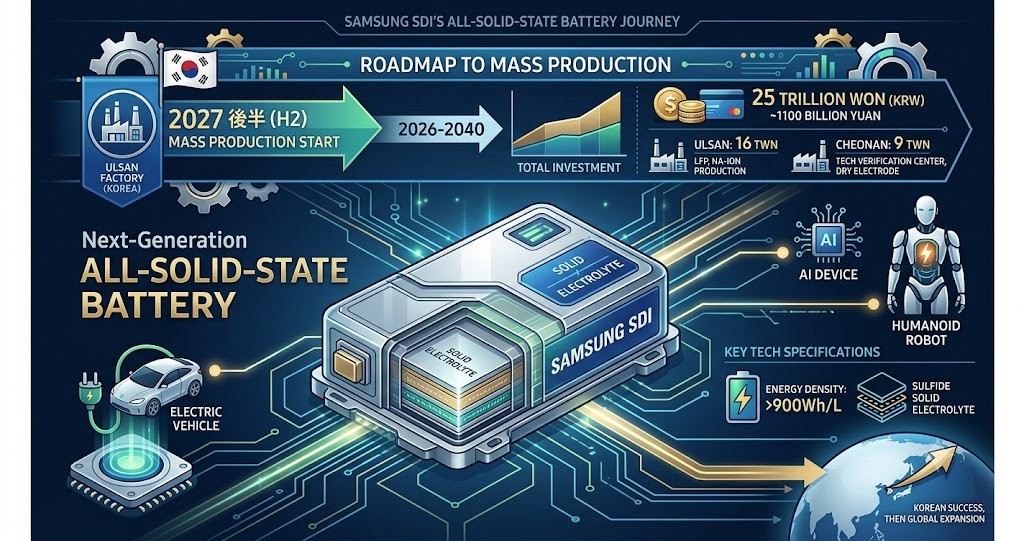
次世代バッテリーとして期待を集める全固体電池を巡り、韓国のサムスンSDIが具体的な商用化ロードマップを提示しました。市場参入に向けた投資計画や技術仕様に加え、業界全体の動向と合わせて要点を整理します。
サムスンSDIの量産計画と投資概要
- 生産開始時期と拠点: 2027年後半に韓国の蔚山工場で量産を開始予定。韓国初の全固体電池メーカーを目指す。
- 大規模投資計画: 2026年から2040年までの14年間で計25兆ウォン(約1100億元)を投入。
- 蔚山工場(16兆ウォン): 全固体電池、ESS(電力貯蔵システム)向けLFP(リン酸鉄リチウム)電池、ナトリウムイオン電池の生産ラインを構築。
- 天安工場(9兆ウォン): 技術検証センターとして拡張。乾式電極パイロットラインが稼働中。
- R&Dと技術仕様:
- 水原R&Dセンターに6,500平方メートルのパイロットライン(Sライン)を整備しプロセス検証を完了。蔚山工場へそのまま技術移行。
- 硫化物系固体電解質を採用し、エネルギー密度目標は900Wh/L超。
- 供給先と今後の展開:
- EV(電気自動車)、AIデバイス、ヒューマノイドロボット向けにサンプル品を出荷し評価中。
- 国内での実績確立後、海外工場へ生産能力を順次拡大。
関連情報:2027年を巡るグローバル競合の動き
2027年は全固体電池の本格実用化に向けた最大の節目となっています。
- 自動車メーカーの参入: トヨタ自動車、吉利汽車(Geely)、奇瑞汽車(Chery)、BYDといった大手EV・自動車メーカーも2027年前後を目標時期に設定しており、実用化レースが激化しています。
- 用途の多様化: 車載用途にとどまらず、ロボティクスやAIデバイスなど高出力・安全性を求める最先端機器への早期展開も焦点となっています。
Samsung SDI’s Solid-State Battery Roadmap: The Full Picture of the 25 Trillion Won Investment Toward Mass Production in 2027
South Korea’s Samsung SDI has unveiled a concrete commercialization roadmap for solid-state batteries, which are generating high expectations as next-generation energy storage. Below is a summary of the key points, covering their investment plan, technical specifications, and broader industry trends.
Samsung SDI Mass Production Plan and Investment Overview
- Production Timeline and Facility: Mass production is scheduled to begin in the second half of 2027 at the Ulsan plant in South Korea. The company aims to become the country’s first solid-state battery manufacturer.
- Large-Scale Investment Plan: A total of 25 trillion won (approx. 110 billion yuan) will be invested over 14 years, from 2026 to 2040.
- Ulsan Plant (16 trillion won): Establishing production lines for solid-state batteries, LFP (lithium iron phosphate) batteries for ESS (energy storage systems), and sodium-ion batteries.
- Cheonan Plant (9 trillion won): Expanding as a technology verification center. A dry electrode pilot line is currently operational.
- R&D and Technical Specifications:
- Set up a 6,500-square-meter pilot line (S-line) at the Suwon R&D Center and completed process verification. The technology will be directly transferred to the Ulsan plant.
- Utilizing a sulfide-based solid electrolyte, with a target energy density exceeding 900 Wh/L.
- Target Applications and Future Expansion:
- Sample shipments are currently undergoing performance evaluation for EVs (electric vehicles), AI-powered devices, and humanoid robots.
- After establishing a commercial track record domestically, production capacity will gradually expand to overseas facilities.
Related Trends: Global Competition Surrounding 2027
The year 2027 is emerging as a critical turning point for the full-scale commercialization of solid-state batteries.
- Automaker Entry: Major EV and automotive manufacturers—including Toyota, Geely, Chery, and BYD—have also set target timelines around 2027, intensifying the commercialization race.
- Diversification of Applications: Beyond automotive use, early deployment in high-output, high-safety cutting-edge equipment, such as robotics and AI devices, is becoming a key focal point.

コメント