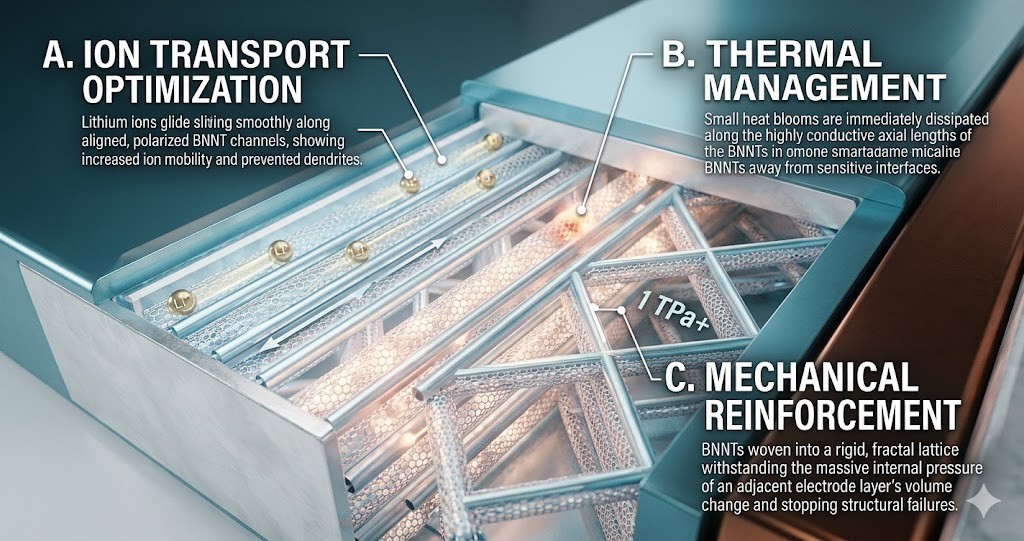
これまで、窒化ホウ素ナノチューブ(BNNT)は、その高い製造コストから電池研究の主役ではありませんでした。しかし、最新の研究は、BNNTを単なる「詰め物(フィラー)」ではなく、イオンの流れ・熱・機械的ストレスを同時に制御する「ナノスケールの調整器」として活用する新しい設計パラダイムを提示しています。
- 1. BNNTの特性:他のナノ材料との比較
- 2. 3つの主要な制御メカニズム
- 3. 実用化に向けた4つの設計指針
- 結論と今後の展望
- Triple-Field Regulation of Ions, Heat, and Mechanics: Mechanisms of Interfacial Stabilization via Boron Nitride Nanotubes (BNNTs)
- 1. Characteristics of BNNTs: Comparison with Other Nanomaterials
- 2. Three Primary Regulatory Mechanisms
- 3. Four Design Principles for Practical Application
- Conclusion and Future Outlook
1. BNNTの特性:他のナノ材料との比較
BNNTは、カーボンナノチューブ(CNT)に似た1次元の筒状構造を持ちながら、全く異なる物理的特性を有しています。
| 特性 | BNNT | CNT | 2D h-BN (窒化ホウ素シート) |
| 電気的性質 | 絶縁体 (電子漏れを防ぐ) | 導電体 (短絡のリスクあり) | 絶縁体 |
| 熱伝導率 | 極めて高い (熱分散に優れる) | 非常に高い | 高い (面内に限定) |
| 機械的強度 | 極めて高い (1 TPa以上) | 高い | 高い |
| 形状の利点 | 1次元 (経路形成が容易) | 1次元 | 2次元 (経路が分断されやすい) |
2. 3つの主要な制御メカニズム
BNNTは電池内部で以下の3つの役割を同時に果たし、システムの不安定性を解消します。
A. イオン輸送の最適化 (Ion Transport)
BNNTの格子(B-N結合)は極性を持っており、これが電解質中のアニオン(負イオン)を緩やかに拘束します。その結果、リチウムイオン(Li+)が動きやすくなり、リチウム輸率が向上します。これにより、充放電がスムーズになり、リチウムの不均一な堆積(デンドライト)を抑制します。
B. 熱勾配の均一化 (Thermal Management)
BNNTの高い軸方向熱伝導率は、電池内部の「ホットスポット(局所的な過熱)」を素早く解消します。CNTと異なり電気を通さないため、電極間でショートさせる心配なく、効率的に熱を逃がすことができます。
C. 機械的補強 (Mechanical Reinforcement)
1 TPa(テラパスカル)を超える剛性を持ち、セラミック電解質や電極界面の物理的補強材として機能します。充放電による電極の膨張・収縮や、デンドライトの貫通を物理的に防ぐ「骨組み」となります。
3. 実用化に向けた4つの設計指針
BNNTを次世代電池へ組み込む際、以下の「アーキテクチャ的思考」が求められます。
- 配向 (Alignment): BNNTをバラバラに混ぜるのではなく、イオンや熱を流したい方向に並べることで、その性能を最大限に引き出します。
- 欠陥エンジニアリング (Defect Engineering): 意図的に格子欠陥を作ることで、イオンとの相互作用を強め、特定の化学反応を制御します。
- 戦略的配置: 電池全体に混ぜるのではなく、不安定性が生じやすい「界面(セパレータと電極の間など)」に集中して配置することで、コストを抑えつつ効果を最大化します。
- フレームワーク化: BNNTを単なる粒子ではなく、電池内部の立体的な「3次元ネットワーク」として構築します。
結論と今後の展望
BNNTは、リチウム金属電池、リチウム硫黄電池、および全固体電池において、界面の不安定性を克服するための最も有望な材料の一つです。
現在は製造コストと供給量が課題となっていますが、2030年までには製造プロセスの効率化と精製技術の向上が進むと予測されています。BNNTを「受動的な添加剤」から「能動的な構造制御デバイス」へと昇華させることで、かつてない安全性と長寿命を備えたバッテリーの実現が期待されます。
出典:https://pubs.rsc.org/en/content/articlelanding/2026/eb/d6eb00016a
Triple-Field Regulation of Ions, Heat, and Mechanics: Mechanisms of Interfacial Stabilization via Boron Nitride Nanotubes (BNNTs)
Historically, Boron Nitride Nanotubes (BNNTs) have remained peripheral to battery research due to their high manufacturing costs. However, recent studies present a new design paradigm that utilizes BNNTs not merely as passive “fillers,” but as “nanoscale regulators” capable of simultaneously controlling ion flux, thermal gradients, and mechanical stress.
1. Characteristics of BNNTs: Comparison with Other Nanomaterials
While BNNTs possess a one-dimensional tubular structure similar to Carbon Nanotubes (CNTs), they exhibit fundamentally different physical properties.
| Property | BNNTs | CNTs | 2D h-BN (Hexagonal Boron Nitride) |
| Electrical Property | Insulator (Prevents electron leakage) | Conductor (Risk of short-circuiting) | Insulator |
| Thermal Conductivity | Ultra-high (Excellent heat dissipation) | Very High | High (Limited to in-plane) |
| Mechanical Strength | Ultra-high (Over 1 TPa) | High | High |
| Geometric Advantage | 1D (Easy to form transport pathways) | 1D | 2D (Pathways easily disconnected) |
2. Three Primary Regulatory Mechanisms
BNNTs fulfill the following three roles simultaneously within the battery to resolve system instabilities.
A. Optimization of Ion Transport
The BNNT lattice (B-N bond) is intrinsically polarized, allowing it to moderately bind anions (negative ions) within the electrolyte. As a result, lithium ions (Li+) become more mobile, increasing the lithium transference number. This facilitates smooth charging and discharging and suppresses the uneven deposition of lithium (dendrite formation).
B. Homogenization of Thermal Gradients (Thermal Management)
The high axial thermal conductivity of BNNTs rapidly eliminates “hotspots” (localized overheating) inside the battery. Unlike CNTs, they do not conduct electricity, meaning they can efficiently dissipate heat without the risk of causing a short circuit between electrodes.
C. Mechanical Reinforcement
With a stiffness exceeding 1 TPa (terapascal), BNNTs function as physical reinforcement for ceramic electrolytes and electrode interfaces. They serve as a “skeleton” that physically prevents electrode expansion/contraction during cycling and hinders the penetration of dendrites.
3. Four Design Principles for Practical Application
Integrating BNNTs into next-generation batteries requires an “architectural mindset” based on the following principles:
- Alignment: Rather than random dispersion, BNNTs should be aligned in the desired direction of ion or heat flow to maximize their performance.
- Defect Engineering: Intentional creation of lattice defects can strengthen interactions with ions and allow for the control of specific chemical reactions.
- Strategic Placement: Instead of mixing them throughout the entire battery, BNNTs should be concentrated at critical “interfaces” (e.g., between the separator and electrode) where instability is most likely to occur, maximizing effect while minimizing cost.
- Framework Construction: BNNTs should be structured as three-dimensional networks within the battery rather than being treated as isolated particles.
Conclusion and Future Outlook
BNNTs are among the most promising materials for overcoming interfacial instabilities in lithium-metal batteries, lithium-sulfur batteries, and all-solid-state batteries. While manufacturing costs and supply remain current challenges, improvements in production processes and purification technologies are expected by 2030. By evolving BNNTs from “passive additives” to “active structural regulators,” the realization of batteries with unprecedented safety and longevity is within reach.


コメント