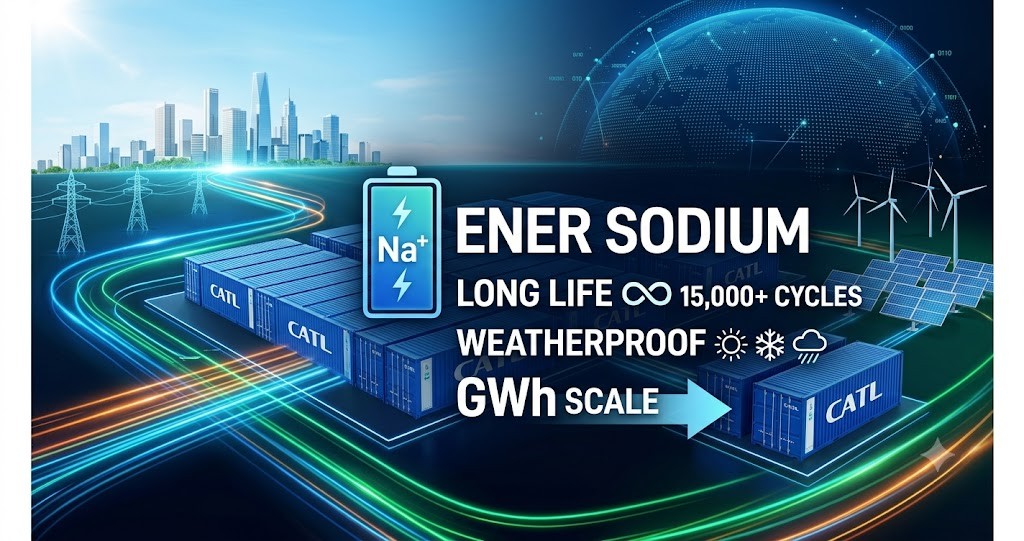
車載電池およびエネルギー貯蔵システム(ESS)で世界最大手のCATL(寧徳時代)が、蓄電市場に新たな激震を起こしています。リチウムの代替として長年注目されてきたナトリウムイオン技術ですが、CATLは世界初となる実地検証済みのナトリウム電池蓄電システム「Tener Sodium」を発表しました。
2026年6月の最新発表に基づき、これまで「次世代技術」の枠に留まっていたナトリウムイオン電池が、いよいよギガワット時(GWh)スケールで大規模な商業化・量産フェーズへと突入する現実とその背景についてまとめます。
- 1. 新システム「Tener Sodium」の革新的なスペック
- 2. 量産ロードマップと市場投入スケジュール
- 3. 【関連・補足情報】CATLの巨額投資と「リチウム代替」の戦略的背景
- まとめ:既存電池市場の最大40%が置き換わる未来
- “Post-Lithium” Finally Enters Mass Production! The World’s Largest Battery Maker Launches Large-Scale Social Implementation of Sodium Batteries
- 1. Innovative Specifications of the New “Tener Sodium” System
- 2. Mass Production Roadmap and Market Launch Schedule
- 3. [Related & Supplementary Information] CATL’s Massive Investments and the Strategic Context of “Lithium Substitution”
- Conclusion: A Future Where Up to 40% of the Existing Battery Market is Replaced
1. 新システム「Tener Sodium」の革新的なスペック
CATLが発表した「Tener Sodium」は、従来の蓄電システムの設計をゼロから見直し、運用安定性、柔軟性、そして可用性を極限まで高めた次世代ソリューションです。
- 圧倒的な長寿命と耐候性 ナトリウム電池の弱点とされてきた寿命性能を大幅に克服しました。通常環境(25°C)において15,000サイクル(容量維持率70%換算)を達成し、これは25年から30年の耐用年数に相当します。さらに、過酷な45°C環境でも1万回以上のサイクルを維持し、マイナス20°Cの極寒環境でも92%以上の放電容量を維持します。
- 柔軟なモジュール設計と高効率 システムは定格容量30MWh以上の完全モジュール式(各モジュール重量42トン)で構成され、1時間から8時間までの幅広い蓄電需要に柔軟に対応します。また、業界初となる双方向電圧制御(Bi-DC)機能を搭載したことで、システムの往復効率(RTE)が約2%向上しています。
- ミリ秒レベルの自己修復(可用性) システム障害が発生した際、200ミリ秒以内に障害箇所を特定して隔離し、正常な部分を150ミリ秒以内に復旧させる自己修復ソリューションを導入。極限状態での火災や爆発も抑制する高い安全性を誇ります。
2. 量産ロードマップと市場投入スケジュール
CATLは実験室レベルではなく、すでに大規模な量産体制を確立したと宣言しています。
- 2026年9月:中国国内での初納入を開始
- 2026年末まで:累計出荷量1GWhを目指す
- 2027年6月:グローバル市場への商業出荷を開始
サイズや規格の面で既存のリチウムイオン電池システムと完全な互換性を持たせており、導入企業はインフラを大幅に変えることなくシームレスにナトリウムシステムへ切り替えることが可能です。
3. 【関連・補足情報】CATLの巨額投資と「リチウム代替」の戦略的背景
CATLがこれほど急速にナトリウム電池の社会実装を推進できる背景には、過去数年にわたる天文学的な投資と、エネルギー安全保障上の緻密な計算があります。
- 100億元におよぶ研究開発と生産拠点の構築 CATLは2025年末時点で、ナトリウム電池の研究開発に累計で100億元(約14億5000万ドル)近くを投じてきました。さらに、直近では需要の急増に応えるため、福建省に40GWhの生産能力を持つナトリウムイオン電池専用工場の建設を決定し、50億元(約7億3900万ドル)の追加投資を行っています。
- 車載ブランド「Naxtra」との両輪戦略 CATLのナトリウム戦略は、今回のグリッド向け蓄電(ESS)だけではありません。2025年4月からは「Naxtra」ブランドを通じて乗用車向けナトリウム電池の商業化も本格化させており、車載と定置型の両面から市場を開拓しています。
まとめ:既存電池市場の最大40%が置き換わる未来
CATLの創業者兼会長であるロビン・ゼン(曽毓群)氏は、「長期的には、低コストなナトリウムイオン電池が既存の電池市場の30%から40%を置き換える可能性がある」との見通しを投資家に示しています。
リチウムに比べて資源的な偏在が少なく、安価かつ安定調達が可能なナトリウムは、地政学的リスクや材料コストの乱高下に悩まされてきたクリーンエネルギー業界にとって理想的な選択肢です。今回の「Tener Sodium」の量産化は、再エネの主力電源化を支える大型蓄電インフラの勢力図を塗り替える、決定的なマイルストーンとなるでしょう。
出典:https://cnevpost.com/2026/06/22/catl-unveils-tener-sodium/
“Post-Lithium” Finally Enters Mass Production! The World’s Largest Battery Maker Launches Large-Scale Social Implementation of Sodium Batteries
CATL, the world leader in automotive batteries and energy storage systems (ESS), is sending shockwaves through the energy storage market. While sodium-ion technology has long been highlighted as an alternative to lithium, CATL has unveiled “Tener Sodium,” the world’s first field-validated sodium-ion energy storage solution.
Based on the latest announcement in June 2026, this article summarizes the reality and strategic background of how sodium-ion batteries—previously confined to the category of “next-generation technology”—are finally entering a large-scale commercialization and mass-production phase on a gigawatt-hour (GWh) scale.
1. Innovative Specifications of the New “Tener Sodium” System
The “Tener Sodium” system announced by CATL completely redesigns traditional energy storage layouts to provide a next-generation solution that maximizes operational stability, flexibility, and system availability.
- Exceptional Lifespan and Weather Resistance CATL has significantly overcome the lifespan degradation issues traditionally seen as a weakness of sodium batteries. The system achieves 15,000 cycles at a standard temperature of 25°C (equivalent to a 70% state of health), which translates to an operational lifespan of 25 to 30 years. Furthermore, it sustains over 10,000 operational cycles in harsh 45°C environments and retains over 92% of its capacity even in extreme cold at minus 20°C.
- Flexible Modular Design and High Efficiency Boasting a rated capacity of over 30 MWh, the system features a fully modular design with each module weighing 42 tons, allowing it to flexibly adapt to varying energy storage requirements from 1 to 8 hours. Additionally, it integrates the industry’s first bidirectional voltage control (Bi-DC) function, boosting the system’s round-trip efficiency (RTE) by approximately 2%.
- Millisecond-Level Self-Healing (Availability) In the event of a system malfunction, CATL’s industry-first self-healing solution isolates faults within 200 milliseconds and restores unaffected sections within 150 milliseconds. This ensures station-level redundancy with minimal added cost while effectively mitigating fire and explosion risks under extreme conditions.
2. Mass Production Roadmap and Market Launch Schedule
Moving far beyond laboratory-level development, CATL has declared that its large-scale mass production lines are fully operational.
- September 2026: Initial deliveries begin in the domestic Chinese market.
- By the end of 2026: Target a cumulative shipping volume of 1 GWh.
- June 2027: Launch global commercial shipments.
The system is designed to be fully compatible with existing lithium-ion battery footprints and specifications, allowing operators to seamlessly switch to the sodium system without requiring extensive modifications to their infrastructure.
3. [Related & Supplementary Information] CATL’s Massive Investments and the Strategic Context of “Lithium Substitution”
The speed at which CATL is driving the social implementation of sodium batteries is backed by years of astronomical investment and a precise calculation regarding energy security.
- 10 Billion Yuan Invested in R&D and Production Sites As of the end of 2025, CATL’s cumulative research and development investment in sodium batteries neared 10 billion yuan (approx. 1.45 billion dollars). To satisfy surging market demand, the company has committed an additional 5 billion yuan (approx. 739 million dollars) to construct a dedicated sodium-ion battery plant in Fujian Province, bringing 40 GWh of production capacity online.
- A Dual-Engine Strategy with the “Naxtra” Automotive Brand CATL’s sodium blueprint extends beyond grid-scale energy storage systems (ESS). Since April 2025, the company has actively pushed the commercialization of sodium-ion batteries for passenger vehicles under its “Naxtra” brand, capturing market opportunities in both the automotive and stationary storage sectors.
Conclusion: A Future Where Up to 40% of the Existing Battery Market is Replaced
Robin Zeng, founder and chairman of CATL, previously indicated to investors that low-cost sodium-ion batteries could replace 30% to 40% of the existing battery market over the long term.
Compared to lithium, sodium resources are geographically widespread, highly affordable, and secure to source. This makes sodium an ideal solution for a clean energy industry plagued by geopolitical risks and volatile material costs. The mass production of “Tener Sodium” serves as a definitive milestone that is poised to redraw the competitive map of large-scale energy storage infrastructure supporting renewable power grids.
コメント