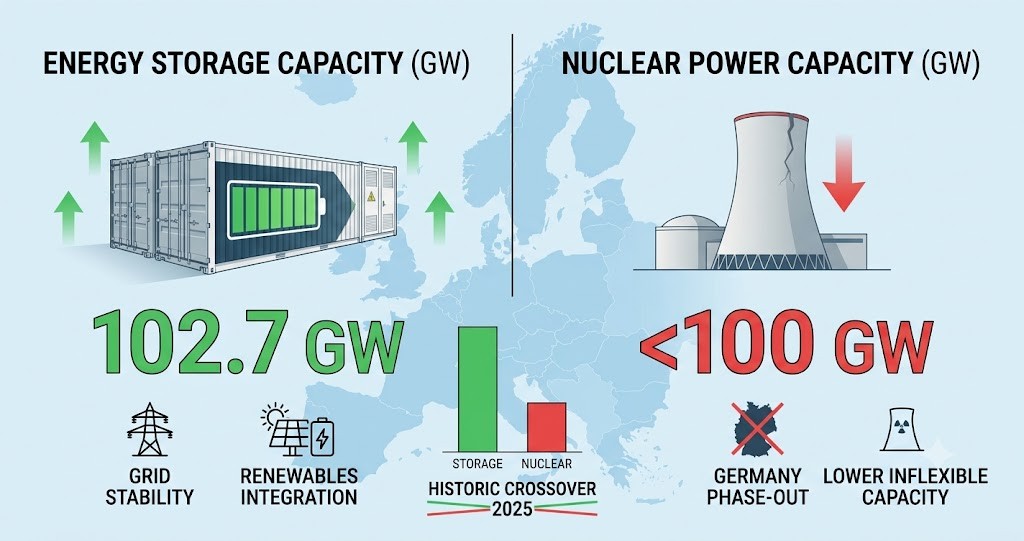
欧州のエネルギー転換において、歴史的な転換点を迎えたことを示す最新の報告書が発表されました。2025年、欧州の蓄電容量が初めて100GW(ギガワット)を突破し、地域内の原子力発電の総容量を上回るという快挙を成し遂げました。
この背景には、再生可能エネルギーの急増に伴うグリッド(送電網)安定化への需要や、ドイツの脱原発政策などがあります。本記事では、発表された報告書の要点に加えて、欧州のエネルギー市場を取り巻く関連情報を交えてわかりやすく解説します。
ニュースの要約:欧州蓄電容量の歴史的到達
LCP DeltaとEnergy Storage Europeが発行した「欧州エネルギー貯蔵市場モニター(EMMES)」第10版によると、2025年の欧州のエネルギー貯蔵市場は以下のような顕著な成長を記録しました。
- 過去最高の導入量: 2025年単年で13.5GW / 26.4GWh(ギガワット時)の電気化学蓄電設備が新たに追加されました。これにより、すべての技術を合わせた欧州の総設置蓄電容量は102.7GWに達しました。
- メーター後方(需要家側:BTM)の成長: 2025年末までに30.2GW / 46.2GWhに達しました。主にドイツ、イタリア、オランダ、オーストリア、英国が牽引しています。家庭や企業での太陽光発電と蓄電システムのセット導入、変動型電力料金の普及、電化の進展が主な原動力です。
- メーター前方(系統側:FTM)の成長: 18.5GW / 34.4GWhに達しました。英国、イタリア、ポーランド、ベルギーなど「容量市場(将来の供給力を確保する市場)」が確立されている国や、ブルガリア、スペインのように大規模な蓄電支援策がある国で導入が加速しています。
- 原子力発電との逆転: ドイツが原子力発電所を段階的に廃止したことで欧州全体の原子力発電容量が約11GW減少したことも影響し、蓄電容量が初めて原子力を上回る結果となりました。
関連情報:蓄電容量急成長の背景と市場のリアル
今回の「蓄電が原子力を上回った」というニュースをより深く理解するために、現在の欧州エネルギー市場に関する3つの重要な背景情報を補足します。
1. 再生可能エネルギーの「出力制御(抑制)」対策
欧州では太陽光発電や風力発電の導入が急速に進んでいますが、これらは天候によって発電量が大きく左右されます。発電が需要を上回ると送電網に負荷がかかるため、これまでは発電を意図的に止める「出力制御」が行われていました。蓄電池は、この余ったクリーンな電力を無駄にせず、夜間や電力需要のピーク時に供給するための必須インフラとなっています。
2. 「容量」と「発電量」の違い
ニュースでは「蓄電容量が原子力発電の容量を上回った」とされていますが、これはあくまで「瞬間的に出力できる最大電力(GW)」の話である点に注意が必要です。 原子力発電は24時間連続して安定して大量の電気を生み出し続けることができますが、蓄電池は貯められたエネルギー(GWh)の分しか放電できません。そのため、「年間の総発電電力量」においては、依然として原子力発電が大きな役割を担っています。
3. バッテリーコストの低下と技術革新
近年のリチウムイオン電池(特に安全性が高く長寿命なリン酸鉄リチウムイオン電池:LFP)の製造コスト低下が、公益事業規模(メガソーラー併設など)から住宅用までの蓄電池導入のハードルを劇的に下げています。
今後の課題と展望
業界の専門家は、今回の結果を歓迎しつつも、今後のさらなる需要拡大に対応するためにはクリアすべき壁があると指摘しています。
専門家による指摘(報告書より) 欧州のどの国も、まだ蓄電能力を最大限に発揮できているとは言えません。今後は、以下のような市場環境の整備が必要不可欠です。
- 技術に偏らない「技術中立的」な市場設計
- 蓄電システムの迅速な許認可と送電網へのスムーズな接続
- 柔軟性市場や容量メカニズムへのアクセス改善
欧州の蓄電市場の見通しは前回予測から25%も上方修正されており、2030年に向けてこの勢いはさらに加速すると予想されます。再生可能エネルギーを主軸としたクリーンな電力網を実現するため、蓄電池は単なる補佐役ではなく、エネルギーインフラの主役へと躍進しています。
Europe’s Major Energy Transition! Storage Capacity Surpasses 100GW, Outpacing Nuclear Power for the First Time
A newly released report highlights a historic turning point in Europe’s energy transition. In 2025, Europe’s energy storage capacity surpassed 100GW (gigawatts) for the first time, achieving the major milestone of overtaking the region’s total nuclear power capacity.
This milestone is driven by factors such as the surging demand for grid stabilization due to the rapid growth of renewable energy, and Germany’s nuclear phase-out policy. This article breaks down the key findings of the report and provides essential context surrounding the European energy market in an easy-to-understand manner.
News Summary: The Historic Milestone of European Storage Capacity
According to the 10th edition of the European Market Monitor on Energy Storage (EMMES), published by LCP Delta and Energy Storage Europe, the European energy storage market recorded remarkable growth in 2025:
- Record-Breaking Installations: In 2025 alone, 13.5GW / 26.4GWh (gigawatt-hours) of electrochemical storage capacity was added. This brought Europe’s total installed storage capacity across all technologies to 102.7GW.
- Behind-the-Meter (BTM) Growth: BTM capacity reached 30.2GW / 46.2GWh by the end of 2025, primarily driven by Germany, Italy, the Netherlands, Austria, and the UK. The main catalysts include the paired deployment of solar power and storage systems, the rollout of dynamic electricity tariffs, and the ongoing electrification of homes and businesses.
- Front-of-the-Meter (FTM) Growth: FTM capacity reached 18.5GW / 34.4GWh. Momentum was strongest in countries with established capacity markets (mechanisms to ensure future supply), such as the UK, Italy, Poland, and Belgium, as well as countries with large-scale storage support schemes like Bulgaria and Spain.
- Overtaking Nuclear Power: Germany’s phased shutdown of its nuclear power plants—which reduced European nuclear capacity by approximately 11GW—contributed significantly to the decline in overall nuclear capacity, resulting in storage capacity surpassing nuclear power for the first time.
Related Context: Driving Factors and Market Realities
To better understand the significance of storage surpassing nuclear capacity, here are three critical context points regarding the current European energy market.
1. Countermeasures Against Renewable Energy “Curtailment”
While solar and wind power installations are expanding rapidly across Europe, their output depends heavily on weather conditions. Previously, when generation exceeded demand, grid operators had to intentionally halt generation (curtailment) to avoid overloading the grid. Battery storage has become an essential infrastructure to prevent this clean energy from going to waste, allowing it to be supplied during the night or peak demand hours instead.
2. The Difference Between “Capacity” and “Generation”
While the headlines state that storage capacity has surpassed nuclear capacity, it is important to note that this refers strictly to “maximum instantaneous power output (GW).” Nuclear power plants can continuously and stably generate massive amounts of electricity 24/7. In contrast, batteries can only discharge energy up to their stored volume (GWh). Therefore, nuclear power still plays a dominant role in terms of “annual total electricity generation.”
3. Falling Battery Costs and Technological Innovation
In recent years, the declining manufacturing costs of lithium-ion batteries—particularly Lithium Iron Phosphate (LFP) batteries, which offer high safety and a long lifespan—have dramatically lowered the barrier to entry for battery adoption, ranging from utility-scale projects (such as those co-located with mega-solar farms) to residential use.
Future Challenges and Outlook
While industry experts welcome these results, they point out that several hurdles must be cleared to meet the growing demand ahead.
Expert Insights (from the Report) No European country has yet unlocked the full potential of its storage capacity. Moving forward, the development of the following market conditions is indispensable:
- Technology-neutral market designs
- Faster permitting processes and smooth grid connections for storage systems
- Improved access to flexibility markets and capacity mechanisms
The outlook for the European storage market has been upwardly revised by 25% compared to previous forecasts, and this momentum is expected to accelerate further toward 2030. To achieve a clean grid centered on renewable energy, battery storage is rapidly evolving from a mere supporting player into a cornerstone of energy infrastructure.
コメント