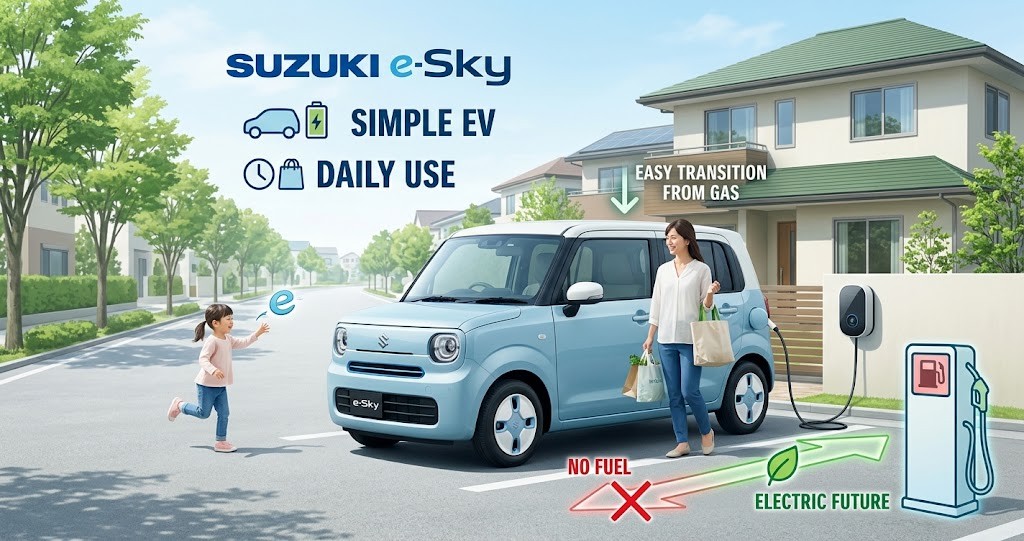
スズキが発表した「eスカイ」は、既存の軽自動車(アルトやワゴンRなど)からのスムーズな乗り換えと日常使いやすさを第一に考えた、親しみやすいベーシックな軽EVです。
- 高電費と実用的航続距離 バッテリー容量は26kWhと抑えつつも、すぐれた電費性能により航続距離310km(WLTCモード想定など)を達成しています。競合となるBYDの新型ラッコ(ベースモデル: 22.4kWh/210km、上級モデル: 35.84kWh/320km)と比較しても、小型バッテリーで効率よく長距離を走れる点が大きな特徴です。
- 扱いやすいパッケージングと操作性 ボディサイズは全長3395mm × 全幅1475mm × 全高1625mmと、ワゴンRに近いサイズ感です。シフトノブには先進的なボタン式やジョイスティック式ではなく、従来のガソリン車でお馴染みの「ゲート式シフト」を採用しており、既存の軽自動車ユーザーが迷わず運転できるよう配慮されています。
- シンプルかつ機能的なインテリア フル液晶メーターや大型ディスプレイを採用しつつも、内装材には実用的なハードタイプを使用し、配色で質感を高めています。後席空間も十分な広さを確保し、センターコンソール後部には家電やスマホが使えるコンセント(100V電源)を備えています。
- 安全性に優れたLFP電池の採用 車載バッテリーには熱安定性が高く、発火リスクが極めて低いLFP(リン酸鉄リチウムイオン)電池を採用しています。
【関連情報・技術的背景解説】
1. 電池容量26kWhで310kmを実現する技術的意義 軽EV市場では、バッテリーの重量増やコスト上昇を抑えるため、バッテリー容量の最適化が重要な課題です。26kWhの容量で310kmという航続距離は、1kWhあたり約11.9kmを走る計算(単純計算)となり、極めて高い電費効率(車体軽量化、高効率インバーター・モーター制御、空気抵抗低減など)を実現していることを示します。
2. LFP(リン酸鉄リチウムイオン)電池の採用動向 eスカイに搭載されるLFP電池(LiFePO4)は、従来のNCM(ニッケル・マンガン・コバルト)系電池と比較して以下のメリットがあります。
- 安全性の高さ: 結晶構造が安定しており、熱暴走(発火・熱分解)を起こしにくい。
- 長寿命・コスト面: サイクル寿命が長く、レアメタル(コバルトやニッケル)を使用しないため調達コストを抑えやすい。
- エネルギー密度の課題: 重層あたりの重量容量・エネルギー密度がNCM系より低い傾向にありますが、スズキは車体の軽量化と電費改善によってこの課題をカバーし、長航続距離を両立させています。
3. 軽EV市場におけるポジショニング 日産サクラや三菱eKクロスEV(バッテリー容量20kWh / 航続距離180km)が上質感や静粛性を前面に出しているのに対し、スズキのeスカイは「アルトやワゴンRの延長線上にある普段使いの道具」としてのポジションを狙っています。普及の鍵を握る価格設定(コストパフォーマンス)と、LFP電池の低コスト性を活かした価格展開が今後の注目点となります。
出典:https://carview.yahoo.co.jp/news/detail/b2c06639abecc508839cb13fdbb200c750b9e6d4/
Suzuki Announces New “e-SKY” Kei EV! Realizing a 310 km Cruising Range with a 26 kWh LFP Battery
The “e-SKY” announced by Suzuki is an approachable, basic mini EV designed with everyday usability and a smooth transition from existing mini vehicles (such as the Alto and Wagon R) as its top priorities.
- High Efficiency and Practical Driving Range: While keeping the battery capacity modest at 26 kWh, it achieves a cruising range of 310 km (under estimated WLTC mode) thanks to excellent energy efficiency. Compared to its competitor, the new BYD Racco (base model: 22.4 kWh / 210 km; high-end model: 35.84 kWh / 320 km), a major feature is its ability to cover long distances efficiently with a smaller battery.
- User-Friendly Packaging and Operation: With dimensions of L 3,395 mm x W 1,475 mm x H 1,625 mm, its size is close to that of the Wagon R. Instead of futuristic push-button or joystick selectors, the shift lever uses a familiar gated shifter found in traditional gasoline cars, ensuring existing mini-car drivers can operate it without confusion.
- Simple yet Functional Interior: While featuring a fully digital instrument cluster and a large display, the interior utilizes practical hard materials elevated in quality through thoughtful color selection. The rear seat offers ample space, and an AC outlet (100V power supply) is installed at the back of the center console for appliances and smartphones.
- Adoption of Highly Safe LFP Batteries: The onboard battery utilizes LFP (lithium iron phosphate) chemistry, which features high thermal stability and an extremely low risk of catching fire.
[Related Information & Technical Background]
- Technical Significance of Achieving 310 km with a 26 kWh Battery In the mini EV market, optimizing battery capacity is a critical challenge to prevent weight gain and rising costs. A cruising range of 310 km on a 26 kWh capacity calculates to roughly 11.9 km per kWh (simple calculation), demonstrating exceptional energy efficiency achieved through vehicle weight reduction, high-efficiency inverter and motor control, and reduced aerodynamic drag.
- Trends in the Adoption of LFP (Lithium Iron Phosphate) Batteries The LFP battery (LiFePO4) installed in the e-SKY offers several advantages over conventional NCM (nickel manganese cobalt) batteries:
- High Safety: The crystalline structure is stable, making it resistant to thermal runaway (fire and thermal decomposition).
- Long Service Life & Cost Advantages: It features a long cycle life and helps reduce procurement costs because it does not use rare metals like cobalt or nickel.
- Energy Density Challenges: Although its gravimetric capacity and energy density tend to be lower than NCM-type batteries, Suzuki balances this to achieve a long driving range by offsetting the drawback through vehicle weight reduction and energy efficiency improvements.
- Positioning in the Mini EV Market While the Nissan Sakura and Mitsubishi eK X EV (20 kWh battery capacity / 180 km range) emphasize a premium feel and quietness, Suzuki’s e-SKY aims for a position as a “daily-use tool extending from the Alto and Wagon R.” Pricing (cost performance) holds the key to widespread adoption, leveraging the low cost of LFP batteries.


コメント