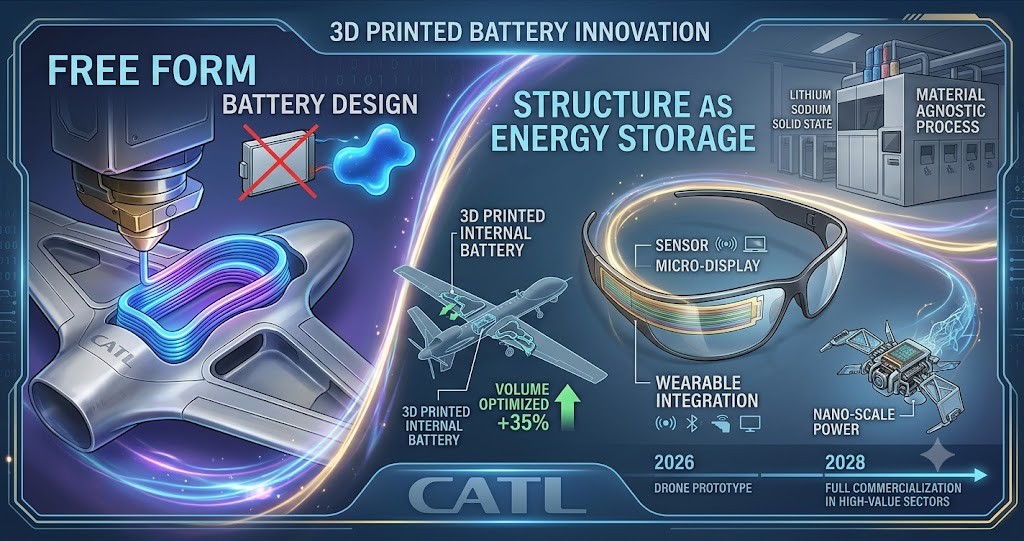
バッテリー革新に関する一般的なニュースは、ナトリウムイオンや全固体電池といった「化学組成(材料)」の進化に焦点を当てがちです。しかしその裏で、電池の「製造方法」そのものを根本から覆す静かな革命が進行しています。それが、3Dプリンティング(積層造形)技術を用いたバッテリー製造です。
従来の「硬くて決まった形状のパック」という制約から脱却し、デバイスの形状に合わせたり、構造そのものにエネルギー貯蔵機能を持たせたりするこのアプローチは、家電から軍事用ドローンに至るまで、あらゆる機器のデザインを劇的に変える可能性を秘めています。本稿では、3Dプリントバッテリーの核心的なイノベーションと、2026年現在の商業化へ向けたスタートアップの動向についてまとめます。
1. 核心的なイノベーション:四角い器からの解放
過去30年間、世界の電池製造方法はほとんど変わっていません。活物質を金属箔のシートに塗布し、それを円筒形やポーチ型、角型のケースに丸めたり積み重ねたりして詰め込む方法です。3Dプリンティングはこの物理的制約を完全に取り払います。
- 構造体としてのエネルギー貯蔵(構造一体型電池) かさばるバッテリーパックに合わせてデバイス側を設計するのではなく、デバイス内のあらゆる空きスペースに電池をプリントしたり、ガソリンタンクや機体フレームなどの「構造パーツ」そのものを電池にしたりすることが可能になります。
- 想定される革新的なユースケース
- 航空・防衛: ドローンの主翼や機体フレーム自体に電池をプリントし、重量を増やさずに航続距離を最大化する。
- ウェアラブル: スマートグラスの薄いフレーム内部にシームレスに電池を組み込み、普段使いのメガネと変わらない洗練されたデザインを実現する。
- 先端ロボティクス: ナノスケールやマイクロスケールの超小型ロボットに、無駄なデッドスペースを作らずに電源を搭載する。
2. バッテリーの化学組成を選ばない「汎用性」
3Dプリンティング技術の最大の強みのひとつは、特定の化学物質や材料の処方に依存しない(ケミストリー・アグノスティックである)点です。
- 「材料」ではなく「プロセス」の革新 この技術は電池の中身を作るのではなく、電池を「どう配置するか」という製造プロセスに焦点を当てています。
- 次世代技術へのシームレスな適応 柔軟に材料を定着させるプロセスであるため、現在主流のリチウムイオン電池だけでなく、今後台頭してくるナトリウムイオン電池や、次世代の本命とされる全固体電池の製造ラインにもそのまま応用することができます。
3. 商業化への壁:規模の経済とコスト
2025年だけで、研究者たちはバッテリーの3Dプリントに関する論文を約2万5000本も発表しており、アカデミアでの関心は非常に高まっています。しかし、これをビジネスとして成立させるのは容易ではありません。
- バッテリー業界の「死の谷」 過去、多くの新興バッテリー企業が、既存の量産巨大メーカー(ギガファクトリー)と価格で競おうとして倒産に追い込まれてきました。新しい電池技術が市場に受け入れられるには、寿命、耐久性、エネルギー密度、安全性、そして「コスト」の5つの柱すべてで既存品と同等以上の競争力を持たなければなりません。
- 大量生産とのギャップ 既存の巨大工場は、同一形状のセルを高速で大量生産することで圧倒的な低コストを実現しています。3Dプリント電池はオーダーメイドの要素が強いため、スマートフォンや一般的なEV(電気自動車)向けの標準的な電池と最初から価格で競うのは現実的ではありません。
4. 防衛分野からの突破口:Material Hybrid Manufacturingの挑戦
コスト制約の厳しい民生品市場を避け、まずは「価格よりも性能やカスタマイズ性が最優先される分野」である防衛・宇宙領域から着手する賢明なスタートアップが現れています。
- F1(フォーミュラワン)の経験から誕生 米国マイアミを拠点とする Material Hybrid Manufacturing のCEO、ゲイブ・エリアス氏は、メルセデスAMG F1チームで6年間エンジニアを務めた経歴を持ちます。当時、トップドライバーであるルイス・ハミルトンの座席の真下など、既存の技術では不可能な「極小かつ不整形なスペース」にバッテリーを詰め込む方法を模索した経験が、この事業の原点となっています。彼はその後、デューク大学の博士課程でバッテリー印刷技術を研究していたクリストファー・レイエス氏と出会い、共同で同社を設立しました。
- 実証される具体的な成果 同社は化学そのものを開発するのではなく、独自のハイブリッド3Dプリンターを用いて既存の電池材料をプリントするアプローチを採っています。すでに710万ドルのシード投資を受け、米国空軍と125万ドルの契約を締結しています。
【従来のドローンの内部構造】 -> 形状が固定された硬い四角い電池パックを4つ載せるのが限界。
【3Dプリントによるアプローチ】 -> 内部の複雑な空隙の形に合わせて電池をぴったり印刷。
                              -> 結果:同じスペースのままエネルギー貯蔵量が35%向上。
同社は2026年8月末までに次のマイルストーンとして、テレダイン・フリル社の軍用ドローン「SkyRaider」向けのプロトタイプバッテリーを開発する予定です。ドローン内部の空きスペースの形状に合わせて完璧にバッテリーを3Dプリントすることで、機体の容積を変えることなく、エネルギー貯蔵量を従来の35%も増加させることに成功しています。
まとめ:プロダクト設計のパラダイムシフト
3Dプリントバッテリー技術は、単なる「電池の長寿命化」ではなく、デバイスの「設計そのものを再定義する」パラダイムシフトです。
コストが最優先される量産型の乗用EVなどでは、今後も従来のロール状・積層型の電池セルが主流であり続けるでしょう。しかし、ドローン、ウェアラブル、ロボティクスといった「軽さ、スペースの最適化、デザイン性」が価値を生む高付加価値領域において、この技術は不可欠なブレイクスルーとなります。エネルギー貯蔵を重い「部品」から自由な「構造」へと変えるこの静かな革命は、次世代のハードウェア開発を根底から支えることになるはずです。
No More Rigid Battery Packs: How 3D Printing Transforms Device Chassis into Power Sources
Conventional news about battery innovation tends to focus on advancements in chemical composition, such as sodium-ion or solid-state technologies. Beneath the surface, however, a quiet revolution is taking place that fundamentally redefines the manufacturing process itself: 3D printing, or additive manufacturing, applied to battery production.
By breaking free from the constraints of rigid, pre-defined rectangular packs, this approach can shape batteries to fit any device geometry or even turn structural components into energy storage systems. This technology holds the potential to dramatically reshape product design across everything from consumer electronics to military drones. This article summarizes the core innovations of 3D-printed batteries and explores the latest commercialization trends among startups as of June 2026.
1. The Core Innovation: Breaking Free from the Rigid Enclosure
For the past three decades, global battery manufacturing methods have remained virtually unchanged. Active materials are coated onto flat metal foil sheets, which are then wound or stacked into cylindrical, pouch, or prismatic cases. 3D printing completely eliminates these physical constraints.
- Structural Energy Storage (Structurally Integrated Batteries) Instead of designing a device around a bulky, pre-sized battery pack, engineers can print batteries directly into any irregular empty space within the device. Alternatively, structural components—such as fuel tanks or fuselage frames—can be manufactured to double as the battery itself.
- Envisioned Revolutionary Use Cases
- Aerospace & Defense: Printing batteries into a drone’s wings or airframe to maximize flight range without adding dead weight.
- Wearables: Seamlessly integrating battery material inside the ultra-thin frames of smart glasses, enabling sleek, everyday eyewear designs.
- Advanced Robotics: Embedding power sources into micro- or nano-scale robots without leaving any unused, wasted space.
2. Universal Chemistry Compatibility
One of the greatest strengths of 3D printing technology is its “chemistry-agnostic” nature, meaning it does not rely on a specific chemical formula or material recipe.
- A Revolution in “Process,” Not “Materials” Rather than developing new active materials inside the cell, this technology focuses entirely on the deposition process—specifically, how and where those battery materials are arranged.
- Seamless Adaptation to Next-Generation Technologies Because the process flexibly deposits materials layer by layer, it can be applied to current mainstream lithium-ion formulas, as well as emerging sodium-ion or next-generation solid-state battery chemistries.
3. Barriers to Commercialization: Economies of Scale and Cost
Academic interest in this field is extraordinarily high, with researchers publishing roughly 25,000 papers on 3D-printed batteries and components in 2025 alone. Turning this academic success into a viable business, however, remains difficult.
- The Battery Industry’s “Death Valley” Historically, many battery startups have gone bankrupt by attempting to compete on price with established mass-production giants (gigafactories). For any new battery technology to gain market acceptance, it must match or exceed conventional options across five critical pillars: lifespan, durability, energy density, safety, and cost.
- The Mass-Production Gap Existing mega-factories achieve ultra-low costs by manufacturing standardized cells at extreme speeds. Because 3D-printed batteries are inherently customized, they cannot realistically compete on price with standard batteries meant for smartphones or high-volume passenger EVs from day one.
4. A Breakthrough in Defense: The Strategy of Material Hybrid Manufacturing
To bypass the severe price pressures of the consumer electronics market, smart startups are targeting the defense and aerospace sectors—fields where performance and customization are prioritized over rock-bottom costs.
- Born from Formula One Experience Gabe Elias, CEO of Miami-based Material Hybrid Manufacturing, spent six years as an engineer for the Mercedes-AMG F1 team. His experience seeking ways to pack batteries into impossibly tight, irregular spaces—such as directly underneath champion driver Lewis Hamilton’s seat—laid the foundation for his current business. He later joined forces with Christopher Reyes, who had researched battery printing methods during his doctoral studies at Duke University, to co-found the company.
- Demonstrating Concrete Results Instead of formulating new chemicals, the company uses a proprietary hybrid 3D printer to print existing battery materials. They have already secured a 7.1 million dollar seed investment round and a 1.25 million dollar contract with the US Air Force.
[Traditional Drone Geometry] -> Capped at 4 rigid rectangular battery packs due to internal space constraints.
[3D-Printed Battery Approach] -> Battery material is printed precisely to match the complex internal cavities.
                              -> Result: A 35% increase in energy storage within the exact same space.
By late August 2026, the company is scheduled to hit its next milestone: delivering prototype batteries for Teledyne FLIR’s “SkyRaider” military drone. By 3D-printing the battery to conform perfectly to the drone’s internal empty space, they have successfully increased the aircraft’s energy capacity by 35% without changing its external volume.
Summary: A Paradigm Shift in Product Design
3D-printed battery technology represents a true paradigm shift—it goes beyond merely extending battery life to actively redefining how devices are engineered.
Mass-produced passenger EVs, where cost reduction is paramount, will likely continue to rely on traditional wound or stacked battery cells for the foreseeable future. However, in high-value segments where weight, space optimization, and design aesthetics are critical—such as drones, wearables, and advanced robotics—this technology provides an indispensable breakthrough. By turning energy storage from a heavy, separate “component” into a flexible “structure,” this quiet revolution is poised to underpin the development of next-generation hardware.


コメント