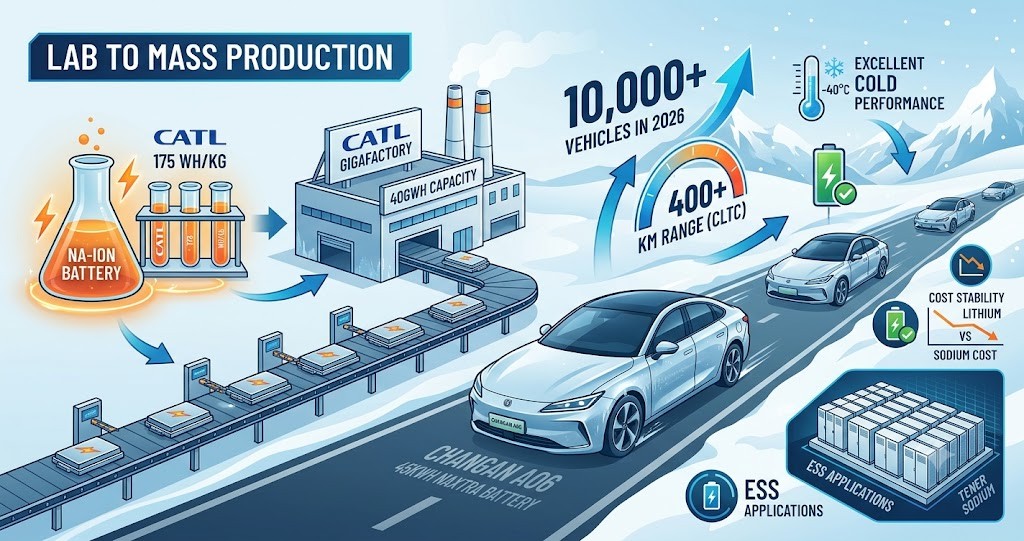
大型蓄電システム(ESS)の分野でナトリウムイオン技術の社会実装を急速に進めるCATL(寧徳時代)ですが、その波は電気自動車(EV)市場にも確実に押し寄せています。同社の製造責任者は、2026年中に同社のナトリウムイオン電池を搭載した電気自動車が、世界で1万台から2万台に達する見込みであることを明らかにしました。
リチウムの価格変動リスクをヘッジし、寒冷地での弱点を克服する「ポスト・リチウム」の大本命が、いよいよ研究室から量産車へと移行し、本格的な実用化フェーズを迎えています。本稿では、CATLが推進する車載用ナトリウム電池の強み、自動車メーカーとの協調、そして2026年現在の最新動向についてまとめます。
1. 氷点下への挑戦:極寒環境で真価を発揮する圧倒的な低温性能
従来のEV、特に安価で主流のLFP(リン酸鉄リチウムイオン)電池は、冬季や極寒地域においてバッテリー容量の低下や充電速度の減速が最大の弱点とされてきました。ナトリウムイオン電池はこの課題を劇的に解決します。
- マイナス30℃から50℃の極限でも動作 CATLの製造責任者である倪軍(ニー・ジュン)氏は、世界経済フォーラム(ダボス会議・大連)において、マイナス20℃からマイナス30℃といった極限環境でも性能を発揮できる画期的なアーキテクチャを開発したと発表しました。
- 圧倒的な放電出力と容量維持 内モンゴル自治区の極寒地で行われた厳冬期テストデータによると、マイナス30℃における放電出力は、同容量のLFP電池の約3から4倍を記録。さらに、マイナス40℃の環境下でも90%以上の容量維持率を誇り、マイナス50℃でも安定した放電を維持します。これにより、北欧や北米、日本の寒冷地などにおけるEVの信頼性が一気に高まります。
2. ついに量産へ:世界初のナトリウム電池搭載EVの誕生
CATLは2025年4月にナトリウム電池の専用ブランド「Naxtra(ナクストラ)」を立ち上げ、量産車へのアプローチを本格化させてきました。
- 長安汽車との共同開発と2026年半ばの市場投入 2026年2月、CATLと中国自動車大手の長安汽車は、世界初となる量産型ナトリウム電池搭載の乗用車「長安 啓源(Nevo / Qiyuan)A06」を初公開しました。容量45kWhのNaxtraバッテリーを搭載し、2026年半ば(夏頃)の市販化を予定しています。
- LFPに匹敵するエネルギー密度と航続距離 Naxtraセルの単体エネルギー密度は最大175Wh/kgに達し、エントリークラスのLFP電池に匹敵する性能を確保。これにより、1回の充電で400キロメートル以上の航続距離(CLTCモード)を実現しています。CATLは、今後のサプライチェーンの成熟に伴い、将来的に航続距離を500から600キロメートルまで延伸できると予測しています。
【Naxtraバッテリーのロードマップ】
現在(2026年半ば): エネルギー密度 175Wh/kg -> 45kWhパックで航続距離 400km超
将来的(技術成熟後): サプライチェーン最適化 -> 航続距離 500から600km(ピュアEV)
3. 【関連・補足情報】リチウム・ナトリウムの「二本柱戦略」と巨額投資
CATLの車載ナトリウム電池展開は、蓄電システム(ESS)での動きと完全に同期した巨大なクリーンエネルギー戦略の一環です。
- 蓄電分野でのギガワット時(GWh)級受注と専用工場の新設 CATLは車載用だけでなく、グリッド向け蓄電システム「Tener Sodium」を発表したばかりです。すでにエネルギー貯蔵プロバイダーのHyperStrongと3年間で合計60GWhという歴史的な供給契約を締結。これに対応するため、福建省に50億元(約7億3900万ドル)を投じて40GWhのナトリウムイオン電池専用工場を建設しています。2025年末までの累計R&D投資額は100億元(約14億7000万ドル)近くに達しています。
- 市場の復活と長期的展望 今年に入りリチウム価格が回復基調にあることも、資源量がほぼ無限で安価なナトリウム電池のコスト競争力をさらに後押ししています。CATLの創業者兼会長であるロビン・ゼン(曽毓群)氏は、「長期的には、低コストなナトリウムイオン電池が既存の電池市場の30%から40%を置き換える可能性がある」と明言しており、長安汽車の他のブランド(AVATR、Deepal、UNIなど)への供給拡大も予定されています。
まとめ:EV市場は「デュアルケミストリー」の新時代へ
今年1万台から2万台のナトリウム電池搭載EVが路上を走り始めるという事実は、実験室の技術が完全に商業化されたことを意味します。また、驚異的な耐破壊試験(クラッシュ、ドリル突き刺し、鋸での切断でも発煙・発火・爆発なし)をクリアする高い安全性も実証されています。
プレミアムモデルや長距離EVには高密度なリチウム電池が使われ、日常のコミューターや寒冷地向けの普及型モデル、そして大型蓄電インフラにはナトリウム電池が選ばれる。CATLが主導する「リチウムとナトリウムの二本柱(デュアルケミストリー)戦略」は、これからのグローバルモビリティの勢力図と、クリーンエネルギーステージの主導権を大きく塗り替えることになりそうです。
出典:https://cnevpost.com/2026/06/24/catl-expects-10000-evs-sodium-batteries-2026/
CATL to Deploy Sodium Batteries in Up to 20,000 EVs This Year, Countering LFP with Cold-Weather Performance
While CATL, the global leader in automotive batteries and energy storage systems (ESS), is rapidly accelerating the social implementation of sodium-ion technology in the grid storage sector, that wave is now unequivocally crashing into the electric vehicle (EV) market. The company’s head of manufacturing recently revealed that the number of electric vehicles worldwide equipped with CATL’s sodium-ion batteries is expected to reach between 10,000 and 20,000 units within 2026.
As the ultimate contender for the “post-lithium” era—designed to hedge against lithium price volatility and overcome vulnerabilities in cold climates—this technology is finally moving from laboratories into mass-production vehicles, marking the dawn of a full-scale commercialization phase. This article outlines the strengths of CATL’s automotive sodium batteries, its collaboration with automakers, and the latest industry trends as of 2026.
1. Defying Sub-Zero Climates: Unrivaled Cold-Weather Performance
Conventional EVs, particularly those utilizing inexpensive and mainstream Lithium Iron Phosphate (LFP) batteries, have historically suffered from drastic drops in battery capacity and slower charging speeds during winter and in ultra-cold regions. Sodium-ion batteries address this bottleneck directly.
- Operating Under Extreme Conditions From Minus 30 to 50 Degrees Celsius Ni Jun, CATL’s head of manufacturing, announced at the World Economic Forum (Annual Meeting of the New Champions in Dalian) that the company has engineered a breakthrough architecture capable of operating smoothly in extreme environments ranging from minus 20 to minus 30 degrees Celsius.
- Dominant Power Output and Capacity Retention According to winter testing data conducted in the frigid regions of Inner Mongolia, the power output of these cells at minus 30 degrees Celsius is roughly 3 to 4 times higher than that of an LFP battery with equivalent capacity. Furthermore, it boasts a capacity retention rate exceeding 90% even at minus 40 degrees Celsius, and maintains stable discharge capability down to minus 50 degrees Celsius. This drastically improves the real-world reliability of EVs in the Nordic countries, North America, and cold-weather regions of Japan.
2. Transitioning to Mass Production: The Birth of the World’s First Sodium EV
CATL has actively accelerated its approach to mass-production passenger vehicles by launching its dedicated sodium battery brand, Naxtra, in April 2025.
- Joint Development with Changan Automobile and Mid-2026 Market Launch In February 2026, CATL and Chinese automotive giant Changan Automobile unveiled the Changan Nevo (Qiyuan) A06, the world’s first mass-produced passenger vehicle powered by a sodium-ion battery. Equipped with a 45 kWh Naxtra battery pack, the vehicle is scheduled for commercial release by mid-2026 (around summer).
- Energy Density and Range Rivaling Entry-Level LFP The cell-level energy density of the Naxtra battery reaches up to 175 Wh/kg, securing a performance level comparable to baseline LFP options. This enables a driving range of over 400 kilometers (under CLTC testing standards) on a single charge. CATL projects that as the supply chain matures, future variations will extend pure EV ranges to between 500 and 600 kilometers.
[Naxtra Battery Roadmap]
Current (Mid-2026): Energy Density 175 Wh/kg -> 45 kWh Pack for 400+ km Range
Future (Post-Maturity): Supply Chain Optimization -> 500 to 600 km Range (Pure EV)
3. [Related & Supplementary Information] The “Dual-Chemistry Strategy” and Massive Capital Backing
The rollout of CATL’s automotive sodium cells is part of a larger, highly coordinated clean energy strategy running in parallel with its stationary storage (ESS) initiatives.
- Gigawatt-Hour (GWh) Orders in Grid Storage and Dedicated Factory Openings Alongside its automotive initiatives, CATL recently debuted “Tener Sodium,” its grid-scale energy storage system. The company has secured a historic three-year, 60 GWh supply contract with energy storage provider HyperStrong. To fulfill this surging demand, CATL has invested 5 billion yuan (approx. 739 million dollars) to build a new 40 GWh sodium-ion battery factory in Fujian Province. By the close of 2025, its cumulative R&D investment in sodium-ion technology reached nearly 10 billion yuan (approx. 1.47 billion dollars).
- Market Recovery and Long-Term Projections A recovery in global lithium prices this year has further enhanced the cost-competitiveness of abundant, low-cost sodium batteries. Robin Zeng, founder and chairman of CATL, has stated to investors that over the long term, low-cost sodium-ion batteries have the potential to replace 30% to 40% of the existing battery market. Plans are already underway to expand supply to Changan’s other subsidiary brands, including AVATR, Deepal, and UNI.
Summary: The EV Market Enters a New Era of Dual-Chemistry
The fact that 10,000 to 20,000 sodium-powered EVs are hitting public roads this year signifies that lab-scale technology has successfully achieved commercial viability. These cells have also demonstrated remarkable safety characteristics, passing extreme abuse testing—including crush, nail-penetration, and sawing tests—without emitting smoke, catching fire, or exploding.
High-performance and long-range luxury models will continue to rely heavily on high-density lithium chemistries, while everyday commuters, budget-friendly cars in cold regions, and massive grid infrastructures will adopt sodium batteries. This “dual-chemistry” strategy spearheaded by CATL is set to redraw the global mobility map and shift the balance of power across the clean energy sector.
コメント