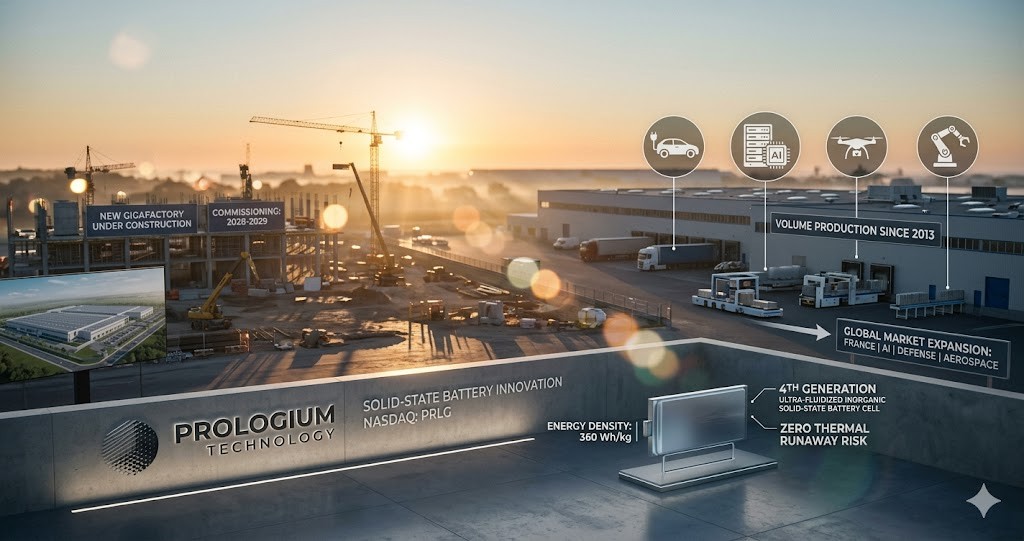
次世代バッテリーの本命とされる固体電池の分野で、20年以上の研究開発と10年以上の量産実績を持つ台湾のProLogiumが、特別目的買収会社(SPAC)であるTDACとの合併により米国ナスダック市場へ上場することが発表されました。資金調達前の企業価値は約38億ドル(純現金フリーベース)と見込まれており、調達資金は同社の「第4世代」超流動化無機固体電池の量産拡大や、フランスで進む巨大工場の建設に投入されます。研究室の技術をいち早く市場へ送り出してきた同社の、新たなグローバル戦略をまとめます。
1. ニュースの概要と上場計画
- ナスダック上場: ProLogiumはTranslational Development Acquisition Corp.(TDAC)との事業統合により、合併後は「ProLogium Technology」としてナスダックに上場します(ティッカーシンボル: PRLG)。取引の完了は2026年後半を予定しています。
- 圧倒的な量産実績: 同社は2013年からこれまでに累計240万個以上のバッテリーセルを出荷しており、そのうち80万個以上は台湾のギガファクトリーで製造された第3世代バッテリーです。単なるプロトタイプではなく、すでに商用規模での製造・供給体制を確立している点が大きな強みです。
2. 第4世代「超流動化無機固体電池」の革新性
ProLogiumが発表した最新の第4世代技術は、第三者機関の試験でもその圧倒的な性能が実証されています。
- 熱暴走リスクゼロの安全性: 不燃性電解質、オールセラミックセパレーター、超流動化オール無機固体電解質による「三重安全機構」を採用。UL Solutions ARCの試験において、加熱待機探索(HWS)方式で熱暴走を起こさないことが検証されました。
- 驚異的なエネルギー密度: 独立検査機関のTUEV Rheinlandにより、最新セルのエネルギー密度が 360 Wh/kg であることが確認されました。これは従来の一般的な液体リチウムイオン電池を50%以上上回る画期的な数値です。
- 多分野への進出: 高い安全性と低温性能、急速充電特性を活かし、従来の電気自動車(EV)だけでなく、需要が急増しているAIデータセンター、航空宇宙、ロボット工学、防衛といった新市場への展開を急ピッチで進めています。
3. フランス・ダンケルクの新工場と今後のロードマップ
今回の調達資金の主な使途となるのが、欧州市場のハブとなるフランスでのギガファクトリー建設です。
- 多額の政府補助金: フランス共和国政府から最大約14億ユーロという巨額の補助金パッケージの承認を得ています。
- スケジュール: 工場が建設されるフランスのダンケルク施設は、2026年に建設が開始されます。2028年第4四半期から2029年第1四半期にかけて生産を本格化させ、2029年第2四半期に正式な量産と出荷を開始する予定です。
【関連情報の追加】技術背景とグローバル市場への影響
液体から「固体」へのパラダイムシフト
現在のEVや電子機器で主流の液体リチウムイオン電池は、エネルギー密度の向上(航続距離の延長)が限界に近づいており、液漏れによる発火リスクという構造的な課題を抱えています。電解液をすべて固体(セラミックなど)に置き換える固体電池は、安全性を劇的に高めながら、セルを限界まで詰め込めるためエネルギー密度を大幅に向上できます。トヨタ自動車などの自動車巨頭も2020年代後半の投入を目指して開発を急いでいますが、ProLogiumはすでに市販デモカーや建機向けに実出荷を行っており、商業化のスピードにおいて一歩リードしています。
AIデータセンターや防衛が「固体電池」を求める理由
現在の生成AIブームにより、世界中でAIデータセンターの消費電力と発熱が深刻な課題となっています。万が一の火災が壊滅的な損失につながるデータセンターのバックアップ電源(UPS)において、「熱暴走リスクゼロ」の固体電池は極めて理想的なソリューションです。また、過酷な温度環境(極地や上空)での作動が求められる防衛用ドローンや航空宇宙分野にとっても、低温特性に優れ、衝撃を受けても発火しない無機固体電池は安全保障上の強力なアドバンテージとなります。
SPAC上場による資金調達の意義
スタートアップが巨額の製造設備(ギガファクトリー)を建設するには膨大な資本が必要です。今回のSPAC(特別目的買収会社)による上場は、通常のIPOよりも迅速に株式公開市場から資金を調達する手段として選ばれました。純現金フリーベースで38億ドルという高い評価額は、同社が持つ1100件以上の特許ポートフォリオと、すでにGWh(ギガワット時)クラスの工場を稼働させているという「製造ノウハウ」に対する市場の強い期待を反映しています。
From Lab to Mass Production: The Global Strategy of Solid-State Battery Leader ProLogium Through Its Nasdaq Listing
Introduction
In the field of solid-state batteries, widely considered the ultimate next-generation battery technology, Taiwan-based ProLogium, which boasts over 20 years of research and development and more than 10 years of mass production experience, has announced that it will list on the US Nasdaq market through a merger with Translational Development Acquisition Corp. (TDAC), a Special Purpose Acquisition Company (SPAC). The pre-money enterprise value is estimated at approximately 3.8 billion dollars on a net-cash-free basis. The raised funds will be deployed to expand mass production of the company’s fourth-generation hyper-fluidized inorganic solid-state batteries and to finance the construction of its ongoing gigafactory project in France. This summary outlines the new global strategy of a company that has consistently been the first to transition laboratory technology into the commercial market.
1. News Overview and Listing Plans
- Nasdaq Listing: Through a business combination with Translational Development Acquisition Corp. (TDAC), the combined company will be named ProLogium Technology and listed on Nasdaq under the ticker symbol PRLG. The transaction is expected to close in the second half of 2026.
- Overwhelming Mass Production Track Record: The company has shipped a cumulative total of more than 2.4 million battery cells since 2013, over 800,000 of which are third-generation batteries manufactured at its gigafactory in Taiwan. Its primary strength lies in having already established a commercial-scale manufacturing and supply system, rather than just producing prototypes.
2. Innovations of the Fourth-Generation Hyper-Fluidized Inorganic Solid-State Battery
The latest fourth-generation technology announced by ProLogium has demonstrated overwhelming performance in independent third-party testing.
- Zero Thermal Runaway Risk Safety: The technology utilizes a triple safety mechanism consisting of a non-flammable electrolyte, an all-ceramic separator, and an active safety mechanism embedded in a hyper-fluidized all-inorganic solid electrolyte. Testing by UL Solutions ARC verified that the battery does not undergo thermal runaway under the Hot Wire Exploration (HWS) method.
- Exceptional Energy Density: TUEV Rheinland, an independent testing organization, confirmed that the latest cell achieves a record energy density of 360 Wh/kg. This breakthrough figure surpasses conventional liquid lithium-ion batteries by more than 50 percent.
- Expansion into Multiple Sectors: Leveraging high safety, superior low-temperature performance, and fast-charging characteristics, the company is rapidly expanding beyond conventional electric vehicles (EV) into fast-growing markets such as AI data centers, aerospace, robotics, and defense.
3. The New Plant in Dunkirk, France and Future Roadmap
The primary use of the raised capital will be the construction of a gigafactory in France, which will serve as the hub for the European market.
- Substantial Government Subsidies: The company has secured approval from the government of the French Republic for a massive subsidy package worth up to approximately 1.4 billion euros.
- Timeline: Construction of the Dunkirk facility in France is scheduled to begin in 2026. Production is expected to ramp up from the fourth quarter of 2028 to the first quarter of 2029, with official mass production and commercial shipments commencing in the second quarter of 2029.
Additional Information: Technical Background and Global Market Impact
Paradigm Shift from Liquid to Solid State
Conventional liquid lithium-ion batteries, currently dominant in EVs and electronics, are approaching their theoretical limits for energy density improvement (extending driving range) and face inherent safety challenges such as fire risks from electrolyte leakage. Solid-state batteries, which replace liquid electrolytes entirely with solid materials like ceramics, dramatically enhance safety while allowing cells to be packed tightly to significantly boost energy density. Although automotive giants like Toyota Motor are rushing development with plans to introduce them in the late 2020s, ProLogium holds a competitive edge in commercialization speed, having already delivered cells for commercial demonstration cars and construction machinery.
Why AI Data Centers and Defense Demand Solid-State Batteries
Driven by the ongoing generative AI boom, electricity consumption and heat generation at AI data centers have become critical issues globally. For uninterruptible power supply (UPS) systems in data centers, where a potential fire could cause catastrophic financial data loss, solid-state batteries with zero thermal runaway risk present an ideal solution. Furthermore, for aerospace applications and defense drones operating in extreme temperature environments (such as polar regions or high altitudes), inorganic solid-state batteries provide a powerful strategic advantage due to their excellent low-temperature characteristics and resistance to ignition under mechanical impact.
Significance of Capital Procurement via SPAC Listing
Startups require massive amounts of capital to construct large-scale manufacturing facilities like gigafactories. This listing via a SPAC (Special Purpose Acquisition Company) was selected as a method to raise funds from public equity markets more rapidly than a traditional IPO. The high valuation of 3.8 billion dollars on a pre-money basis reflects strong market expectations for the company’s intellectual property portfolio of over 1100 patents and its proven manufacturing know-how gained from already operating a GWh-class facility.
コメント