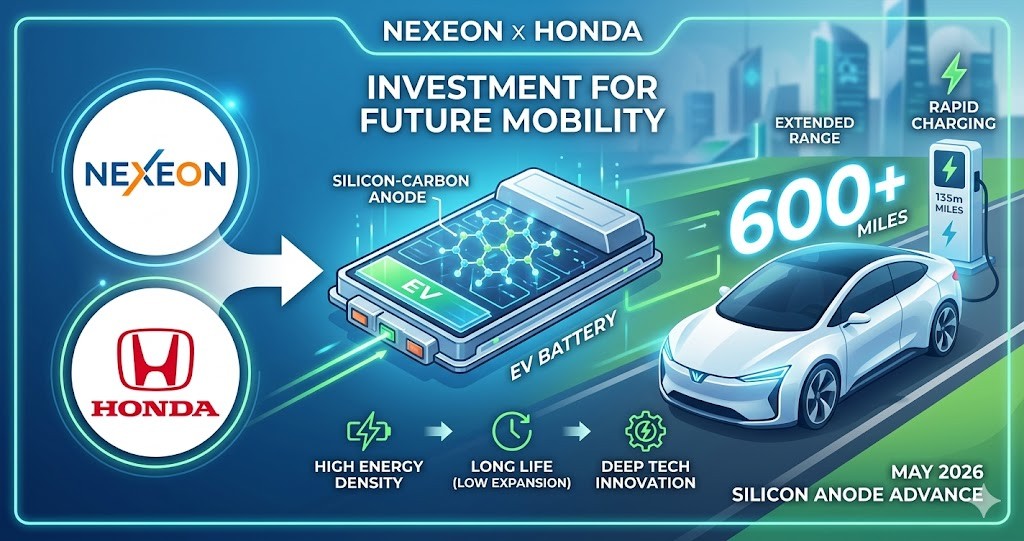
電気自動車(EV)の航続距離延長や充電時間の短縮に向け、次世代バッテリー技術の開発競争が世界中で激化しています。その中で、英国のバッテリー素材スタートアップであるネクセオン(Nexeon)は、日本の本田技研工業(以下「ホンダ」)から戦略的投資を受けたことを発表しました。ホンダのオープンイノベーションプログラム「Honda Xcelerator Ventures」を通じたこの出資は、ネクセオンの革新的なシリコン負極材料への高い期待を示すものです。本稿では、この発表の要点と、EVシフトにおけるシリコン負極技術の重要性などの関連情報をまとめて解説します。
1. 発表の要点と投資の目的
- ニュースの核心: ネクセオンは、ホンダのコーポレートベンチャーキャピタル(CVC)である「Honda Xcelerator Ventures」からの新たな資金調達を実施しました。
- 資金の使途と期待される効果: 今回の資金は、ネクセオンの継続的な成長と、同社が強みを持つ「シリコン負極材料」の開発・商用化および生産規模の拡大(スケールアップ)に充てられます。これにより、EVをはじめとする様々な用途において、さらなる高エネルギー密度と優れたバッテリー性能の実現を目指します。
- 経営陣のコメント: ネクセオンのCEOであるスコット・ブラウン博士は、ホンダを株主として迎えた喜びを語るとともに、今回の投資が自社の技術力と商業的実績、そして世界の電動化への移行における戦略的役割が認められた証であると強調しています。
2. 【関連情報】シリコン負極技術とは何か?なぜ重要なのか?
- 従来のグラファイト(黒鉛)との違い: 現在主流のリチウムイオン電池では、負極(マイナス極)の素材として主にグラファイトが使われています。しかし、グラファイトの理論容量には限界が近づいています。これに対して「シリコン」は、グラファイトの約10倍の理論容量を持つため、バッテリーの大幅な大容量化・高エネルギー密度化が可能になります。
- 克服すべき課題とネクセオンの強み: シリコン負極の最大の弱点は、充放電時に体積が約4倍に膨張・収縮し、材料が崩壊して寿命が短くなってしまう点にあります。ネクセオンは、この膨張を抑制する独自の「シリコンカーボン(Si-C)複合材料」の技術を開発しており、寿命特性と安全性を両立させながら、エネルギー密度を飛躍的に高めることに成功しています。
3. 【関連情報】ホンダのEV戦略と外部連携の背景
- 2040年までの電動化目標: ホンダは「2040年までに四輪車の新車販売をすべてEV(電気自動車)またはFCEV(燃料電池車)にする」という野心的な目標を掲げています。この目標達成には、バッテリーのコスト削減と性能向上が最優先課題です。
- 「Honda Xcelerator Ventures」によるアプローチ: 自社開発だけでなく、世界中の先進的なスタートアップと連携する「オープンイノベーション」を加速させています。ネクセオンへの出資は、次世代EVの競争力を左右するコア技術(バッテリー素材)を早期に確保し、将来の自社車両へ組み込むための戦略的な布石と言えます。
4. 【関連情報】ネクセオンのグローバル展開と市場の動向
- 大手サプライチェーンとの連携: ネクセオンはホンダだけでなく、すでに韓国の化学大手であるSKCとも戦略的提携を結んでおり、韓国国内での量産工場の建設などを進めています。自動車メーカーや化学大手を巻き込んだグローバルなサプライチェーン構築を着実に進めています。
- 自動車業界でのシリコン負極の採用ラッシュ: テスラをはじめ、ポルシェやメルセデス・ベンツなどのプレミアムEVブランドでも、航続距離の延長と超急速充電(10分から15分での充電)を実現するために、シリコン負極を部分的に採用、あるいは本格導入する計画が相次いでいます。
【結論・まとめ】
ホンダによるネクセオンへの戦略的投資は、単なる資金援助にとどまらず、次世代EVバッテリーの主導権争いにおける重要なマイルストーンです。 ネクセオンの持つ高性能なシリコン負極材料は、EVの「航続距離を大幅に伸ばす」「充電時間を劇的に短縮する」という、消費者にとって最も重要な課題を解決する鍵を握っています。自動車メーカーと最先端素材スタートアップの強力なタッグにより、次世代リチウムイオン電池の商用化と量産化へのカウントダウンがさらに加速していくことが期待されます。
出典:https://www.nexeonglobal.com/media/nexeon-welcomes-honda-as-a-strategic-investor
- 1. 発表の要点と投資の目的
- 2. 【関連情報】シリコン負極技術とは何か?なぜ重要なのか?
- 3. 【関連情報】ホンダのEV戦略と外部連携の背景
- 4. 【関連情報】ネクセオンのグローバル展開と市場の動向
- 【結論・まとめ】
- From Graphite to Silicon: The Potential of Nexeon, the Next-Gen Battery Material Catching Honda’s Attention
- Introduction
- 1. Key Points of the Announcement and Investment Objectives
- 2. [Related Information] What is Silicon Anode Technology, and Why Does It Matter?
- 3. [Related Information] Honda’s EV Strategy and the Context of External Collaboration
- 4. [Related Information] Nexeon’s Global Expansion and Market Trends
- Conclusion
From Graphite to Silicon: The Potential of Nexeon, the Next-Gen Battery Material Catching Honda’s Attention
Introduction
The global race to develop next-generation battery technologies is intensifying, driven by the need to extend the driving range of electric vehicles (EVs) and shorten charging times. Against this backdrop, Nexeon, a UK-based battery materials startup, announced that it has received a strategic investment from Japan’s Honda Motor Co., Ltd. (hereinafter “Honda”). This investment, made through Honda’s global open innovation program, Honda Xcelerator Ventures, reflects high expectations for Nexeon’s innovative silicon anode materials. This article provides a summary of the announcement alongside relevant insights into the critical role of silicon anode technology in the shift toward EVs.
1. Key Points of the Announcement and Investment Objectives
- The Core News: Nexeon has secured new funding from Honda Xcelerator Ventures, the corporate venture capital (CVC) arm of Honda.
- Use of Funds and Expected Outcomes: The capital will support Nexeon’s continuous growth, the development and commercialization of its core silicon anode materials, and the scaling up of its production capacity. The ultimate goal is to achieve higher energy density and superior battery performance for EVs and various other applications.
- Management Commentary: Dr. Scott Brown, CEO of Nexeon, expressed his excitement about welcoming Honda as a shareholder. He emphasized that this investment serves as recognition of Nexeon’s technology, commercial achievements, and strategic role in the global transition to electrification.
2. [Related Information] What is Silicon Anode Technology, and Why Does It Matter?
- Difference from Conventional Graphite: In today’s mainstream lithium-ion batteries, graphite is primarily used as the anode (negative electrode) material. However, graphite is nearing its theoretical capacity limit. In contrast, silicon offers a theoretical capacity roughly 10 times higher than that of graphite, enabling a massive increase in total battery capacity and energy density.
- Challenges to Overcome and Nexeon’s Strengths: The greatest weakness of silicon anodes is that they expand and contract by about four times their volume during charging and discharging, causing the material to degrade and severely shortening battery life. Nexeon has developed a proprietary silicon-carbon (Si-C) composite material that restrains this expansion, successfully delivering a leap in energy density while maintaining cycle life and safety.
3. [Related Information] Honda’s EV Strategy and the Context of External Collaboration
- Electrification Goal by 2040: Honda has set an ambitious target to make EVs and fuel cell electric vehicles (FCEVs) represent 100% of its global vehicle sales by 2040. Reducing battery costs and boosting performance are top-priority challenges to achieving this goal.
- The Honda Xcelerator Ventures Approach: Rather than relying solely on in-house development, Honda is accelerating “open innovation” by partnering with advanced startups worldwide. The investment in Nexeon is a strategic move to secure a core technology (battery materials) early on, which will define the competitiveness of next-generation EVs, and to integrate it into future Honda vehicles.
4. [Related Information] Nexeon’s Global Expansion and Market Trends
- Integration into Major Supply Chains: Beyond Honda, Nexeon has already established a strategic partnership with SKC, a major South Korean chemical company, and is progressing with the construction of a mass-production plant in South Korea. The company is steadily building a global supply chain involving both automakers and chemical giants.
- The Rush to Adopt Silicon Anodes in the Auto Industry: Led by Tesla, premium EV brands like Porsche and Mercedes-Benz are increasingly planning to partially adopt or fully introduce silicon anodes. This shift aims to extend driving ranges and unlock ultra-fast charging capabilities, targeting charge times of just 10 to 15 minutes.
Conclusion
Honda’s strategic investment in Nexeon is more than just financial backing; it represents a major milestone in the battle for leadership in next-generation EV batteries. Nexeon’s high-performance silicon anode materials hold the key to solving the most critical consumer challenges: significantly extending EV driving range and dramatically cutting down charging times. This powerful combination of an established automaker and a cutting-edge materials startup is set to accelerate the countdown toward the commercialization and mass production of next-generation lithium-ion batteries.
コメント