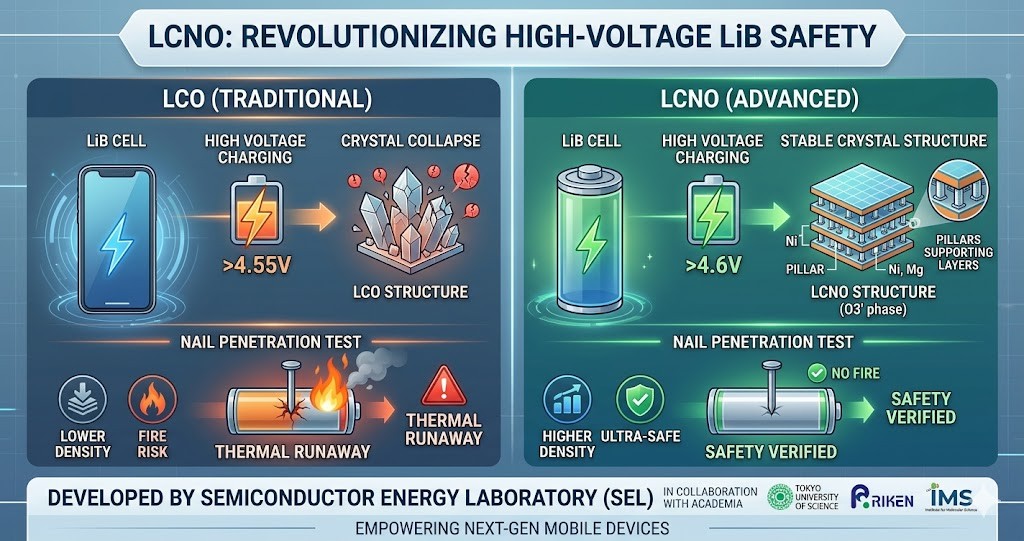
スマートフォンなどのモバイル機器に欠かせないリチウムイオン二次電池(LiB)において、「エネルギー密度の向上」と「発火リスクの低減」の両立は長年の最重要課題です。株式会社半導体エネルギー研究所(SEL)は、独自の結晶制御技術を応用し、4.6V以上の高電圧充電時でも結晶構造が崩れない新規正極材料「LCNO(ニッケル添加コバルト酸リチウム)」を開発しました。
本技術により、従来のコバルト酸リチウム(LCO)を上回る高いエネルギー密度を確保しながら、釘刺し試験でも発火や熱暴走を一切起こさない極めて高い安全性を実証しました。
1. 従来材料(LCO)の課題とLCNOのブレイクスルー
モバイル機器の正極材料として広く普及しているLCOは、より多くの電気を蓄えるために高電圧(目安として4.55V vs. Li/Li以上)で充電しようとすると、結晶構造内のリチウム(Li)イオンが抜けすぎてしまい、結晶を構成するCoO2(コバルト酸)層に「ズレ」が生じます。
- LCOの弱点(H1-3相への転移): 高電圧充電によって結晶構造が「H1-3相」と呼ばれる不安定な状態に変化します。この状態になると放電しても元の健全な結晶構造(O3相)に戻れなくなり、充放電サイクルの劣化や、短絡(ショート)時の熱暴走・発火を引き起こす原因となっていました。
- LCNOの解決アプローチ(O3’相の維持): SELが開発したLCNOは、LCOに微量のNiとMgを添加した材料です。リチウムが大量に引き抜かれた高電圧充電状態(4.6V vs. Li/Li以上)でも、Liサイトに入り込んだニッケルやマグネシウムが「柱(ピラー)」の役割を果たして層状構造を支えます。これにより、有害なH1-3相への変化を抑制し、安定した「O3’相」という結晶構造を維持することに成功しました。
2. 釘刺し試験における圧倒的な安全性
リチウムイオン電池の最も厳しい安全性試験の一つである「釘刺し試験(内部短絡のシミュレーション)」において、試作されたLCNO電池は発火や破裂を起こさないことが確認されました。
短絡が生じてもセル表面の温度上昇がほとんど見られないことは、電池内部での化学的な連鎖反応による「熱暴走」が完全に抑制されていることを示しています。安全性を担保するためにエネルギー密度を犠牲にする必要がなく、材料の重量当たりの放電エネルギー密度は市販のLCO製品よりも向上しています。
【関連情報】技術的背景と共同研究の広がり
- フッ化物溶融塩を用いた相転移制御(論文からの補足) 本発表のベースとなっている共同研究論文(Communications Materials, 2024)の題目「Controlling lithium cobalt oxide phase transition using molten fluoride salt…」が示す通り、このLCNO正極の合成または改質には、フッ化物溶融塩(Molten fluoride salt)を用いた特殊なプロセスが関与していると推察されます。溶融塩プロセスを用いることで、微量元素(Ni、Mg)を結晶構造内の狙った位置(Liサイトなど)に均一かつ精密に配置し、理想的なピラー効果を発現させていると考えられます。
- 強力なアカデミアとの連携 今回の開発はSEL単独ではなく、蓄電池研究の第一人者である東京理科大学の駒場慎一教授や、固体化学・電池材料の最先端研究を行う理化学研究所(理研)の小林玄器氏(現・分子科学研究所教授など)との共同研究による成果です。固体結晶の構造解析(XRD測定など)において最高峰の知見が投入されており、基礎科学的な裏付けが非常に強固です。
- 民生市場(スマホ・ウェアラブル)へのインパクト 車載向けでは安全性を重視してLFP(リン酸鉄リチウム)などの採用が進んでいますが、LFPは体積当たりのエネルギー密度が低いため、スペースに限りのあるスマートフォンへの搭載は困難でした。エネルギー密度が最優先されるモバイル市場において、LCOベースのまま高電圧化と耐発火性を両立できるLCNOは、次世代スマートフォンの薄型化や長寿命化に直結する極めて商業価値の高い技術と言えます。
出典:https://prtimes.jp/main/html/rd/p/000000014.000021882.html
Dramatic Evolution in Smartphone Batteries: The True Potential of “LCNO” Batteries That Never Suffer Thermal Runaway Even in Nail-Penetration Tests
In lithium-ion secondary batteries (LiBs), which are indispensable for mobile devices such as smartphones, balancing “increased energy density” with “reduced ignition risk” has been the most critical challenge for many years. Semiconductor Energy Laboratory Co., Ltd. (SEL) has applied its proprietary crystal control technology to develop a novel cathode material, “LCNO” (nickel-added lithium cobalt oxide), which maintains its crystal structure even during high-voltage charging at 4.6V or higher.
With this technology, SEL has demonstrated extremely high safety, completely preventing ignition or thermal runaway even during nail-penetration tests, while securing a higher energy density than conventional lithium cobalt oxide (LCO).
1. Challenges of Conventional Material (LCO) and the LCNO Breakthrough
LCO, which is widely used as a cathode material for mobile devices, faces a challenge when charged at high voltages (approximately 4.55V vs. Li/Li or higher) to store more electricity. Too many lithium (Li) ions are extracted from the crystal structure, causing a “distortion” in the CoO2 (cobalt oxide) layers that make up the crystal.
- Weakness of LCO (Transition to H1-3 phase): High-voltage charging changes the crystal structure into an unstable state called the “H1-3 phase.” Once in this state, the material cannot return to its original healthy crystal structure (“O3 phase”) even during discharge. This has been a primary cause of capacity degradation during charge-discharge cycles, as well as thermal runaway and ignition during a short circuit.
- LCNO’s Solution Approach (Maintaining O3′ phase): The LCNO developed by SEL is a material in which trace amounts of Ni and Mg are added to LCO. Even in a high-voltage charged state (4.6V vs. Li/Li or higher) where a large amount of lithium is extracted, the nickel and magnesium that have entered the Li sites act as “pillars” to support the layered structure. This suppresses the transition to the harmful H1-3 phase and successfully maintains a stable crystal structure known as the “O3′ phase.”
2. Overwhelming Safety in Nail-Penetration Tests
In the “nail-penetration test” (a simulation of an internal short circuit), which is one of the most severe safety tests for lithium-ion batteries, it was confirmed that the prototype LCNO battery did not ignite or rupture.
The fact that there is almost no visible temperature rise on the cell surface even when a short circuit occurs indicates that “thermal runaway” caused by chemical chain reactions inside the battery is completely suppressed. There is no need to sacrifice energy density to guarantee safety, and the discharge energy density per weight of the material is higher than that of commercially available LCO products.
[Related Information] Technical Background and Expansion of Joint Research
- Phase Transition Control Using Molten Fluoride Salt (Supplement from the Paper) As indicated by the title of the joint research paper underpinning this announcement (Communications Materials, 2024), “Controlling lithium cobalt oxide phase transition using molten fluoride salt…”, it is inferred that a special process using molten fluoride salt is involved in the synthesis or modification of this LCNO cathode. By using a molten salt process, trace elements (Ni, Mg) are thought to be uniformly and precisely positioned at targeted locations within the crystal structure (such as Li sites), allowing the ideal pillar effect to manifest.
- Strong Collaboration with Academia This development is not the result of SEL alone, but rather a collaborative achievement with Professor Shinichi Komaba of the Tokyo University of Science, a leading authority on battery research, and Genki Kobayashi of RIKEN (currently a professor at the Institute for Molecular Science, etc.), who conducts cutting-edge research in solid-state chemistry and battery materials. The highest level of expertise in solid-state crystal structure analysis (such as XRD measurement) has been invested, providing an extremely solid foundation in basic science.
- Impact on the Consumer Market (Smartphones and Wearables) For automotive applications, materials like LFP (lithium iron phosphate) are increasingly being adopted due to their emphasis on safety. However, LFP has a low volumetric energy density, making it difficult to install in smartphones where space is limited. In the mobile market where energy density is the top priority, LCNO—which can achieve both high voltage and ignition resistance while remaining LCO-based—is a highly valuable commercial technology that directly links to the thinning and longer lifespan of next-generation smartphones.


コメント