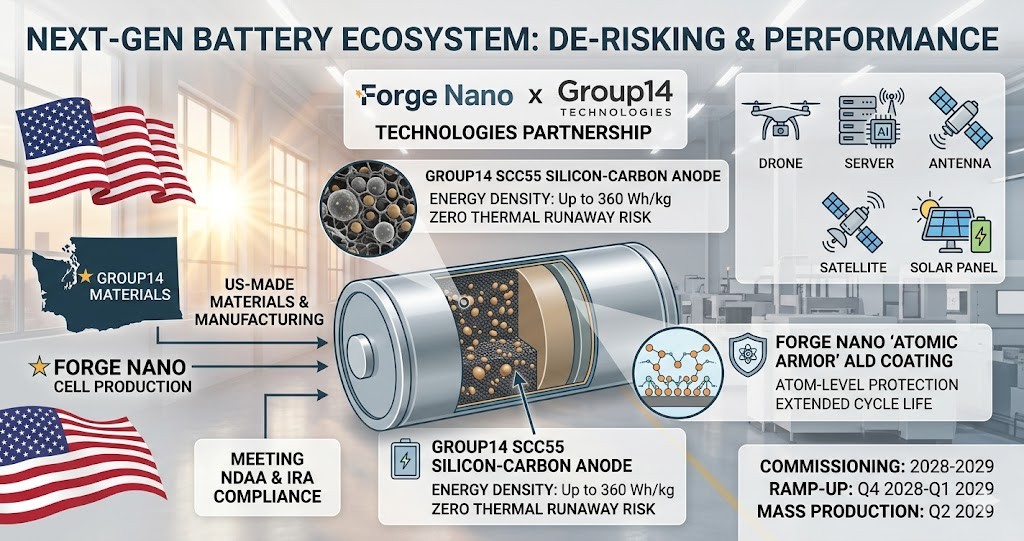
AI時代の到来や防衛調達の強化に伴い、次世代バッテリーの「脱中国」と「高性能化」が世界的な最優先課題となっています。このような中、原子層堆積(ALD)技術のパイオニアであるForge Nanoと、シリコン負極材料のグローバルリーダーであるGroup14 Technologiesが、主に米国国内の材料と製造インフラを活用した高性能リチウムイオン電池セルの開発・量産で提携を発表しました。米国の国家戦略とも連動する、次世代バッテリーエコシステムの新展開についてまとめます。
1. ニュースの概要と提携の背景
- 実用的な米国製セルの実現: Forge Nanoの電池セル製造プラットフォームに、Group14の先進シリコンカーボン負極材料「SCC55」を組み込み、防衛、航空宇宙、エネルギー貯蔵(ESS)向けの次世代セルを供給します。
- SPAC合併と調達強化: Forge Nanoは最近、Archimedes Tech SPAC Partners II Co.(NASDAQ: ATII)との合併を発表したばかりであり、今回の提携により国内製造業および国防権限法(NDAA)の厳しい国内調達要件を満たす体制を強固にします。
2. 融合する2つの革新的コア技術
本提携は、バッテリーのエネルギー密度を極限まで高めつつ、実用上の最大の課題であった「寿命」を克服する技術的アプローチです。
- Group14の「SCC55」: 従来のグラファイト(黒鉛)負極に比べ、理論容量が圧倒的に高いシリコンをベースとした炭素複合材料。これにより、バッテリーのエネルギー密度の飛躍的な向上と、超急速充電を可能にします。
- Forge Nanoの「Atomic Armor」: 独自のリチウムイオン電池向けALD(Atomic Layer Deposition: 原子層堆積)ナノコーティング技術。シリコン材料は充放電時に激しく体積膨張・収縮し、電解液との副反応で劣化しやすい欠点がありますが、原子レベルの超薄膜保護層を形成することで副反応を抑え、サイクル寿命を大幅に延長します。
【関連情報の追加】技術背景とグローバル市場への影響
シリコン負極材料(SCC55)が注目される理由
電気自動車(EV)や防衛用ドローンにおいて「航続距離の延長」と「充電時間の短縮」は必須です。従来のグラファイト負極の理論容量が 372 mAh/g であるのに対し、シリコンの理論容量は 10 倍以上の約 4200 mAh/g に達します。Group14のSCC55は、このシリコンの特性を活かしつつマクロポラス炭素構造内にナノシリコンを配置することで、膨張をコントロール可能にした市場実証済みの先端材料です。
ALD(原子層堆積)技術のバッテリー応用
Forge Nanoが得意とするALDは、もともと半導体製造で培われた超精密な薄膜成形技術です。これをバッテリー粒子や電極のコーティングに応用することで、極薄(数ナノメートル単位)かつ均一な保護膜を作ることができます。厚いコーティングはイオンの移動を阻害して電池性能を落としますが、ALD技術(Atomic Armor)であれば、出力特性を落とさずにシリコン負極の最大の弱点である「構造崩壊と劣化」を防ぐことができます。
米国インフレ抑制法(IRA)および安全保障戦略との連動
米国のバイデン・ハリス政権以降推進されているインフレ抑制法(IRA)や、国防権限法(NDAA)では、中国などの「懸念される外国の事業体(FEOC)」からのバッテリー材料調達を厳しく制限しています。Group14はすでに米エネルギー省(DOE)から多額の資金援助を受けてワシントン州に商業プラットフォームを建設中であり、Forge Nanoとの協業によって「上流の材料調達(Group14)」から「下流のセル製造(Forge Nano)」までを完全に米国籍企業で完結させる、安全な国内サプライチェーンが誕生することになります。
Forge Nano and Group14 Partner: Building a Domestic Battery Supply Chain with US-Made Silicon Materials and ALD Technology
Introduction
With the advent of the AI era and the strengthening of defense procurement, shifting away from Chinese supply chains and improving performance in next-generation batteries have become top global priorities. In this context, Forge Nano, a pioneer in Atomic Layer Deposition (ALD) technology, and Group14 Technologies, a global leader in silicon anode materials, have announced a partnership to develop and mass-produce high-performance lithium-ion battery cells using primarily US-domestic materials and manufacturing infrastructure. This summary outlines the new developments in the next-generation battery ecosystem, which aligns closely with US national strategy.
1. News Overview and Partnership Background
- Realizing Practical US-Made Cells: By integrating Group14’s advanced silicon-carbon anode material, SCC55, into Forge Nano’s battery cell manufacturing platform, the partnership will supply next-generation cells for defense, aerospace, and energy storage systems (ESS).
- SPAC Merger and Procurement Strengthening: Forge Nano recently announced its merger with Archimedes Tech SPAC Partners II Co. (NASDAQ: ATII). This new partnership strengthens its capacity to meet the strict domestic procurement requirements of the National Defense Authorization Act (NDAA) and support expanding domestic manufacturing.
2. Fusion of Two Innovative Core Technologies
This collaboration represents a technical approach to pushing battery energy density to its limits while overcoming the greatest practical challenge: cycle life.
- Group14’s SCC55: A carbon-composite material based on silicon, which possesses a theoretical capacity vastly superior to conventional graphite anodes. This enables a dramatic increase in battery energy density and facilitates ultra-fast charging.
- Forge Nano’s Atomic Armor: A proprietary ALD (Atomic Layer Deposition) nano-coating technology for lithium-ion batteries. Silicon materials characteristically undergo severe volumetric expansion and contraction during charge-discharge cycles, making them prone to degradation through side reactions with the electrolyte. Applying an ultra-thin, atomic-level protective layer suppresses these side reactions and significantly extends cycle life.
Additional Information: Technical Background and Global Market Impact
Why Silicon Anode Material (SCC55) is Drawing Attention
Extending driving range and shortening charging times are imperative for electric vehicles (EV) and defense drones. While the theoretical capacity of conventional graphite anodes is 372 mAh/g, the theoretical capacity of silicon is more than 10 times higher, reaching approximately 4200 mAh/g. Group14’s SCC55 is a market-proven advanced material that harnesses these silicon characteristics while controlling expansion by embedding nano-silicon within a macroporous carbon framework.
Battery Application of ALD (Atomic Layer Deposition) Technology
The ALD technology in which Forge Nano excels was originally an ultra-precise thin-film fabrication technique developed in semiconductor manufacturing. Applying this to coat battery particles or electrodes enables the creation of extremely thin (on the scale of a few nanometers) and uniform protective films. While thick coatings block ion movement and degrade battery performance, ALD technology (Atomic Armor) prevents structural collapse and degradation of the silicon anode without compromising power output characteristics.
Alignment with the US Inflation Reduction Act (IRA) and Security Strategy
The Inflation Reduction Act (IRA) and the National Defense Authorization Act (NDAA), championed since the Biden-Harris administration, strictly limit the procurement of battery materials from Foreign Entities of Concern (FEOC) such as China. Group14 has already received significant funding from the US Department of Energy (DOE) and is constructing a commercial platform in Washington State. Through this collaboration with Forge Nano, a secure domestic supply chain will be established, entirely contained within US-based companies from upstream material sourcing (Group14) to downstream cell manufacturing (Forge Nano).


コメント