スマートフォンやPCの普及に伴い、今や生活必需品となったモバイルバッテリー。しかし、ニュースなどで時折見かける「破裂」や「発火」のトラブルに不安を抱く人も少なくありません。こうした中、充電器ブランドの大手であるAnker(アンカー)が、従来の常識を覆す圧倒的な安全性を備えた「ネオリチウムイオンバッテリー」を発表しました。あえて流行の「次世代素材」を使わず、既存の技術を極限まで進化させる道を選んだAnkerの新たな挑戦と、その革新的な中身について詳しく解説します。
1. なぜ「新しい素材」を使わないのか?
現在、世界中で「全固体電池」や「ナトリウムイオン電池」といった、リチウムイオン電池に代わる次世代電池の開発が進んでいます。しかし、Ankerはこれらを採用せず、あえて既存のリチウムイオン電池を進化させる選択をしました。
代替素材を採用しない3つの理由
- データ不足: 新素材は、長期間使った際の実証データがまだ十分に蓄積されていません。
- ルールの未整備: 航空機への持ち込み制限や、廃棄に関するルールが世界的に追いついていないケースがあります。
- サイズと重量: 同じ容量を確保しようとすると、リチウムイオン電池よりも大きく、重くなってしまう傾向があります。
毎日持ち運ぶモバイルバッテリーには「軽さと小ささ(利便性)」と「安全性」の両立が不可欠であるため、実績のあるリチウムイオン電池を改良するのがベストだと判断されました。
2. ネオリチウムイオン電池が解決する「3つの主要課題」
リチウムイオン電池が発火・劣化する主な原因に対し、今回の新技術は以下のようにアプローチしています。
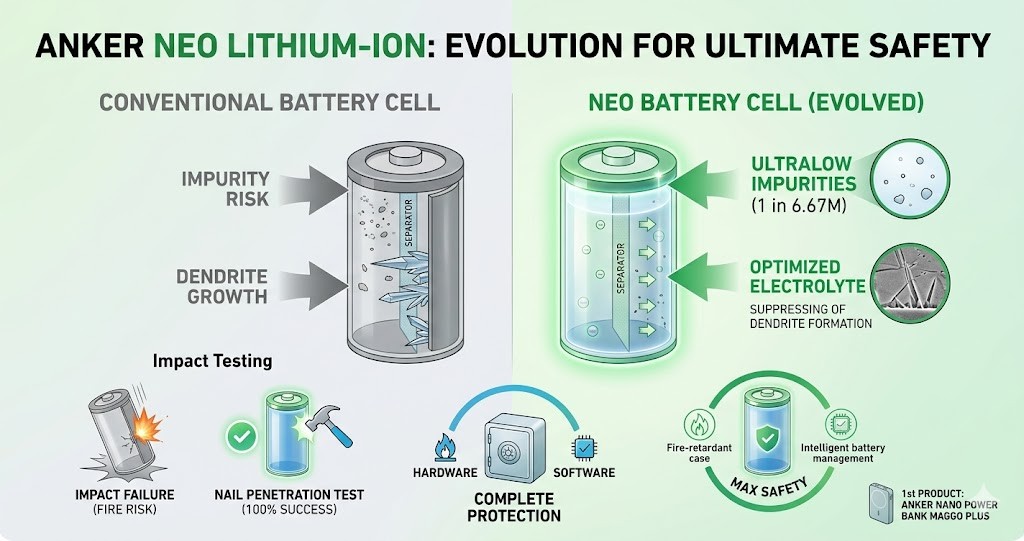
原因1:製造工程での異物混入(不純物の徹底排除)
電池の内部に微細なゴミ(不純物)や水分が混ざると、それが原因で内部ショートや異常な化学反応が起き、発熱・発火につながります。
- 対策: 製造工程を見直し、異物混入率を「667万分の1未満」という超低確率に抑制。電解液の中の水分や腐食性イオンも厳しく制限し、発火の原因を根本から断ち切ります。
原因2:充放電による経年劣化(デンドライト現象の抑制)
リチウムイオン電池は、充電と放電を繰り返すと、内部に「デンドライト(樹枝状結晶)」と呼ばれるイバラのような物質が成長していきます。これが電池の内部を突き破ると、ショートして発火の原因になります。
- 対策: 独自の表面処理技術と、電解液の配合を最適化。これによりデンドライトの蓄積を抑え、長期間使っても安全性が落ちない構造を実現しました。
原因3:外部からの物理的損傷(過酷な物理試験をクリア)
ニュースなどで話題になる発火事故の多くは、バッテリーが潰れたり、強い衝撃を受けたりして内部ショートを起こすことが原因です。
- 対策: 満充電のバッテリーに金属の釘を真っ芯から突き刺す、極めて過酷な「釘刺し試験」を100%クリア。さらに、135度の熱風にさらす熱暴走試験や、強い圧力をかける耐圧試験にも合格しています。
3. ハードとソフトによる「鉄壁の守り」
安全対策は電池の「中身(セル)」だけにとどまりません。製品全体で発火を防ぐ仕組みが取り入れられています。
- 燃え広がらない筐体(ハード面): 外装カバーに高い難燃性素材を使用。万が一、内部で火が出たとしても、外へ火を広げずに封じ込める設計になっています。
- 新開発の監視システム(ソフト面): 新しいバッテリーマネジメントシステム(BMS)を導入。電池を1つずつ秒単位で監視し、異常を検知すると自動で本体を一時ロック、または強制停止します。また、使用回数(劣化具合)に応じて充電する電圧を自動で調整します。これらの状態はアプリや本体ディスプレイで確認可能です。
4. 今後の展開と第1弾製品
Ankerはこのネオリチウムイオンバッテリーを「Anker史上最高水準の安全性を目指した技術」と位置づけています。
- 第1弾製品: マグネット式ワイヤレスモバイルバッテリー「Anker Nano Power Bank MagGo Plus」に初搭載。2026年5月27日より数量限定で予約販売が開始され、今夏に一般販売が予定されています。
- 今後のロードマップ: 2027年頃までに、Ankerのすべてのバッテリー搭載製品へこの技術を順次導入していく方針です。
従来のモバイルバッテリーが危険というわけではありませんが、普及率が高まる中で「より高い安心感」をユーザーに届けるための、大きな技術的ブレイクスルーとなります。
出典:https://japan.cnet.com/article/35248078/
Not a New Material! Anker’s “Neo Lithium-ion Battery” Masters Existing Tech, and It Is Amazing
With the widespread use of smartphones and PCs, mobile batteries have now become an essential part of daily life. However, quite a few people feel anxious about “swelling” or “catching fire” incidents that they occasionally see in the news. In this context, Anker, a major charging brand, has announced the “Neo Lithium-ion Battery,” which features overwhelming safety that defies conventional wisdom. This article provides a detailed look into Anker’s new challenge—choosing to evolve existing technology to its absolute limit rather than using trendy “next-generation materials”—and its innovative details.
1. Why Not Use “New Materials”?
Currently, the development of next-generation batteries to replace lithium-ion, such as “solid-state batteries” and “sodium-ion batteries,” is progressing worldwide. However, Anker did not adopt these and instead chose to evolve existing lithium-ion batteries.
Three Reasons for Not Adopting Alternative Materials
- Lack of Data: New materials have not yet accumulated enough verified data from long-term use.
- Unresolved Regulations: In some cases, global rules regarding airline carry-on restrictions and disposal methods have not caught up.
- Size and Weight: To secure the same capacity, these batteries tend to become larger and heavier than lithium-ion batteries.
For a mobile battery carried around every day, balancing “lightness and compactness (convenience)” with “safety” is indispensable. Therefore, Anker determined that improving the proven lithium-ion battery was the best path forward.
2. The Three Major Challenges Solved by the Neo Lithium-ion Battery
This new technology addresses the main causes of lithium-ion battery fires and degradation through the following approaches:
Cause 1: Foreign Object Contamination During Manufacturing (Complete Elimination of Impurities) If microscopic dust (impurities) or moisture mixes inside the battery, it can cause internal short circuits or abnormal chemical reactions, leading to heat generation or fire.
- Solution: By reviewing the manufacturing process, the contamination rate is suppressed to an ultra-low probability of less than 1 in 6.67 million. The moisture and corrosive ion content in the electrolyte are also strictly limited to cut off the cause of fire at its root.
Cause 2: Degradation Over Time Due to Charging and Discharging (Suppression of Dendrite Phenomenon) When lithium-ion batteries undergo repeated charging and discharging, thorn-like substances called “dendrites” (crystalline structures) grow inside. If these pierce the battery’s internal components, they cause a short circuit and fire.
- Solution: Anker optimized its unique surface treatment technology and the formulation of the electrolyte. This suppresses dendrite accumulation, creating a structure that maintains safety even after long-term use.
Cause 3: Physical Damage from the Outside (Passing Severe Physical Tests) Many of the battery fire incidents that make the news are caused by internal short circuits when the battery is crushed or receives a strong impact.
- Solution: The battery 100% passed the extremely harsh “nail penetration test,” in which a metal nail is driven straight into the center of a fully charged battery. Furthermore, it has passed thermal runaway tests in 135 degrees Celsius hot air, as well as pressure resistance tests that apply strong force.
3. Ironclad Protection via Hardware and Software
Safety measures are not limited to the battery “insides (cells)” alone. Mechanisms to prevent fire are implemented across the entire product.
- Non-flammable Enclosure (Hardware): A highly flame-retardant material is used for the outer cover. Even in the unlikely event that a fire starts inside, it is designed to contain the fire without letting it spread outward.
- Newly Developed Monitoring System (Software): A new Battery Management System (BMS) has been introduced. It monitors each cell individually by the second, and if it detects an abnormality, it automatically locks the device temporarily or forces it to shut down. It also automatically adjusts the charging voltage according to the number of uses (degradation level). These statuses can be checked via the app or the device display.
4. Future Outlook and the First Product
Anker positions this Neo Lithium-ion Battery as a “technology aimed at the highest standard of safety in Anker’s history.”
- First Product: It will be featured for the first time in the magnetic wireless mobile battery, “Anker Nano Power Bank MagGo Plus.” Pre-orders began in limited quantities on May 27, 2026, with general sales scheduled for this summer.
- Future Roadmap: Anker plans to gradually introduce this technology to all of its battery-powered products by around 2027.
While conventional mobile batteries are not inherently dangerous, this marks a major technological breakthrough to provide users with a higher level of peace of mind as mobile battery adoption rates continue to rise.
コメント