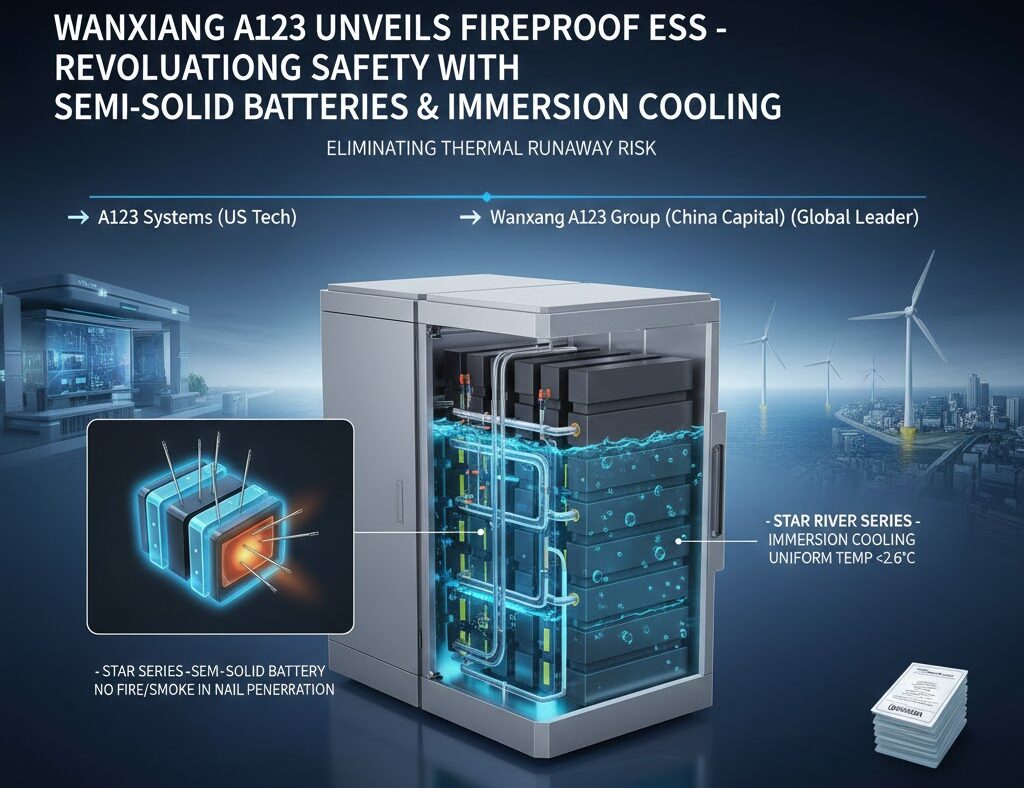
エネルギー貯蔵システム(ESS)における火災事故が世界的な課題となる中、デトロイトに本拠を置く万向A123システムズ(Wanxiang A123 Systems Corp.)が、安全性の概念を根底から覆す革新的なソリューションを発表しました。同社は、材料レベルの対策である「半固体電池」と、システムレベルの対策である「液浸冷却」を統合し、熱暴走のリスクを実質的にゼロにすることを目指しています。
1. 「Starシリーズ」半固体電池:物理的破壊でも燃えない安全性
従来の液体リチウムイオン電池は、破損時に内部の電解液が反応し、激しい発火(熱暴走)を引き起こすリスクがありました。Wanxiang A123の「Starシリーズ」は、以下の技術でこの問題を解決しています。
- Full-Domain Ice Sealing技術: 電解質を半固体状態で固定する独自技術。機械的な衝撃を受けても反応性が極めて低く抑えられます。
- 針刺し試験での無反応: 10本の鋼針を同時に突き刺すという過酷な試験において、「発火・発煙・熱伝播」がいっさい確認されないという驚異的な安全性を実証しました。
- 多層防御構造: 内部の「セーフティグリッド」と外部の「アーマーコーティング」により、極端な温度環境下での短絡を防止します。
2. 「Star Riverシリーズ」液浸冷却システム:温度差2.6度以内の精密管理
システム全体の熱を制御するため、同社はセルを専用の絶縁冷却液に完全に浸す「液浸冷却」を採用しました。
- 均一な冷却: 外気温が45度Cの過酷な環境下でも、セル間の温度差を2.6度C未満に保ちます。
- 液体の熱シールド: 万が一、特定のセルが故障しても、周囲の冷却液が即座に熱を吸収・遮断し、隣接するセルへの熱伝播を物理的に防ぎます。
3. 用途別ソリューションとインテリジェンス
この技術プラットフォームは、データセンター、屋外、オフショアなど、高リスクな環境に合わせて展開されます。
- データセンター向けHVDC: 800Vアーキテクチャを採用し、システム効率を4%以上向上。
- ワイヤレスBMS(バッテリー管理システム): 圧力センサーを統合。従来の監視システムより最大10分早く異常を検知し、警告を発します。
【関連情報】万向A123とエネルギー貯蔵市場の背景
万向A123の動きをより深く理解するための背景情報です。
- A123の歩みと万向グループ: もともと米国マサチューセッツ工科大学(MIT)発のベンチャーだったA123 Systemsは、リン酸鉄リチウム(LFP)電池の先駆者でした。2013年に中国の自動車部品最大手、万向集団(Wanxiang Group)に買収され、現在は米国の技術力と中国の資本・量産スピードを融合させたグローバル企業として活動しています。
- 液浸冷却のトレンド: データセンターのサーバー冷却で普及し始めた液浸技術ですが、蓄電池分野への応用は「次世代のスタンダード」と目されています。空冷や水冷に比べ冷却効率が圧倒的に高く、システムの長寿命化にも寄与します。
- エネルギー貯蔵火災の深刻化: 記事にある「年間50件近い火災報告」は、再生可能エネルギー普及の大きな足かせとなっています。特に韓国や米国での大規模火災を受け、国際的な安全基準(UL9540Aなど)が厳格化されており、今回のWanxiang A123の技術はこれらへの強力な回答となります。
まとめ
万向A123は、電池セルの「材料(半固体)」とシステムの「冷却(液浸)」の両面から熱暴走を封じ込める、多層的な安全アーキテクチャを提示しました。この技術が普及すれば、都市部やデータセンターなど、これまで設置が難しかった場所でも安全に大規模蓄電システムを運用できるようになり、エネルギー転換を加速させる鍵となるでしょう。
Wanxiang A123 Unveils Next-Gen ESS Solutions: Integration of Semi-Solid-State Batteries and Immersion Cooling is Key
As fire incidents in Energy Storage Systems (ESS) become a global concern, Detroit-based Wanxiang A123 Systems Corp. has announced an innovative solution that fundamentally redefines safety. By integrating “semi-solid-state batteries” at the material level with “immersion cooling” at the system level, the company aims to virtually eliminate the risk of thermal runaway.
1. “Star Series” Semi-Solid-State Batteries: Non-Flammable Even Under Physical Destruction
Conventional liquid lithium-ion batteries carry the risk of intense fire (thermal runaway) when damaged, as the internal electrolyte reacts. Wanxiang A123’s “Star Series” solves this through the following technologies:
- Full-Domain Ice Sealing Technology: A proprietary method that fixes the electrolyte in a semi-solid state. This drastically reduces reactivity even under mechanical stress.
- Zero-Response in Nail Penetration Tests: In a rigorous test where 10 steel nails pierced the cell simultaneously, the battery demonstrated extraordinary safety with no fire, no smoke, and no thermal propagation.
- Multi-Layer Defense Structure: An internal “safety grid” and external “armor coating” prevent internal short circuits even under extreme temperature conditions.
2. “Star River Series” Immersion Cooling: Precision Control Within 2.6 Degrees C
To control heat across the entire system, the company adopted “immersion cooling,” where cells are completely submerged in a specialized dielectric insulating coolant.
- Uniform Cooling: Even in harsh environments with an ambient temperature of 45 degrees C, the temperature difference between cells is kept below 2.6 degrees C.
- Liquid Thermal Shield: If a specific cell fails, the surrounding coolant immediately absorbs and blocks the heat, physically preventing thermal propagation to adjacent cells.
3. Application-Specific Solutions and Intelligence
This technology platform is deployed across four specialized solutions tailored for high-risk environments such as data centers, outdoor installations, and offshore sites.
- HVDC for Data Centers: Utilizes an 800V architecture to improve system efficiency by more than 4 percent.
- Wireless BMS (Battery Management System): Integrates pressure sensors that can detect internal changes and issue safety warnings up to 10 minutes faster than conventional monitoring methods.
Context: Background on Wanxiang A123 and the ESS Market
To better understand Wanxiang A123’s trajectory, here is some additional context:
- The Journey of A123 and Wanxiang Group: Originally a spin-off from the Massachusetts Institute of Technology (MIT), A123 Systems was a pioneer in Lithium Iron Phosphate (LFP) batteries. After being acquired by the Chinese automotive parts giant Wanxiang Group in 2013, it now operates as a global entity combining American engineering with Chinese capital and manufacturing speed.
- The Immersion Cooling Trend: While immersion cooling first gained popularity in cooling data center servers, its application in the battery storage sector is seen as the “next-generation standard.” It offers significantly higher cooling efficiency compared to air or water cooling, contributing to a longer system lifespan.
- Escalating ESS Fire Risks: The nearly 50 fire incidents reported annually serve as a major bottleneck for the adoption of renewable energy. Following large-scale fires in South Korea and the U.S., international safety standards (such as UL9540A) have become more stringent. Wanxiang A123’s new technology serves as a robust answer to these regulations.
Summary
Wanxiang A123 has presented a multi-layered safety architecture that contains thermal runaway from both the “material (semi-solid)” and the “system (immersion cooling)” sides. If this technology becomes widespread, it will allow for the safe operation of large-scale energy storage in urban areas and data centers where installation was previously difficult, acting as a catalyst for the global energy transition.

コメント