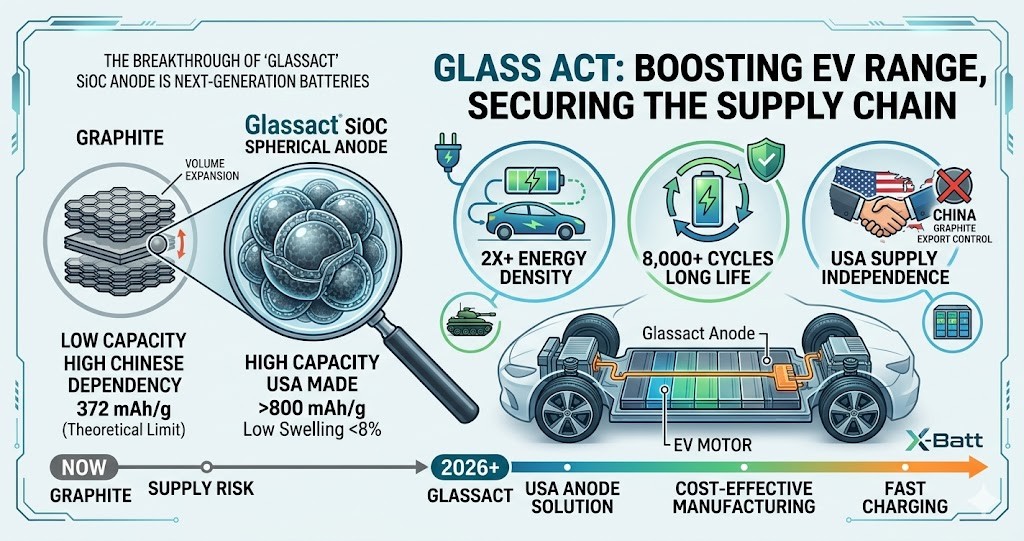
電気自動車(EV)や定置型蓄電池(BESS)の性能をさらに引き上げるため、リチウムイオン電池の「負極(アノード)材料」の革新が急務となっています。長年主流だったグラファイト(黒鉛)は理論上の容量限界(約372 mAh/g)に近づいており、さらなるエネルギー密度の向上にはシリコン(Si)系材料の導入が不可欠とされてきました。しかし、従来の純シリコン負極は充放電時に約400%もの激しい体積膨張を起こし、電池の崩壊や急速な劣化を招くという致命的な欠点がありました。
2026年5月、米国のX-Batt社は、この膨張問題を克服しつつグラファイトの2倍以上のエネルギー密度を実現するシリコンオキシカーバイド(SiOC)球状負極技術「Glassact」を発表しました。本まとめでは、この技術のメカニズムや、米国のサプライチェーン内製化を巡る関連情報を補足して解説します。
- 1. 新技術「Glassact(SiOC負極)」の性能とブレイクスルー
- 2. 【関連情報】米国のグラファイト禁輸リスクと国内サプライチェーンの確保
- 3. 【関連情報】次世代負極市場におけるSiOCの位置づけ
- 結論:バッテリー材料主権の奪還へ
- 1. Performance and Breakthroughs of the New “Glassact (SiOC Anode)” Technology
- 2. [Related Information] Graphite Export Ban Risks and Securing the US Domestic Supply Chain
- 3. [Related Information] Position of SiOC in the Next-Generation Anode Market
- Conclusion: Reclaiming Battery Material Sovereignty
1. 新技術「Glassact(SiOC負極)」の性能とブレイクスルー
X-Batt社が開発したGlassact技術は、素材に「セラミック構造」を取り入れることで、シリコン系負極の最大の弱点であった膨張と劣化の課題をクリアしています。
- 圧倒的な可逆容量と急速充電: 標準的な黒鉛負極の約350 mAh/gに対し、2倍以上となる「800 mAh/g超」の可逆容量を目指しています。さらに、8Cという極めて高い充電レート(約7.5分でフル充電に相当する高負荷)でも公称容量の80%以上を維持します。
- 驚異的な長寿命と低膨張率: 放電深度(DoD)80%以上の厳しい環境下で「8,000サイクルを超える」寿命を達成。シリコン系でありながら、サイクル膨張率はわずか「8%未満」に抑えられています。
- 球状粒子構造と製造プロセスの簡略化: 導電性カーボンの骨格とガラス状セラミックマトリックスを組み合わせた球状粒子を採用し、表面は電解質との界面を安定させる保護外殻でコーティングされています。独自のプレセラミック樹脂を微小球状に成形後、低温熱分解炉で短時間処理するだけで製造できるため、競合するシリコン負極技術のような複雑な後処理(粉末処理)を回避でき、コスト構造の最適化(スケーラブルな生産)が可能です。
2. 【関連情報】米国のグラファイト禁輸リスクと国内サプライチェーンの確保
記事内でCEOが「米国のバッテリーサプライチェーンが待ち望んでいた材料革新」と語る背景には、差し迫った地政学的リスクと米国の政策があります。
関連情報①:中国による黒鉛の輸出規制強化
現在、世界の天然・人造グラファイト(黒鉛)の精錬・供給シェアの約7割から9割を中国が握っています。中国政府による黒鉛の輸出管理(許可制)の厳格化に伴い、米国や欧州の自動車メーカー・電池メーカーは、黒鉛の調達が途絶えるリスクに直面しています。X-Batt社が「100%国内産(国産)」の負極材料にこだわるのは、この中国依存からの完全脱却を狙うためです。
関連情報②:インフレ抑制法(IRA)の「FEOC(懸念される外国の事業体)」規制
米国のインフレ抑制法(IRA)では、中国などのFEOCから調達した重要鉱物(負極材含む)を使用したEVに対し、税額控除の対象から除外する厳しい規制を課しています。Glassactのように、米国内で原材料を調達・製造できる次世代アノード技術は、米国のEVメーカーが補助金受給資格を維持するための強力な救世主となります。
3. 【関連情報】次世代負極市場におけるSiOCの位置づけ
現在、市場ではさまざまな「ポスト・グラファイト」技術の開発が競われています。
関連情報③:シリコン負極(Si-C、Si-Ox)との差別化
現在実用化が進んでいる初期のシリコン負極(グラファイトに数%から10%程度シリコンを混ぜる手法)や、シリコン酸化物(SiOx)に比べ、X-Batt社が採用する「シリコンオキシカーバイド(SiOC)」は熱的・化学的に極めて安定したセラミック構造を持っています。これにより、材料自体がクッションの役割を果たし、純シリコンのような微粉化(ひび割れ)が起きません。エネルギー密度、寿命(8000サイクル)、安全性のマージンを同時に高められるため、EVのみならず防衛システムや過酷な環境の定置型蓄電池(BESS)などへの横展開が期待されています。
結論:バッテリー材料主権の奪還へ
X-Batt社の「Glassact」の登場は、単にリチウムイオン電池の容量を2倍にするという技術的進歩に留まりません。
地政学的リスクによって不安定化するグラファイト市場に対して、「米国内で、低コストかつ大規模に生産可能な代替シリコン系材料」を提示したことに最大の価値があります。EVの航続距離を飛躍的に伸ばし、充電時間を短縮し、なおかつ安全性を確保するこの新材料は、次世代のクリーンエネルギーおよび防衛インフラの基盤を自国でコントロールするための、極めて重要なマイルストーンとなるでしょう。
出典:https://www.bestmag.co.uk/x-batt-sioc-anode-spheres-graphite/
The Birth of a Non-Swelling Silicon Anode: The Reality of the Material Innovation Long Awaited by the US Supply Chain
To further elevate the performance of electric vehicles (EVs) and Battery Energy Storage Systems (BESS), innovation in the “anode material” of lithium-ion batteries has become an urgent matter. Graphite, which has been the mainstream material for many years, is approaching its theoretical capacity limit (approximately 372 mAh/g), making the introduction of silicon (Si)-based materials essential for further improvements in energy density. However, conventional pure silicon anodes suffer from a fatal flaw: they undergo a severe volumetric expansion of approximately 400% during charging and discharging, leading to battery destruction and rapid degradation.
In May 2026, US-based X-Batt announced “Glassact,” a silicon oxycarbide (SiOC) spherical anode technology that overcomes this expansion problem while delivering more than double the energy density of graphite. This summary explains the mechanism of this technology, supplemented with relevant information regarding the onshoring of the US supply chain.
1. Performance and Breakthroughs of the New “Glassact (SiOC Anode)” Technology
The Glassact technology developed by X-Batt clears the challenges of expansion and degradation—the biggest weaknesses of silicon-based anodes—by incorporating a “ceramic structure” into the material.
- Overwhelming Reversible Capacity and Fast Charging: The technology aims for a reversible capacity of “over 800 mAh/g,” which is more than double the approximately 350 mAh/g of standard graphite anodes. Furthermore, it maintains over 80% of its nominal capacity even at an extremely high charge rate of 8C (heavy load equivalent to a full charge in about 7.5 minutes).
- Incredible Longevity and Low Expansion Rate: It achieves a cycle life of “over 8,000 cycles” under harsh conditions with a Depth of Discharge (DoD) of 80% or higher. Despite being a silicon-based material, its cycle expansion rate is kept to “less than 8%.”
- Spherical Particle Structure and Simplified Manufacturing Process: The technology utilizes spherical particles combining a conductive carbon framework with a glassy ceramic matrix, and the surface is coated with a protective outer shell to stabilize the electrolyte interface. Because it can be manufactured simply by molding a proprietary preceramic resin into microspheres followed by a brief treatment in a low-temperature pyrolysis furnace, it avoids the complex downstream powder processing associated with competing silicon anode technologies, allowing for the optimization of the cost structure (scalable production).
2. [Related Information] Graphite Export Ban Risks and Securing the US Domestic Supply Chain
The background behind the CEO’s statement that this is “the material innovation the US battery supply chain has been waiting for” involves pressing geopolitical risks and US policies.
- Related Information 1: China’s Tightening of Graphite Export Controls: Currently, China controls approximately 70% to 90% of the global refining and supply share of natural and synthetic graphite. With the Chinese government tightening export controls (permitting systems) on graphite, US and European automakers and battery manufacturers face the risk of supply disruptions. X-Batt’s insistence on “100% domestically produced” anode materials aims for a complete decoupling from this dependence on China.
- Related Information 2: Inflation Reduction Act (IRA) “FEOC” Regulations: The US Inflation Reduction Act (IRA) imposes strict regulations that exclude EVs from tax credit eligibility if they use critical minerals (including anode materials) procured from a Foreign Entity of Concern (FEOC), such as China. Next-generation anode technologies like Glassact, which can source and manufacture raw materials within the US, serve as a powerful savior for US EV manufacturers looking to maintain their subsidy eligibility.
3. [Related Information] Position of SiOC in the Next-Generation Anode Market
Currently, development races for various “post-graphite” technologies are intensifying in the market.
- Related Information 3: Differentiation from Other Silicon Anodes (Si-C, Si-Ox): Compared to early silicon anodes currently being commercialized (which mix a few to 10% silicon into graphite) or silicon oxides (SiOx), the “silicon oxycarbide (SiOC)” adopted by X-Batt has an extremely stable ceramic structure both thermally and chemically. Because of this, the material itself acts as a cushion, preventing pulverization (cracking) like that seen in pure silicon. Since it can simultaneously improve energy density, lifespan (8,000 cycles), and safety margins, horizontal expansion is expected not only for EVs but also for defense systems and stationary energy storage systems (BESS) in harsh environments.
Conclusion: Reclaiming Battery Material Sovereignty
The emergence of X-Batt’s “Glassact” represents more than just a technical advancement that doubles the capacity of lithium-ion batteries.
Its greatest value lies in presenting an “alternative silicon-based material that can be produced domestically at low cost and on a large scale” against a graphite market destabilized by geopolitical risks. This new material, which dramatically extends EV driving ranges, shortens charging times, and ensures safety, will serve as a critical milestone for a nation to control the foundations of its next-generation clean energy and defense infrastructure locally.

コメント