電気自動車(EV)の普及に伴い、車載バッテリーには「航続距離の延長」と「安全性の確保」という、相反する課題の同時解決が求められています。特にリチウムイオン電池のエネルギー密度が高まる中で、万が一の事故や故障時に発生する熱暴走(サーマルランナウェイ)を防ぐ技術は、乗員の安全を守るための最優先事項となっています。
2026年3月に開催された「BATTERY JAPAN 2026」において、三洋貿易はこれらの課題に直結する欧州・韓国の最先端材料を披露しました。断熱、分散、放熱という3つの側面から次世代バッテリーを支える技術を解説します。
- 1. 次世代の熱暴走対策:エアロゲル断熱シート「SKOGAR」
- 2. 製造工程を革新する分散剤:水素ニトリルゴム「Therban」
- 3. 高効率な放熱と絶縁:PAP製「板状アルミナ」
- Next-Generation Materials Showcased by Sanyo Trading: Solving Battery Safety Challenges via Insulation, Dispersion, and Heat Dissipation
- Introduction
- 1. Next-Generation Thermal Runaway Countermeasure: Aerogel Insulation Sheet “SKOGAR”
- 2. Dispersant Revolutionizing Manufacturing: Hydrogenated Nitrile Rubber “Therban”
- 3. High-Efficiency Heat Dissipation and Insulation: “Platelet Alumina” by PAP
- Summary Points
1. 次世代の熱暴走対策:エアロゲル断熱シート「SKOGAR」
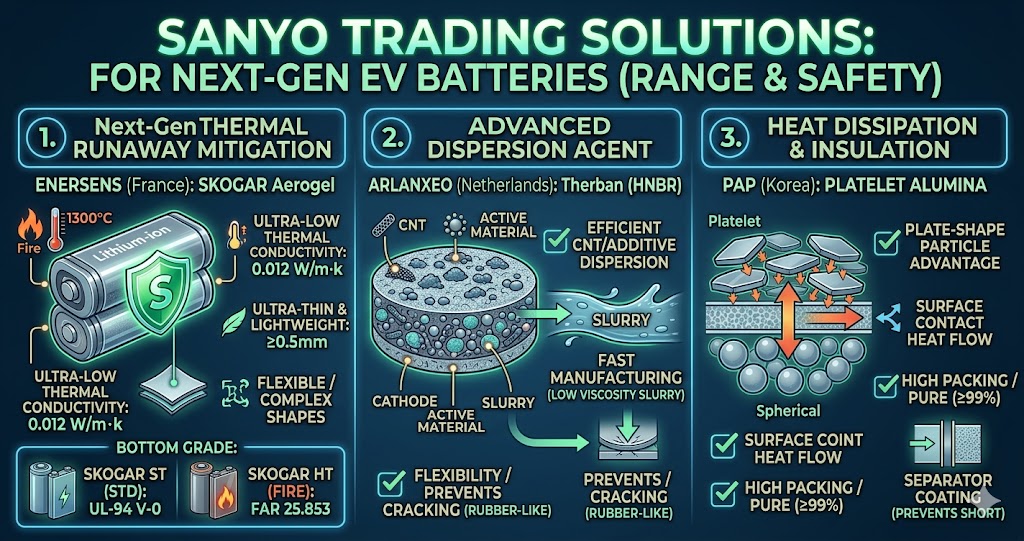
フランス・ENERSENS(エネルセンス)社製の断熱材で、バッテリーセル間での熱の連鎖を防ぐ切り札です。
- 驚異の耐火・断熱性能: 最大1300度までの高温に耐え、熱伝導率は0.012W/m・kと極めて低いため、隣接するセルへの熱移りを物理的に遮断します。
- 薄型・軽量・柔軟: 厚さ0.5mmから対応可能で、狭い隙間や複雑なセル形状にもフィット。限られたスペースに詰め込まれる車載バッテリーに最適です。
- グレード展開:
- SKOGAR ST(標準): ガラス繊維を使用。硬めで難燃規格「UL-94 V-0」を取得。
- SKOGAR HT(耐火): PAN(ポリアクリロニトリル)繊維を使用。柔らかく、航空機基準の厳しい燃焼試験「FAR 25.853」もクリア。
2. 製造工程を革新する分散剤:水素ニトリルゴム「Therban」
オランダ・ARLANXEO(アランクセオ)社製の水素ニトリルゴム(HNBR)です。
- 高効率な分散力: 電極の導電性を高めるカーボンナノチューブ(CNT)などの助剤を、少ない添加量で均一に混ぜ合わせます。
- 生産スピードの向上: 材料を混ぜた液体(スラリー)の粘度を低く保てるため、塗工や乾燥の時間を短縮し、製造ラインの高速化を可能にします。
- 柔軟性の付与: 従来の樹脂系分散剤とは異なり、ゴム特有の柔軟性を持たせることで、電極を厚塗りしたりプレスしたりする際の「ひび割れ」を強力に防ぎます。
3. 高効率な放熱と絶縁:PAP製「板状アルミナ」
韓国・PAP社が独自の結晶成長技術で開発したセラミック粉末です。
- プレート形状のメリット: 従来の「球状」アルミナに比べ、粒子同士の接点(面接触)が多くなるため、熱を逃がす効率(放熱性)が格段に向上します。
- 高い充填性と純度: 表面が滑らかなため樹脂や塗料に混ぜやすく、酸化アルミニウム(Al2O3)純度は99%以上と不純物が極めて少ないのが特徴です。
- 主な用途: リチウムイオン電池のセパレーター向けコーティング材。内部ショートを防ぐ絶縁性と、充電時の発熱を抑える放熱性を両立させます。
まとめのポイント
三洋貿易が紹介したこれらの材料は、「火災を防ぐ(SKOGAR)」「より多くの電気を蓄える(Therban)」「熱を効率よく逃がす(板状アルミナ)」という、EVバッテリーの進化に欠かせない3つのキーテクノロジーを網羅しています。
出典:https://monoist.itmedia.co.jp/mn/articles/2603/25/news029.html
Next-Generation Materials Showcased by Sanyo Trading: Solving Battery Safety Challenges via Insulation, Dispersion, and Heat Dissipation
Introduction
With the widespread adoption of Electric Vehicles (EVs), on-board batteries are required to simultaneously solve the conflicting challenges of extending cruising range and ensuring safety. As the energy density of lithium-ion batteries increases, technology to prevent thermal runaway—which can occur during accidents or malfunctions—has become the highest priority for protecting passenger safety.
At BATTERY JAPAN 2026, held in March 2026, Sanyo Trading showcased cutting-edge materials from Europe and South Korea that directly address these issues. This report explains the technologies supporting next-generation batteries from three perspectives: insulation, dispersion, and heat dissipation.
1. Next-Generation Thermal Runaway Countermeasure: Aerogel Insulation Sheet “SKOGAR”
An insulation material manufactured by ENERSENS (France), acting as a trump card to prevent thermal propagation between battery cells.
- Extraordinary Fire Resistance and Insulation: It withstands high temperatures up to 1300 degrees C. With an extremely low thermal conductivity of 0.012W/m.k, it physically blocks heat transfer to adjacent cells.
- Thin, Lightweight, and Flexible: Available from a thickness of 0.5mm, it fits into narrow gaps and complex cell shapes. It is ideal for EV batteries packed into limited spaces.
- Available Grades:
- SKOGAR ST (Standard): Uses glass fiber. A rigid type that has obtained the UL-94 V-0 flame retardancy rating.
- SKOGAR HT (High Temperature): Uses PAN (polyacrylonitrile) fiber. A soft type that passes the rigorous FAR 25.853 flammability test for aircraft interiors.
2. Dispersant Revolutionizing Manufacturing: Hydrogenated Nitrile Rubber “Therban”
A hydrogenated nitrile rubber (HNBR) manufactured by ARLANXEO (Netherlands).
- High-Efficiency Dispersion: Even with a small dosage, it uniformly disperses additives such as carbon nanotubes (CNT) that enhance electrode conductivity.
- Improved Production Speed: By maintaining low viscosity in the slurry, it shortens coating and drying times, enabling faster manufacturing lines.
- Enhanced Flexibility: Unlike conventional resin-based dispersants, its rubber-like flexibility strongly prevents “electrode cracking” during thick coating or pressing processes.
3. High-Efficiency Heat Dissipation and Insulation: “Platelet Alumina” by PAP
A ceramic powder developed using proprietary crystal growth technology by PAP (South Korea).
- Advantages of Platelet Shape: Compared to conventional spherical alumina, the increased contact points (surface contact) between particles significantly improve heat dissipation efficiency.
- High Loading and Purity: The smooth surface makes it easy to mix into resins or coatings. It is characterized by extremely low impurities, with an aluminum oxide (Al2O3) purity of 99% or higher.
- Main Applications: Coating material for lithium-ion battery separators. It achieves both insulation to prevent internal short circuits and heat dissipation to manage heat generated during charging.
Summary Points
The materials introduced by Sanyo Trading encompass three key technologies essential for the evolution of EV batteries: Preventing fire (SKOGAR), Storing more electricity (Therban), and Efficiently dissipating heat (Platelet Alumina).
コメント