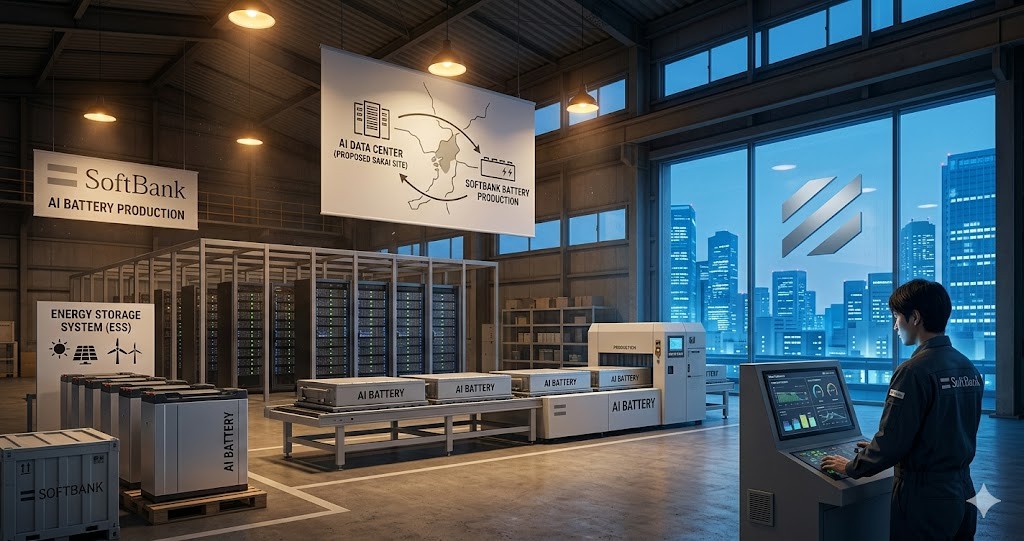
AI(人工知能)の急速な普及に伴い、世界中でデータセンターの需要が爆発的に増加しています。しかし、その運用には膨大な電力が必要であり、エネルギーの安定確保が各社の最重要課題となっています。ソフトバンクはこの課題に対し、「自社で電池を作る」という垂直統合型の戦略で挑もうとしています。
- ニュースの概要:堺工場跡地での電池製造計画
- 補足:なぜ「AI」に「電池」が必要なのか?
- 関連情報:ソフトバンクの戦略的背景
- まとめ
- SoftBank to Manufacture AI Batteries In-House: Redeveloping the Sakai Plant Site
- News Overview: Battery Manufacturing Plan at the Sakai Plant Site
- Context: Why Does “AI” Need “Batteries”?
- Strategic Background: SoftBank’s Vision
- Future Outlook: Expansion into External Sales
- Summary
ニュースの概要:堺工場跡地での電池製造計画
ソフトバンクは、シャープ堺工場の跡地を活用し、AIデータセンター専用の大型電池生産ラインを構築する方針を固めました。詳細は5月の新事業計画で発表される見通しです。
計画の主なポイント
- 場所: 大阪府堺市(旧シャープ液晶パネル工場跡地)
- 目的: 自社AIインフラへの安定的な電力供給と、外部依存の低減
- 時期: 今後5年以内の稼働開始を目指す
- 規模: 年産数ギガワット時(GWh)クラスを想定(国内最大級)
補足:なぜ「AI」に「電池」が必要なのか?
今回の計画の背景には、従来のデータセンターとは比較にならないAI特有の事情があります。
1. 膨大な消費電力への対応
AIの学習(LLMなど)には高性能なGPU(グラフィックス処理装置)を大量に使用するため、消費電力は従来型の10倍以上に達することもあります。電池を備えることで、停電対策だけでなく、電力需要のピークを分散させる「ピークカット」が可能になります。
2. 再生可能エネルギーとの親和性
脱炭素の流れから、AIデータセンターも太陽光や風力などの再生可能エネルギーの活用が求められています。しかし、これらは天候に左右されやすいため、「蓄電システム(ESS:Energy Storage System)」を併設して電力を安定化させることが不可欠です。
関連情報:ソフトバンクの戦略的背景
堺拠点の多機能化
ソフトバンクはすでに、この堺の地を日本最大級のAIデータセンター(受電容量約440メガワット(MW)規模)にする計画を進めています。同じ敷地内で電池を製造・運用することで、送電ロスを減らし、土地を最大限に有効活用する狙いがあります。
サプライチェーンの自国保有
宮川潤一社長は、地政学的リスクによるサプライチェーンの混乱を警戒しています。主要部品である電池を国内自社拠点で生産することは、エネルギーの安全保障を強化し、海外メーカーに依存しない強固なインフラを築くことにつながります。
今後の展望:外部販売への展開
まずは自社利用でコストを抑えつつノウハウを蓄積し、将来的には他のデータセンター事業者や電力会社への電池の外部供給も視野に入れています。これにより、通信・AIに次ぐ新たな収益柱(エネルギー事業)を育てる意図が見て取れます。
まとめ
ソフトバンクのこの動きは、単なる工場建設ではなく、「通信 + AI + エネルギー」を一体化させた次世代インフラ戦略の象徴と言えます。5月の公式発表では、具体的な投資額や提携先パートナー(電池技術の提供元など)が注目されます。
出典:https://www.sbbit.jp/article/st/185137
SoftBank to Manufacture AI Batteries In-House: Redeveloping the Sakai Plant Site
With the rapid spread of Artificial Intelligence (AI), the demand for data centers is exploding worldwide. However, operating these facilities requires an enormous amount of power, making the securing of a stable energy supply a top priority for companies. SoftBank is addressing this challenge through a vertical integration strategy: manufacturing its own batteries.
News Overview: Battery Manufacturing Plan at the Sakai Plant Site
SoftBank has finalized a plan to utilize the former Sharp Sakai plant site to build a large-scale battery production line dedicated to AI data centers. Details are expected to be announced in the new business plan scheduled for May.
Key Points of the Plan
- Location: Sakai City, Osaka Prefecture (former site of the Sharp LCD panel plant)
- Objective: Ensure stable power supply for in-house AI infrastructure and reduce dependence on external providers
- Timeline: Aiming for operations to commence within the next 5 years
- Scale: Anticipated annual production in the several gigawatt-hour (GWh) class (one of the largest in Japan)
Context: Why Does “AI” Need “Batteries”?
This plan is driven by unique AI-related factors that differ significantly from traditional data centers.
1. Handling Massive Power Consumption
Training AI (such as LLMs) requires a vast number of high-performance GPUs (Graphics Processing Units), leading to power consumption that can be more than 10 times that of conventional facilities. Implementing batteries allows for “peak shaving”—distributing power demand during peak hours—as well as providing emergency backup.
2. Synergy with Renewable Energy
Due to decarbonization trends, AI data centers are increasingly required to use renewable energy like solar and wind. However, since these sources are weather-dependent, it is essential to install Energy Storage Systems (ESS) to stabilize the power supply.
Strategic Background: SoftBank’s Vision
Multi-functionalization of the Sakai Base
SoftBank is already moving forward with plans to turn this Sakai site into one of Japan’s largest AI data centers (with a power receiving capacity of approximately 440 megawatts (MW)). Manufacturing and operating batteries on the same site aims to minimize transmission losses and maximize land utility.
Securing Domestic Supply Chains
President Junichi Miyagawa has expressed caution regarding supply chain disruptions caused by geopolitical risks. Producing batteries—a key component—at a domestic, company-owned base strengthens energy security and builds a robust infrastructure independent of overseas manufacturers.
Future Outlook: Expansion into External Sales
The strategy is to first reduce costs and accumulate expertise through in-house use. In the future, SoftBank envisions supplying batteries to other data center operators and power companies. This indicates an intent to grow a new revenue pillar (Energy Business) alongside Telecommunications and AI.
Summary
SoftBank’s move is more than just factory construction; it symbolizes a next-generation infrastructure strategy that integrates “Telecom + AI + Energy.” The official announcement in May will be closely watched for specific investment figures and potential technology partners.


コメント