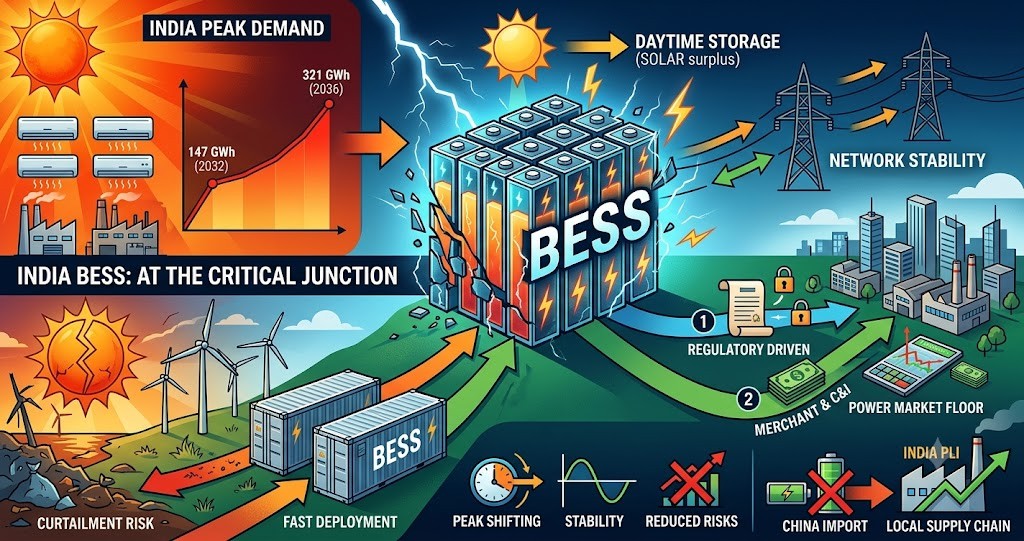
猛暑による電力需要の増加やモンスーンの遅れ、太陽光発電の急増に伴う送電網の制約(出力抑制リスク)を背景に、インドの蓄電池エネルギー貯蔵(BESS)部門は極めて重要な局面を迎えています。原材料価格の高騰や中国の政策変更によるバッテリー価格の上昇といった短期的な変動はあるものの、電力系統の安定化に向けた蓄電池の重要性については強い合意が形成されています。
1. 急増する電力需要と蓄電池の必要性
- 需給ギャップと出力抑制の解決: 昼間の余剰太陽光発電を蓄電し、夕方から夜間のピーク需要期に放電することで、出力抑制を防ぎつつ電力供給を安定化させます。インド中央電力庁(CEA)は、2031-32年までに147 GWh、2035-36年までに321 GWhの蓄電池容量が必要と予測しています。
- 迅速な導入性: 石炭火力発電の増設が追いつかない中、蓄電池は建設期間が短いため、急速な demand(需要)の拡大に柔軟に対応可能です。
2. 契約モデルと規制の進化
- 入札と自立型市場: 再生可能エネルギー実施機関(REIA)や配電会社(DISCOM)主導の確定・調整可能再生可能エネルギー(FDRE)入札が中心ですが、商業・産業(C&I)部門での直接契約や、ジュニパー・グリーンの100 MWhシステムのような電力取引所を活用した商用運用も始まっています。
- 規制強化の動き: マハラシュトラ州のように新規プロジェクトに対し容量の50パーセントに相当する2時間以上の蓄電を義務付ける自治体や、2026年4月からの偏差決済メカニズム厳格化に伴い、ペナルティ回避のために蓄電池を導入する事業者が増加しています。
3. 国内製造(ローカライズ)とサプライチェーンの課題
現在展開されているバッテリーの多くは中国からの輸入に依存しています。政府の生産連動型インセンティブ(PLI)制度により40 GWh分の製造能力が割り当てられたものの、実際の立ち上がりは遅れています。長期的にはセル製造を含めた国内サプライチェーンの構築が、コスト削減と供給安定化の鍵となります。
【関連情報】市場拡大に向けた課題と今後の展望
- 取引価格上限の見直し: 現在、翌日市場やリアルタイム市場における電力取引価格の上限は1 kWhあたり10 インドルピーに制限されており、これが蓄電池事業者の収益性(アービトラージ取引の利幅)を抑える要因となっています。この上限緩和が民間投資の呼び込みに不可欠とされています。
- 付帯サービス(アンシラリーサービス)の拡充: 蓄電池の優れた応答性を活かし、周波数制御などの一次・二次・三次予備力サービスへの参加枠組みを拡充することで、新たな収益源の創出が期待されています。
The Current State of the Indian Battery Energy Storage Market: Challenges and Growth Outlook Amid Rapid Renewable Energy Expansion
Against the backdrop of surging power demand driven by extreme heat, delayed monsoons, and grid constraints (curtailment risks) caused by the rapid increase in solar power generation, India’s Battery Energy Storage System (BESS) sector has reached a critical juncture. Despite short-term fluctuations such as battery price increases due to raw material supply pinches and policy changes in China, a strong consensus has formed around the essential role of energy storage in stabilizing the power grid.
1. Surging Power Demand and the Need for Battery Storage
- Addressing Supply-Demand Gaps and Curtailment: Storing surplus solar energy during the day and discharging it during peak demand periods in the evening and night stabilizes the power supply while preventing curtailment. The Central Electricity Authority (CEA) of India estimates that battery storage capacity of 147 GWh by 2031-32 and 321 GWh by 2035-36 will be required.
- Rapid Deployment: As the addition of coal-fired thermal power capacity fails to keep pace, battery storage offers short construction timelines, allowing for flexible responses to rapidly growing electricity demand.
2. Evolution of Contracting Models and Regulations
- Tenders and Merchant Markets: While Firm and Dispatchable Renewable Energy (FDRE) tenders led by Renewable Energy Implementing Agencies (REIAs) and Distribution Companies (DISCOMs) remain central, direct contracting in the Commercial and Industrial (C&I) sector and merchant operations utilizing power exchanges—such as Juniper Green’s 100 MWh system—are also gaining traction.
- Regulatory Tightening: An increasing number of developers are adopting battery storage to avoid penalties under the stricter Deviation Settlement Mechanism (DSM) effective from April 1, 2026, as well as to comply with state-level mandates, such as Maharashtra’s requirement for new projects to include storage capacity equivalent to at least 50 percent of project capacity for 2 hours.
3. Domestic Manufacturing (Localization) and Supply Chain Challenges
Most batteries currently deployed rely on imports from China. Although 40 GWh of manufacturing capacity was allocated under the government’s Production Linked Incentive (PLI) scheme, actual progress on the ground has been slower than expected. Over the long term, establishing a domestic supply chain, including cell manufacturing, will be key to reducing costs and enhancing supply security.
[Related Information] Challenges and Outlook for Market Expansion
- Reviewing Price Caps in Power Trading: Currently, the price cap in the day-ahead and real-time electricity markets is capped at 10 Indian Rupees per kWh, which restricts profitability (arbitrage spreads) for battery storage operators. Raising or relaxing this cap is considered essential to attracting private investment.
- Expanding Ancillary Services: Leveraging the fast-response capabilities of battery storage to expand participation frameworks for ancillary services—such as primary, secondary, and tertiary frequency control—is expected to create new revenue streams and accelerate adoption.


コメント